Rowing Calorie Calculator: Watts, Weight and Monitor Math
Estimate rowing calories from watts, pace, body weight and time. Compare Concept2 monitor maths with research and MET values, in kcal and kilojoules.
kcalm editorial team
Prepared with AI assistance
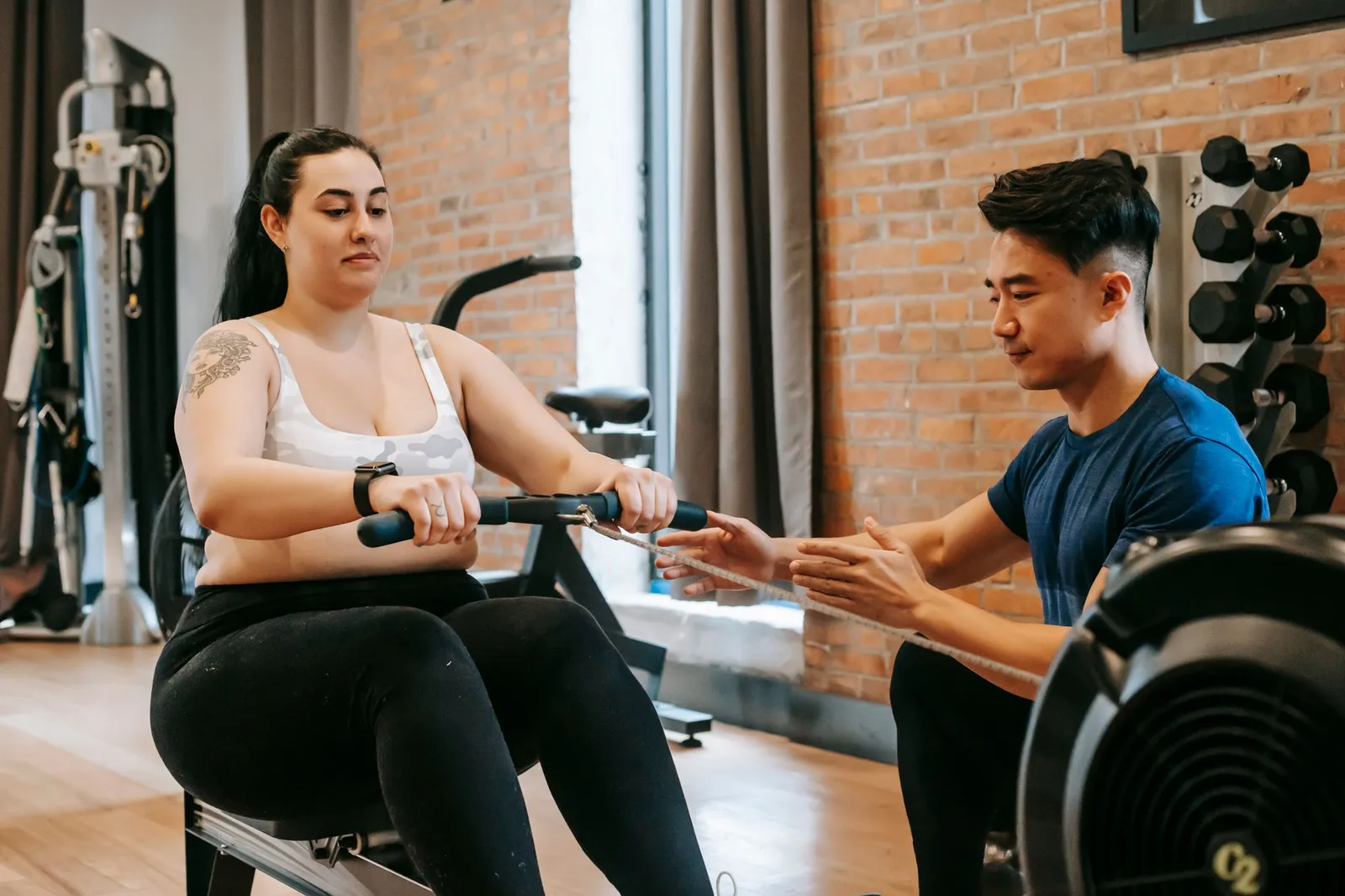
Calculate your rowing estimate
For Concept2 indoor rowing. Use average power and matching rowing time. Results estimate total session energy, not measured active calories.
Weight-adjusted estimate: 409 kcal (1,711 kJ)
Monitor-style estimate: 408 kcal (1,706 kJ)
Calculated power: 150.0 W. Rounded results; individual expenditure varies.
Formula: (4 × watts ÷ 1.1639 + 1.714 × weight in lb) × minutes ÷ 60. Sources and assumptions are explained below.
A rowing calorie calculator estimates energy use from your average power, rowing time and body weight. At 150 watts for 30 minutes, an 80 kg rower gets approximately 409 kcal (1,711 kJ) using the Concept2 weight-adjusted formula. That is a modelled estimate, not a measurement of your metabolism. The monitor uses a reference body weight, which helps explain why its number differs from a personalised calculation [1][2].
Use the calculator above with your workout summary. The practical question is not whether you earned a meal; it is which number belongs in your training record. You can understand the calculation without treating every calorie as a precise instruction about eating.
How does this rowing calorie calculator work?
This rowing calorie calculator combines Concept2 average watts with its published body-weight adjustment and your rowing duration. It displays both the monitor-style estimate and the weight-adjusted estimate, in kcal and kilojoules, so you can see exactly which assumption changes the result [1][2].
Select kilograms or pounds, enter your body weight, and add the minutes spent rowing. You can supply average watts directly or enter a steady 500 m split. A split of 2:30 means 2 minutes and 30 seconds per 500 metres, not a stroke rate of 30.
For intervals, average watts from the recorded work periods is the clearer input. Converting one average split to watts does not recreate average power across changing speeds, because the pace conversion is nonlinear [3]. Match the duration to the periods represented by the power figure. A 20-minute row followed by 10 minutes stretching is a 20-minute rowing entry.
The tool is intended for Concept2-style stationary rowing estimates. It is not a validated calculator for every water-resistance machine, on-water boat or individual. For a broader explanation of activity estimates, see our MET calorie calculator guide.
What is the monitor doing with watts and calories?
The monitor converts mechanical power into an estimated metabolic energy rate and adds a fixed allowance. Concept2 documents the equation as kcal per hour = 300 + (4 × watts ÷ 1.1639); its separate weight adjustment replaces the 300 term with 1.714 × body weight in pounds [1][2].
Here is a worked example, calculated from those equations rather than measured in a participant:
- Start with power: 150 W gives 4 × 150 ÷ 1.1639 = approximately 515.5 kcal/hour before the fixed allowance.
- Calculate the monitor estimate: 515.5 + 300 = 815.5 kcal/hour, or about 408 kcal over 30 minutes.
- Convert body weight: 80 kg is approximately 176.4 lb.
- Replace the allowance: 515.5 + (1.714 × 176.4) = approximately 817.8 kcal/hour.
- Apply duration and units: half an hour gives approximately 409 kcal, equivalent to 1,711 kJ.
The near agreement here is expected: 80 kg is close to the monitor's reference person. Try 60 kg or 100 kg in the calculator to make the adjustment easier to see.
The display labels also matter. A rate of 800 kcal/hour does not mean that a 15-minute effort used 800 kcal. Multiplying by 15/60 gives 200 kcal (837 kJ). This is arithmetic, not an assessment of fitness or effort.
How many calories does 30 minutes of rowing burn?
Thirty minutes of rowing at 100 to 200 W gives approximately 323 to 495 kcal (1,351 to 2,070 kJ) for an 80 kg adult using the weight-adjusted Concept2 model. The table below shows calculated examples at identical power outputs, not measured averages for all rowers [1][2].
Each body-weight cell gives kcal / kJ for 30 minutes. Pounds are rounded for readability; calculations use kilograms converted without that rounding. Splits are derived from the Concept2 power equation and rounded to the nearest second [3].
| Average power | Split per 500 m | 60 kg / 132 lb | 80 kg / 176 lb | 100 kg / 220 lb |
|---|---|---|---|---|
| 75 W | 2:47 | 242 / 1,014 | 280 / 1,172 | 318 / 1,330 |
| 100 W | 2:32 | 285 / 1,193 | 323 / 1,351 | 361 / 1,509 |
| 150 W | 2:13 | 371 / 1,553 | 409 / 1,711 | 447 / 1,869 |
| 200 W | 2:01 | 457 / 1,912 | 495 / 2,070 | 533 / 2,228 |
These rows are comparisons, not training targets. If 75 W is your comfortable pace, its value is not diminished by a smaller number on the screen. You can use the same row across sessions to understand your records without chasing the highest entry.
The difference between 60 kg and 100 kg is approximately 76 kcal (316 kJ) per half-hour at any listed wattage. That constant gap comes from the additive weight term. Multiplying the entire monitor number by a body-weight ratio would produce a different model.
Does four times the work mean four kcal per kilojoule?
Four times mechanical work means four times the energy in the same units. At an assumed 25% efficiency, 1 kJ of mechanical work corresponds to 4 kJ of metabolic energy, approximately 0.96 kcal, before additional allowances. It does not correspond to 4 kcal [2].
This distinction is easy to lose because exercise machines and food labels both use the word energy. Watts describe how quickly mechanical work is delivered. Food Calories are kilocalories; converting kilojoules to kcal involves dividing by 4.184.
For an illustrative 150 W, 30-minute row, mechanical work is 150 × 1,800 = 270,000 joules, or 270 kJ. Four times that is 1,080 kJ, approximately 258 kcal. The model then adds its separate body-movement allowance. These are two parts of an estimate, not competing measurements of the same quantity.
Research also shows why one efficiency number is an approximation. A study of five university oarsmen rowing in a tank reported gross efficiency near 17.5% over part of the tested range, net efficiency of 19.8%, and work efficiency of 27.5%. Each definition subtracts a different baseline [4]. Those results do not directly validate a modern ergometer calculator, but they show why the word efficiency needs context.
Our cycling power and calorie guide explores a related conversion. Transferring a cycling shortcut to rowing without its assumptions can obscure the extra allowance in the rowing formula.
How does the estimate compare with rowing MET values?
Rowing MET values classify activity into broad intensity bands, while the Concept2 model changes continuously with watts. The 2024 Compendium assigns 5.0 METs below 100 W, 7.5 at 100 to 149 W, 11.0 at 150 to 199 W, and 14.0 at 200 W or more [5].
Using the conventional oxygen-based calculation, kcal = MET × 3.5 × weight in kg ÷ 200 × minutes, produces the following comparisons. These are calculated estimates for an 80 kg adult rowing for 30 minutes, with kilojoules converted from unrounded results [2][5].
| Example power | Compendium MET | MET estimate, kcal / kJ | Concept2 adjusted estimate, kcal / kJ |
|---|---|---|---|
| 75 W | 5.0 | 210 / 879 | 280 / 1,172 |
| 100 W | 7.5 | 315 / 1,318 | 323 / 1,351 |
| 150 W | 11.0 | 462 / 1,933 | 409 / 1,711 |
| 200 W | 14.0 | 588 / 2,460 | 495 / 2,070 |
The research underpinning the 2024 Adult Compendium covers 1,114 activities and is tailored to adults aged 19 to 59 [6]. It is a substantial reference resource, but its standard values do not remove individual variation. For your own record, switching between methods whenever one gives a larger result makes comparison harder.
Why are elite rowing calorie figures so much higher?
Elite rowing calorie figures reflect the athletes, workloads and measurement methods in those studies. They are not interchangeable with a recreational 30-minute session. Research in 14 elite open-class male rowers, with mean body mass 91.8 kg, examined much higher training demands than many everyday gym rows [7].
That study used indirect calorimetry during incremental and ramp tests and accounted for resting metabolism and anaerobic energy contributions. It reported rowing exercise expenditure from 15.6 to 49.8 kcal/minute across its intensity zones [7]. The upper figure describes extreme exercise demands, not a sustainable hourly calorie target for a beginner.
A useful comparison asks whether the study participants and protocol resemble your session. A headline figure from elite sport can be scientifically sound and still be a poor estimate for your lunchtime workout. Likewise, the tank-rowing efficiency study involved only five men [4], so its percentages are explanatory evidence rather than universal constants.
How can you log rowing without counting it twice?
Logging rowing without counting it twice means choosing one session estimate and checking whether your daily energy target already includes that activity. A machine entry, a watch entry and a manually entered row can all describe the same workout; adding all three does not describe three workouts.
Consider recording a simple note such as “30 minutes, 150 W, Concept2 weight-adjusted estimate”. The note makes a later discrepancy easier to understand. If another service imports that session, compare the date, duration and activity before adding a separate record.
The calculator output is not a personalised recommendation to eat exactly that amount more. It also is not a separately measured active-calorie value. Concept2 explains that its weight term accounts for moving the body during rowing [2]; subtracting the entire 300 term as though it represented resting metabolism alone would misinterpret the formula.
For food tracking in kcalm, you can keep meal entries grounded in what you ate and use exercise estimates as context. Our guide to exercise calorie double counting explains the difference between a daily activity allowance and a separate workout entry. A consistent record can be useful without turning dinner into a calculation you have to earn.
Frequently Asked Questions
These frequently asked questions clarify rowing calorie inputs, body-weight adjustments and the limits of the estimate. The calculation describes the chosen model; it does not measure your individual energy expenditure.
Is the Concept2 calorie number accurate for everyone?
Concept2 describes its calculation as an approximation and offers a body-weight correction [1][2]. Individual efficiency is still unmeasured. A corrected number is more personalised in one respect, but that does not establish a precise error margin for you.
Can I enter pounds instead of kilograms?
Yes. The calculator accepts either unit and converts kilograms using 1 lb = 0.45359237 kg. The published weight term uses pounds [1]. Changing units preserves the same underlying body weight apart from small display-rounding differences.
Is a 2:00 split twice as powerful as a 4:00 split?
No. Concept2 uses watts = 2.8 ÷ (seconds per metre cubed) [3]. Halving the split time therefore multiplies calculated power by eight, not two. This is why a small pace improvement can represent a substantial power increase.
Can I use the calculator for rowing intervals?
Yes, if the power and duration refer to the same rowing periods. You can calculate separate blocks and add their estimates. Avoid applying the final hard interval's watts to the whole workout, including rests and easier rowing.
Does a heavier person always burn more at the same watts?
The model gives a higher estimate at a higher body weight because of its body-movement allowance [2]. That is a model property, not a guarantee about two individuals. Their actual efficiency and technique are not measured here.
Can I use these numbers for rowing on water?
The calculator uses indoor ergometer formulas. It does not include boat, wind or water conditions. Consider keeping indoor and on-water records distinct rather than treating the same displayed pace as equivalent evidence of energy expenditure.
Sources
These sources provide the retrieved manufacturer formulas, activity reference values and peer-reviewed research used in this article. Table values are our calculations, not new participant measurements. Sources were retrieved on 25 September 2026.
- Concept2: Calorie Calculator and body-weight adjustment
- Concept2 Netherlands: METs and calorie formulas
- Concept2: Pace and Watts Calculators
- Fukunaga et al. (1986): Mechanical efficiency in rowing
- 2024 Compendium of Physical Activities: Conditioning Exercise
- Herrmann et al. (2024): Adult Compendium update, full text via Europe PMC
- Winkert et al. (2022): High Energetic Demand of Elite Rowing
Ready to track smarter?
Join thousands who use kcalm for calorie tracking. AI-powered food recognition, scientifically-validated calculations, and zero anxiety.
Related Articles
Sugar Alcohol Calories: What Zero Sugar Costs in Your Log
Zero sugar does not mean zero calories. Sugar alcohols carry anywhere from 0 to 3 kcal (0 to 12.6 kJ) per gram, and the label value depends on where the product was made: the US assigns maltitol 2.1 kcal/g while the EU counts it at 2.4, mannitol swings from 1.6 to 2.4 across the same border, and only erythritol earns a genuine zero in both markets. Australia added allulose to its energy tables in August 2024 at 2 kJ per gram — a fifth of sugar. The full per-gram table in kcal and kJ, why the same protein bar can legally show different calories in three markets, how tracker databases inherit the confusion, and a five-step way to log zero-sugar products accurately.
ScienceStanding Desk Calories: The Real Number Is 9 Per Hour
Standing at your desk burns about 9 extra kcal (38 kJ) per hour compared with sitting — 0.15 kcal per minute for a 65 kg adult, per a meta-analysis of 46 studies and 1,184 participants — roughly one-sixth of the 30-to-50 kcal figure desk vendors advertise. Replacing six hours of sitting with standing adds about 54 kcal a day, while one easy 30-minute lunchtime walk adds roughly the same as standing all afternoon. Where the vendor number goes wrong, the measured MET table for desk tasks, why standing occupations really do double occupational burn, and how to handle standing time in your calorie log.
ScienceHow Many Calories Does an Ice Bath Burn? The Real Math
A typical 10-to-15-minute ice bath burns roughly 20 to 80 extra kcal (85 to 335 kJ) — less than a single banana, and an order of magnitude below the 250 to 500 kcal that plunge marketing claims. The measured literature is consistent: an 18 degree cooling suit raised energy expenditure by 250 kcal across three full hours, the 88-minute world-record ice immersion roughly doubled heat production from 169 to 321 watts, and a meta-analysis of 10 randomised trials put mild cold exposure at 188 extra kcal per day. Even six weeks of two-hours-daily cold acclimation lifted cold-induced thermogenesis to only 289 kcal a day. Real physiology, trivial energy cost — the protocol-by-protocol table, the shivering math behind the vendor claims, and how to log a plunge honestly.