Does Blending Fruit Destroy Fiber? Blender vs Juicer
Does blending fruit destroy fiber? No: a blender cuts the pulp into smaller pieces that stay in your glass, while a juicer separates much of it out.
kcalm editorial team
Prepared with AI assistance

The 5-minute video goes live on 13 November.
Does blending fruit destroy fiber? No: a blender cuts the fruit's fiber-containing pulp into smaller pieces that stay in your smoothie, while a juicer separates much of that pulp out. One lab study did measure less fiber after minutes of high-speed mixing, but it cannot tell you what a home blender does.
kcalm makes a food-logging app, so we have a commercial interest in people logging smoothies. This is general information, not medical or nutrition advice.
Does blending fruit destroy fiber?
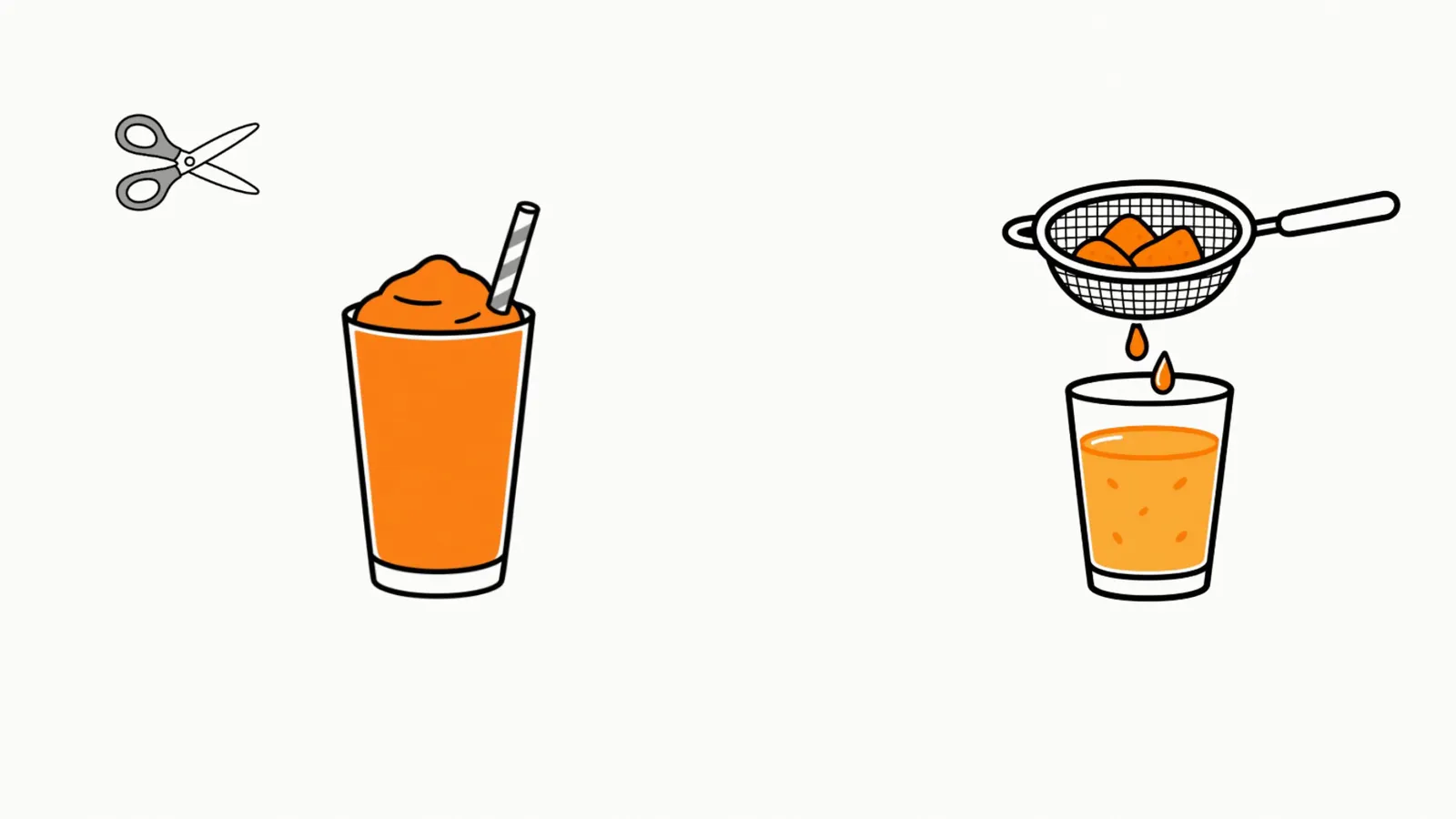
A blender jug is closed, with one way out, the spout, so what goes in ends up in the glass, apart from the thin film left on the jug. A juicer has two ways out: juice one way, stringy pulp the other.
A Tufts reader Q&A says juicing removes more fiber than blending, and Utah State University Extension describes whole-fruit smoothies as juice plus pulp, with the fiber in the pulp. Both are explanations, not before-and-after measurements.
So a blender works like scissors and a juicer like a sieve. That picture is about pieces of fruit, not fiber molecules: it shows where the material goes, not whether every fiber property stays the same.
Smoothie vs juice: how much fiber is left?
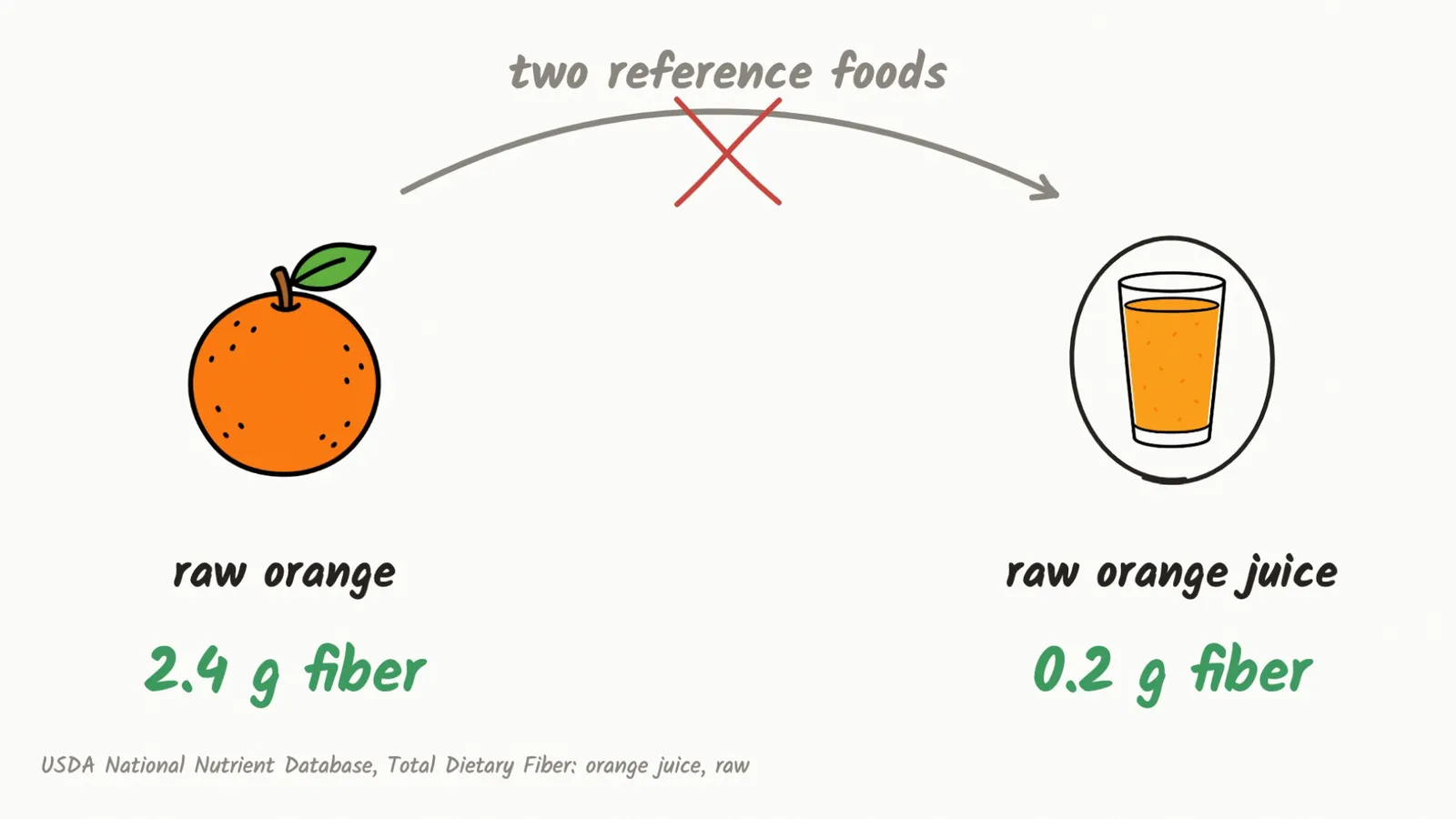
USDA reference data lists these amounts per 100 grams of each food:
| Food | Fiber per 100 g | Source |
|---|---|---|
| Raw orange | 2.4 g | USDA FoodData Central 169097 |
| Plain blended orange | pulp retained; estimate 2.4 g | our estimate, not a USDA measurement |
| Raw orange juice | 0.2 g | USDA Total Dietary Fiber table |
FDA's dietary fiber Q&A lists flours among the foods with naturally occurring fiber and calls those fibers "intact" because they have not been removed from the food. FDA is not writing about blenders. The comparison is ours: ground isn't removed, and by the same logic neither is blended. That is a rule about what counts on a US label, not a measurement.
Does blending longer break down fiber?
Longer blending makes smaller pieces, in one instrument maker's test. Malvern Panalytical, which builds particle-measuring instruments, compared two blenders on two recipes. After 30 seconds, the median particle in its pink smoothie was 336 micrometers in one machine and 380 in the other, about a third of a millimeter. In a further run with one blender, longer blending meant smaller particles and a thinner drink.
That test measured size, not fiber, so it cannot say how many grams are left.
One lab study did measure fiber. Chu, Igbetar and Orfila ran one commercial fruit smoothie through a lab homogenizer at 10,000 revolutions a minute, testing 2, 5 and 10 minutes, and total fiber came out lower. How much lower depends on where you read:
- The abstract reports a 30 percent reduction.
- The results text says about 10 percent.
- The table's totals go from 1.6 to 1.2 and from 2.2 to 1.6 under two lab methods, about 25 and 27 percent by our calculation.
Even the largest figure leaves most of the fiber the paper measured. Processing and lab methods can affect the measured result, so "blending changes nothing" overshoots too. But this is one smoothie in a lab machine, with figures that disagree, in work funded by the smoothie's maker. Ten minutes of lab mixing can't tell you what 30 seconds at home does, so it is no reason to time your blender.
Does peeling an apple remove fiber?
Some of it. USDA's fiber table lists raw apple with skin at 2.4 g per 100 grams and raw apple without skin at 1.3 g. Those are separate entries, not one apple measured twice, so the gap is not an exact measure of the skin.
Apple skin contributes fiber. The flesh contains fiber too, so peeling is a preference you can make. Blend an apple with the skin on and the skin comes along in smaller pieces.
How much fiber is in a smoothie?
The best estimate of a smoothie's fiber is the fiber of whatever went in, when nothing is strained out. Blend 100 grams of orange with 100 grams of ice, treating the ice as water, and the same orange is spread through 200 grams of drink. Using the USDA figure, that is an estimated 2.4 g in the whole batch, or about 1.2 g per 100 grams of drink.
"Smoothie" names the finished drink, not a recipe, which matters if you log one. In kcalm, the app that made this article, you can type what went in and correct any ingredient or amount in chat. For juice, part of the fruit stayed in the machine, so log the juice itself rather than the oranges you fed it. Either way you get an estimate, not a lab result, and we are not claiming kcalm works out the exact fiber left in your glass.
Whole fruit, smoothies and juice are different ways to enjoy fruit.
What this does not mean
- Not "every gram survives every blender". Keeping the pulp is the solid claim; identical measured fiber under every machine and lab method has not been shown.
- Not "a smoothie and whole fruit act the same in your body". This evidence covers what is in the glass, not what happens after you drink it.
- Not "juice is the wrong drink". These numbers compare fiber only, and there is nothing to make up for. Juice also varies: the same lab paper measured more fiber in one commercial orange juice than USDA lists for raw juice.
- Not a target. Per-100-gram figures are reference examples, not daily goals or a measure of your glass.
- Not a global label rule. The FDA explanation applies to US labels.
How we made this
Made by kcalm, an iPhone app for logging food by photo, text or voice. AI narration. Researched from the sources below and checked by a separate AI fact-check; not reviewed by a dietitian. The kitchen tests in the video are drawn, and no oranges were blended or measured for it. General information, not medical or nutrition advice. Written November 2026. Corrections are welcome at [email protected].
Sources
- Watson K. Tufts Health and Nutrition Letter (2014, updated 2019). Reader Q&A on blending and fiber. https://www.nutritionletter.tufts.edu/general-nutrition/q-i-have-a-new-blender-that-will-take-a-whole-fruit-and-turn-it-into-juice-is-there-a-loss-of-nutrients-when-i-do-this-am-i-destroying-the-fiber/
- Stoker D, Durward C. Utah State University Extension. Smoothies: Helpful or Harmful? https://extension.usu.edu/nutrition/research/smoothies-helpful-or-harmful
- USDA FoodData Central (2019). Oranges, raw, all commercial varieties. SR Legacy, FDC 169097. https://fdc.nal.usda.gov/food-details/169097/nutrients
- USDA. National Nutrient Database: Total Dietary Fiber (orange juice, raw; apples, raw, with skin; apples, raw, without skin). https://www.nal.usda.gov/sites/default/files/page-files/Total_Dietary_Fiber.pdf
- FDA. Questions and Answers on Dietary Fiber. https://www.fda.gov/food/nutrition-food-labeling-and-critical-foods/questions-and-answers-dietary-fiber
- FDA. 21 CFR 101.9(c)(6)(i), definition of dietary fiber. https://www.ecfr.gov/current/title-21/chapter-I/subchapter-B/part-101/subpart-A/section-101.9
- Malvern Panalytical (2016). Smoothie wars! The Bullet versus the Ninja. https://www.malvernpanalytical.com/en/learn/knowledge-center/application-notes/an160308smoothierheologypartcilesize
- Chu J, Igbetar BD, Orfila C (2017). Fibrous Cellular Structures are Found in a Commercial Fruit Smoothie and Remain Intact during Simulated Digestion. Journal of Nutrition and Food Sciences. https://eprints.whiterose.ac.uk/id/eprint/110985/
Video transcript
The full narration of the video, with its chapter times. Watch it on YouTube: Does Blending Fruit Destroy Fiber? Blender vs Juicer
0:00 Does blending fruit destroy fiber?
Two oranges, two machines. The juicer leaves a stringy heap behind. The blender throws nothing away, and its glass comes out perfectly smooth. So where did the blender's strings go? Does blending fruit destroy fiber? Smooth looks a lot like gone. So the blender gets three tests, a bin, a book and a lab, and the least glamorous goes first. The blender is a closed jug with one way out, the spout. Pour, rinse, bin check: rind, and nothing else. The juicer sends juice out one side and piles the stringy, fiber-containing pulp on the other. Bin check: rind, plus a heap of pulp. So a blender works like scissors: big pieces of fruit become lots of small ones, and they all end up in your glass, apart from the film on the jug, which belongs to whoever washes up. A juicer works like a sieve, and a sieve keeps the big pieces for itself. Blending fruit doesn't destroy its fiber: the blades cut the fiber-containing pulp into smaller pieces that stay in your glass, while the juicer separates much of that pulp out.
1:01 Smoothie vs juice: how much fiber is left?
Test two is the book: America's national food data, which lists fiber per 100 grams. Raw orange has about two and a half grams. Raw orange juice has a fifth of a gram, so gram for gram, about a twelfth as much. Not zero, though: juice keeps a little. Those are two reference foods, not one orange before and after juicing. A plain blended orange doesn't need its own entry: nothing added, nothing strained, so the fair estimate for the glass is the orange's own number. Even the American label rules think this way. Fiber that grows in a food counts as intact as long as it hasn't been removed from the food, and one of their examples is flour, grain ground to powder. Ground isn't removed, and by the same logic, a blended orange isn't either. That's a rule about what counts, though, not a measurement. For that, you need the lab.
1:51 Does blending longer break down fiber?
Test three, the lab, is the one that could still sink the blender. A company that builds particle-measuring instruments put two blenders head to head, which is a very scientific way to settle a kitchen argument. Longer blending made smaller pieces and a thinner drink, and after thirty seconds, the middle-sized piece in their pink smoothie was about a third of a millimeter across. Smaller isn't less, though: cutting a pizza into sixteen slices doesn't make less pizza. But smoothness only tells you something changed, not how many grams of fiber are left. So researchers measured the fiber itself, after running a store-bought smoothie through a lab mixer at ten thousand revolutions a minute for up to ten minutes, which in a kitchen isn't a smoothie, it's a noise complaint. This time the measured fiber did come out lower, though how much lower depends on which part of the paper you read. Nothing went in a bin, so for once the bin has no answer. Lab methods can move that number, so "blending changes nothing" overshoots too. But even the paper's biggest drop leaves most of the measured fiber, and ten minutes of lab machinery can't tell you what thirty seconds at home does, so it's no reason to time your blender.
3:00 Does peeling an apple remove fiber?
There's one more kitchen tool that really does send some fiber to the bin, and it's the smallest one in the drawer: the peeler. This time nobody can blame the blender. It isn't even plugged in. Back in the book, 100 grams of raw apple with the skin has about two and a half grams of fiber, and 100 grams of peeled apple a bit over one gram. Those are separate entries, not one apple measured twice, so the gap isn't an exact measure of the skin. Bin check: one long curl of peel, the kind that only comes off in a single spiral when nobody's watching. So peeling takes some fiber with it, just not all of it. Apple skin has fiber. So does the flesh, so peel it or don't, that's up to you. Blend it with the skin on, and the skin just comes along in smaller pieces.
3:46 How much fiber is in a smoothie?
The best estimate of a smoothie's fiber is the fiber of whatever went in. Blend 100 grams of orange with 100 grams of ice, and the same orange is now spread through 200 grams of drink, so the fiber per 100 grams halves. Bin check: empty. The ice just took up half the room. Smoothie names the finished drink, not a recipe, which matters when you log one. If you use kcalm, which made this video, you can type it the way you made it and fix any amount it got wrong in the chat. For a smoothie, that list is the drink. For juice it isn't, because part of the fruit stayed behind in the machine, so log the juice itself, not the oranges you fed it. Either way, you get an estimate, not a lab result. As for the blender's missing strings, the pulp was in the glass all along, just cut small. Neither glass is the wrong one, though. Tea is what you get when you strain out the leaves, and nobody calls it a broken salad. Whole fruit, smoothies and juice are different ways to enjoy fruit, which is why the cook is happily having all three. So if anyone tells you the blender ate the fiber, don't ask the blade. Check the bin.
Ready to track smarter?
Join thousands who use kcalm for calorie tracking. AI-powered food recognition, scientifically-validated calculations, and zero anxiety.