Why Does Greek Yogurt Have So Much Protein? It's the Straining
Greek yogurt has so much protein because straining drains away the watery whey while much of the milk protein stays, so each 100 g holds more.
kcalm editorial team
Prepared with AI assistance
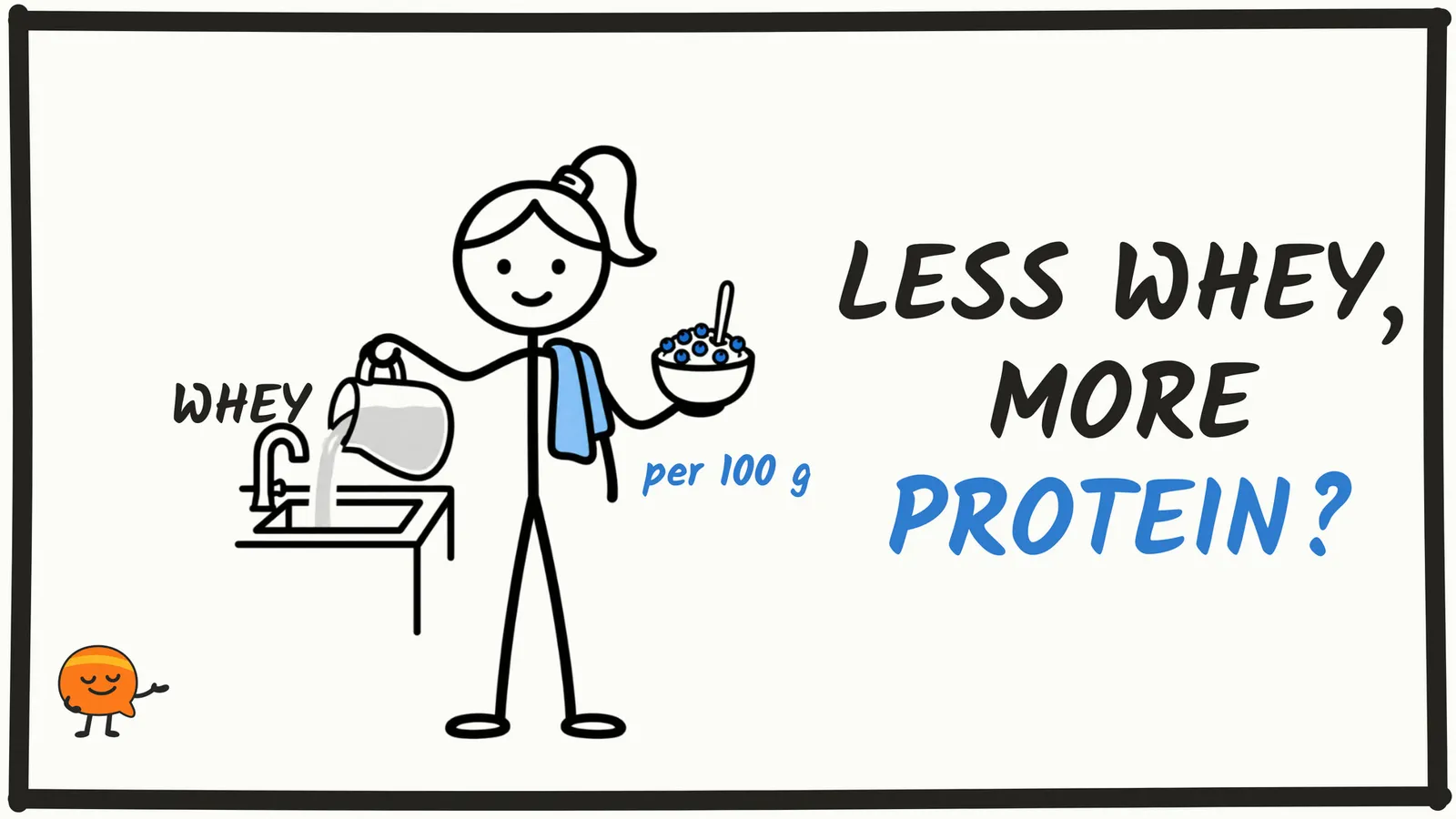
The 5-minute video goes live on 27 November.
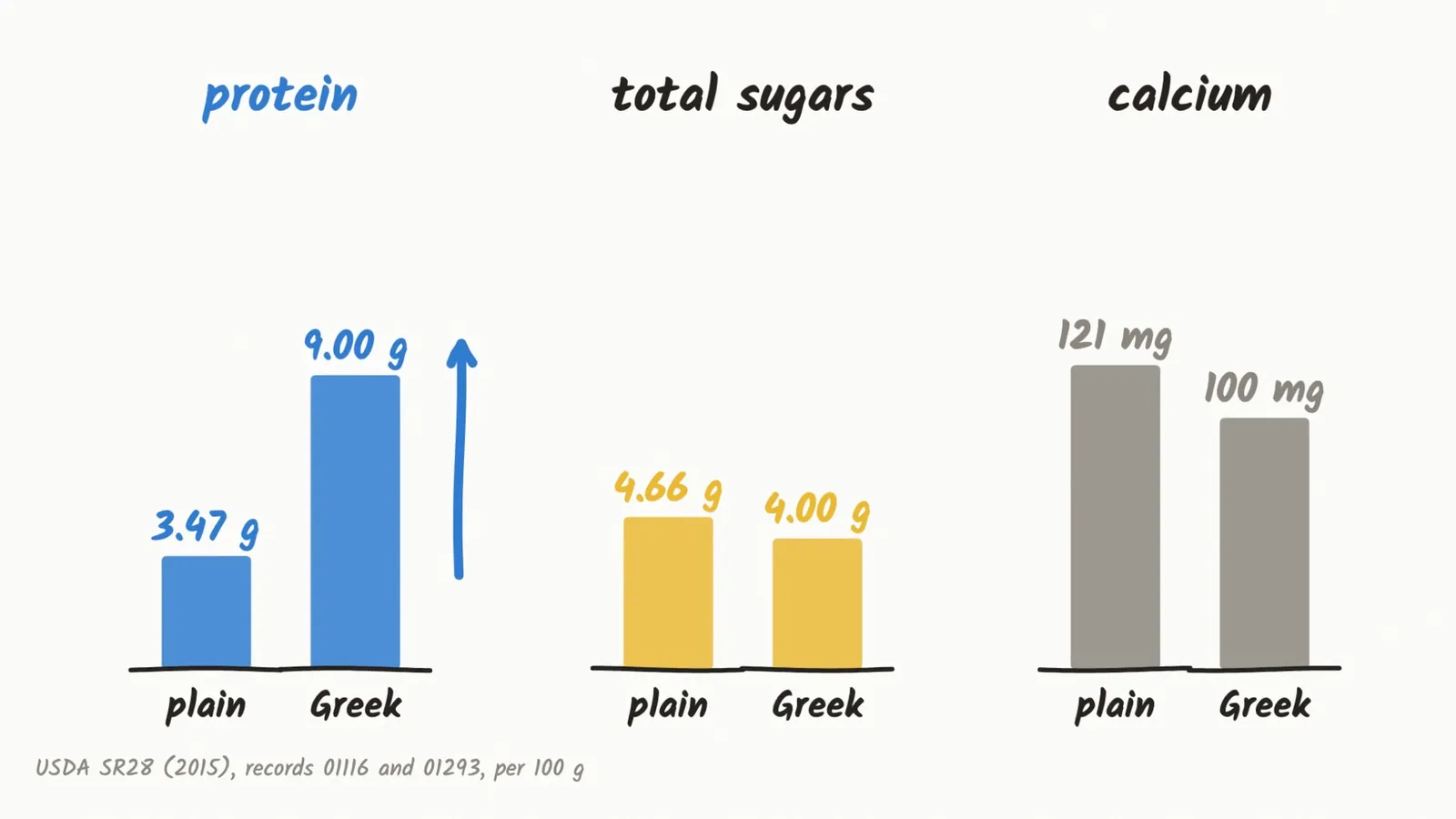
Strained Greek yogurt has so much protein because the watery whey drains away while much of the milk protein stays behind, so every 100 grams of what's left holds more protein. In USDA reference data, plain whole-milk yogurt lists 3.47 g per 100 g and plain Greek whole-milk yogurt 9.00 g.
kcalm makes a food-logging app, so we have a commercial interest in people logging their yogurt. This is general information, not medical or nutrition advice.
Why does Greek yogurt have so much protein?
Whey is the big word on tubs of protein powder, and it is also what drips out of yogurt through a cloth. Yet the yogurt that loses it ends up with more protein, gram for gram.
The obvious guess is a sauce boiling down. That is right about the water and wrong about the sauce: straining also removes some of what is dissolved in the water, so it sorts the yogurt instead of concentrating everything evenly.
How does straining make yogurt higher in protein?
Milk is mostly water, with its main protein, casein, in tiny clusters. As cultures make the milk acidic, the casein sets into a gel, a loose net that holds the water. Heating the milk before fermentation also lets some of its other proteins, the whey proteins, join that net (University of Wisconsin Center for Dairy Research).
In a cloth, the net is too big for the weave and the liquid is not. Water, lactose (milk sugar) and minerals run out (Yeo Valley, 2026) with a few loose whey proteins, and the net shrinks around the protein it caught.
Dairies more often use centrifugal separators or membrane filters. The FDA's 2025 notice on high-protein yogurt lists straining, membrane methods and protein fortification as separate routes, so some tubs reach a high number by adding protein.

If whey is protein, why does Greek yogurt have more?
The liquid draining from yogurt is mostly water, with some milk sugar, minerals such as calcium and some whey protein. Whey sold as protein powder has been concentrated. This liquid has not.
Some protein does leave, but far more water leaves with it. In one lab study, each kilogram of strained yogurt left 1.8 to 2.75 kg of acid whey behind. By our arithmetic, that is about 2.8 to 3.75 kg of starting yogurt per kilogram kept. That is a lab centrifuge result, not a factory yield.
How much more protein does Greek yogurt have than regular yogurt?
USDA's Standard Reference data (Release 28, 2015) lists two plain whole-milk yogurts. They are separate foods with different fat levels, not one batch before and after, so this is a pattern, not a proof.
| Per 100 g | Plain | Greek plain |
|---|---|---|
| Protein | 3.47 g | 9.00 g |
| Water | 87.90 g | 81.30 g |
| Fat | 3.25 g | 5.00 g |
| Total sugars | 4.66 g | 4.00 g |
| Calcium | 121 mg | 100 mg |
What is the watery liquid on top of yogurt?
Jalna says it is whey that the set yogurt has pushed out, and that you can stir it back in or pour it off. siggi's describes it as mainly water, with calcium and some whey protein.
Pouring it off is straining in miniature. Stirring it in is un-straining. What the layer can't tell you is whether a tub is still good: go by the date and storage instructions.
Why is Greek yogurt so thick?
Straining thickens yogurt for the same reason it raises the protein: with less water, the net is packed tighter. But thick doesn't prove strained. Yeo Valley says its Greek-style yogurt is stirred, with higher fat and its choice of cultures giving it texture, while its Greek Recipe range is membrane-strained. A spoon standing upright tells you about thickness, not protein.
Does Greek yogurt have to be made in Greece?
In Britain, the word carries that meaning. In FAGE UK Ltd v Chobani UK Ltd ([2014] EWCA Civ 5), the Court of Appeal in England upheld an injunction stopping American-made yogurt from being sold in the UK as Greek yogurt. It was a passing-off case about how UK shoppers understood the words. That yogurt was strained too, so the fight was about where it was made, not how.
The ruling stops at the UK border. The FDA says the US has no separate standard of identity for Greek or Greek-style yogurt, though its yogurt standard still applies. Australia's Standard 2.5.3 has no Greek-style category.
Is Greek-style yogurt the same as Greek yogurt?
Not necessarily. On an Australian shelf, Greek-style names a style, not a method. The Coles Greek Style Yoghurt 1 kg listing shows milk, cream, milk solids and live cultures, with 4.63 g of protein per 100 g (checked 8 November 2026), and doesn't say how it was made. Those ingredients don't prove it wasn't strained, and some Greek-style yogurts are sold as strained. They are different recipes, not lesser yogurts.
If you log food in kcalm, the app that made this article, type the brand and the exact name on the tub rather than just "Greek yogurt", check the estimate against the panel, and fix it in chat if it's off. Whatever you type, the answer is an estimate, not a lab result.
What this does not mean
- Not "every Greek yogurt is strained". Some are filtered and some have protein added.
- Not "straining always gives 2.6 times the protein". That ratio is one USDA pair.
- Not "Greek-style is second best". A recipe is not a ranking.
- Not "Greek always has less calcium". One pair can't rank every tub.
- Not "more protein is better". These figures describe what is in 100 g of a food. They are not targets or amounts to eat, and they say nothing about health, fullness or weight.
How we made this
Made by kcalm, an iPhone app for logging food by photo, text or voice. AI narration. Researched from the sources below and checked by a separate AI fact-check; not reviewed by a dietitian. The cloth, jugs and tubs in the video are drawn, and no yogurt was strained or measured for it. General information, not medical or nutrition advice. Written November 2026. Corrections are welcome at [email protected].
Sources
- USDA (2015). Standard Reference, Release 28: Dairy and Egg Products, records 01116 and 01293. https://www.ars.usda.gov/ARSUserFiles/80400525/Data/SR/SR28/reports/sr28fg01.pdf
- FDA (2025). High-Protein Yogurt; Request for Information. Federal Register, 15 January 2025. https://www.federalregister.gov/documents/2025/01/15/2025-00754/high-protein-yogurt-request-for-information
- FDA. 21 CFR 131.200, Yogurt (current text). https://www.ecfr.gov/current/title-21/chapter-I/subchapter-B/part-131/subpart-B/section-131.200
- University of Wisconsin Center for Dairy Research (2023). Yogurt Monograph Series: Production. https://cdr.wisc.edu/yogurt-monograph-production
- Karastamatis S, Zoidou E, Moatsou G, Moschopoulou E (2022). Effect of Modified Manufacturing Conditions on the Composition of Greek Strained Yogurt and the Quantity and Composition of Generated Acid Whey. Foods 11:3953. https://pubmed.ncbi.nlm.nih.gov/36553693/
- U.S. Dairy Export Council. Whey Protein Concentrate 80: product definition and composition. https://www.thinkusadairy.org/products/whey-protein-and-ingredients/whey-categories/wpc-80
- Jalna. FAQs (the liquid on top of yoghurt). https://jalna.com.au/faqs/
- siggi's. If there is liquid on top of my yogurt when I open it, is that OK? https://www.siggis.ca/faq/if-there-is-liquid-on-top-of-my-yogurt-when-i-open-it-is-that-ok/
- Yeo Valley (2026). The Ultimate Yogurt Guide. https://www.yeovalley.co.uk/blog/the-ultimate-yogurt-guide
- Coles. Greek Style Yoghurt 1 kg (product listing checked 8 November 2026). https://www.coles.com.au/product/coles-greek-style-yoghurt-1kg-1856561
- JJ Foodservice. Lancashire Farm Greek Style Luxury Strained Yoghurt (product listing). https://www.jjfoodservice.com/product/Newcastle/DAI147/Lancashire-Farm-Greek-Style-Luxury-Strained-Yoghurt-%28Suzme%29-%2810-percent-Fat%29-1x1kg
- Court of Appeal of England and Wales (2014). FAGE UK Ltd v Chobani UK Ltd [2014] EWCA Civ 5. https://www.wipo.int/wipolex/en/judgments/details/1509
- FSANZ. Australia New Zealand Food Standards Code, Standard 2.5.3, Fermented milk products. https://www.legislation.gov.au/F2015L00413/asmade/2015-03-31/text/original/epub/OEBPS/document_1/document_1.html
Video transcript
The full narration of the video, with its chapter times. Watch it on YouTube: Why Does Greek Yogurt Have So Much Protein? It's the Straining
0:00 Why does Greek yogurt have so much protein?
Whey. It's the big word on tubs of protein powder. It's also what's dripping out of this yogurt through a cloth, and the Greek yogurt left behind ends up with more protein, gram for gram. A spoon that used to keel over in it now stands up, like it's been promoted. Less whey, more protein? Is it just less water, like a sauce boiling down? Right about the water. Wrong about the sauce.
0:25 How does straining make yogurt higher in protein?
Milk is mostly water, with protein drifting through it in tiny clusters: these blue beads. The cultures turn the milk sour, and that acid links the clusters into a loose net. Heating the milk first helps some of its other proteins, the whey proteins, hook on too. That net, holding all that water, is yogurt: basically a puddle with scaffolding. In the cloth, the net's too big for the weave. The liquid isn't. Out runs water with whatever is dissolved in it: some milk sugar, some minerals, a few loose whey proteins. The net shrinks around the beads it caught. Strained Greek yogurt has so much protein because the watery whey drains away while much of the milk protein stays behind, so every 100 grams of what's left holds more protein. Big dairies use spinning separators or fine filters instead, and the net doesn't mind how the water leaves. Some tubs simply add protein, but this cloth holds only yogurt.
1:19 If whey is protein, why does Greek yogurt have more?
So what's in the jug? Mostly water, carrying some milk sugar, minerals like calcium and some whey protein. The whey on a protein powder tub has been concentrated. The whey in this jug hasn't, so here protein is a passenger, not the driver. Some of it does leave. Far more water leaves with it. In one lab study, each kilogram of strained yogurt left about two to nearly three kilograms of whey behind. Three or four tubs walk in, one walks out. Tough audition.
1:50 How much more protein does Greek yogurt have than regular yogurt?
Back to the sauce. America's food tables list a plain whole-milk yogurt at 3.5 grams of protein per 100 grams, and a plain Greek whole-milk yogurt at nine, about 2.6 times as much. These come from two separate yogurts in the tables, and the Greek one has more fat, so it's a pattern, not a proof. If straining only took out water, like a sauce boiling down, everything else would climb with the protein. It doesn't. Total sugars: a little under five grams in the plain, four in the Greek. Calcium: about 120 milligrams against 100. More protein, less sugar, less calcium. A saucepan can't sort like that. A net can, and milk sugar and calcium are just what turn up in the whey. And the yogurt that spoon is so proud of standing up in? Still about four fifths water. Thick, yes. Dry, not even close.
2:40 What is the watery liquid on top of yogurt?
You've probably met whey without straining anything: the watery layer that sometimes sits on top when you peel the lid. Yogurt makers say it's whey the set yogurt has pushed out, mostly water with some protein and calcium, and that you can stir it back in or pour it off. Think of it as the tub having a tiny go at being Greek. Pouring it off is straining in miniature. Stirring it back in is un-straining. Both camps are right, a rare happy ending for a food fight. What the layer can't tell you is whether a tub is still good. For that, go by the date and storage instructions, not the puddle.
3:13 Why is Greek yogurt so thick?
Straining thickens yogurt for the same reason it raises the protein: with less water, the net is packed tighter, and the spoon stands up. But it doesn't work backwards. Thick doesn't prove strained. Fat thickens yogurt too, and so does the choice of cultures. One British maker's Greek-style is stirred, and it saves straining for a different range. The spoon can't tell protein from cream. It's a spoon.
3:38 Does Greek yogurt have to be made in Greece?
Then there's the word on the front. In 2014, the Court of Appeal in England upheld an order stopping an American-made yogurt from being sold in Britain as Greek yogurt, because shoppers there took Greek to mean made in Greece. That yogurt was strained too. The fight was about where it was made, not how. The spoon was not called as a witness. The ruling stops at the UK border. America's yogurt rules don't carve out Greek, and neither does Australia's food code.
4:06 Is Greek-style yogurt the same as Greek yogurt?
So on an Australian shelf, Greek-style names a style, not a method. One supermarket's Greek-style tub lists milk, cream and milk solids, with about 4.6 grams of protein per 100 grams, and its listing doesn't say how it was made. Some Greek-style yogurts are even sold as strained. Different recipes, not lesser yogurts. The per 100 grams line on the panel tells you that tub's protein, which is more than the spoon managed. This is the one spot where logging gets fussy. If you log food in kcalm, and yes, kcalm made this video, type the brand and the exact name on the tub, not just Greek yogurt, then check the estimate against the panel and fix it in chat if it's off. Whatever you type, the answer is an estimate. Back at the cloth, the jug of whey has ended up bigger than the yogurt left behind. Nothing was added to the yogurt. Much of the water its protein was swimming in was taken away. A spoon is a fine judge of thick. On protein, the tub gets the final word.
Ready to track smarter?
Join thousands who use kcalm for calorie tracking. AI-powered food recognition, scientifically-validated calculations, and zero anxiety.