Why Are Serving Sizes So Small? US, UK, Australia
Serving sizes can look small because they were never sized to you: a serving is the amount the label's numbers describe, not advice. US, UK and Australia.
kcalm editorial team
Prepared with AI assistance
The 5-minute video goes live on 4 December.
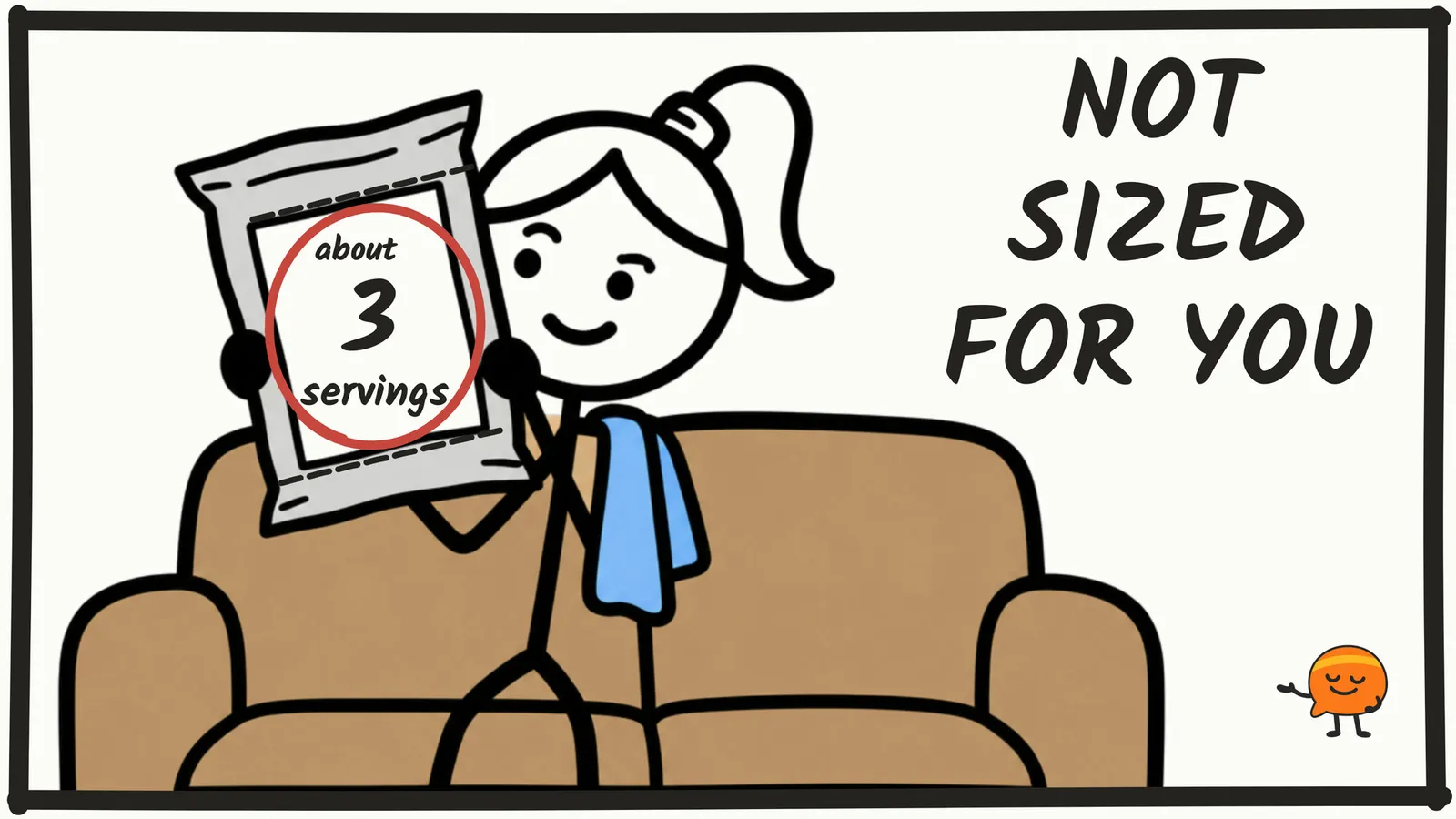
Serving sizes can look small because they were never sized to you. A serving size is the amount the label's numbers describe, not advice. In the United States it starts from surveys of how much people reported eating at one time, across a whole category of food, and other countries set it differently.
kcalm makes a food-logging app and made this article.
Why are serving sizes so small?
In 2016 the US Food and Drug Administration changed the reference amount behind a serving of ice cream from 1/2 cup to 2/3 cup, a third more. No tub had to grow and no recipe had to change. If a serving were the amount you're meant to eat, that would have been a government instruction to have more ice cream.
It wasn't. FDA says serving sizes must be based on how much food people actually consume, and not on what they should eat. The rule's own name makes the same point: US serving sizes begin in a federal table called Reference Amounts Customarily Consumed per Eating Occasion. Customarily consumed, not recommended.
How is a serving size determined?
In the US, four steps:
- One reference amount per food category. 21 CFR 101.12 lists them, so the starting point comes from the rulebook, not the maker. Chips sit in the snacks row, at 30 g.
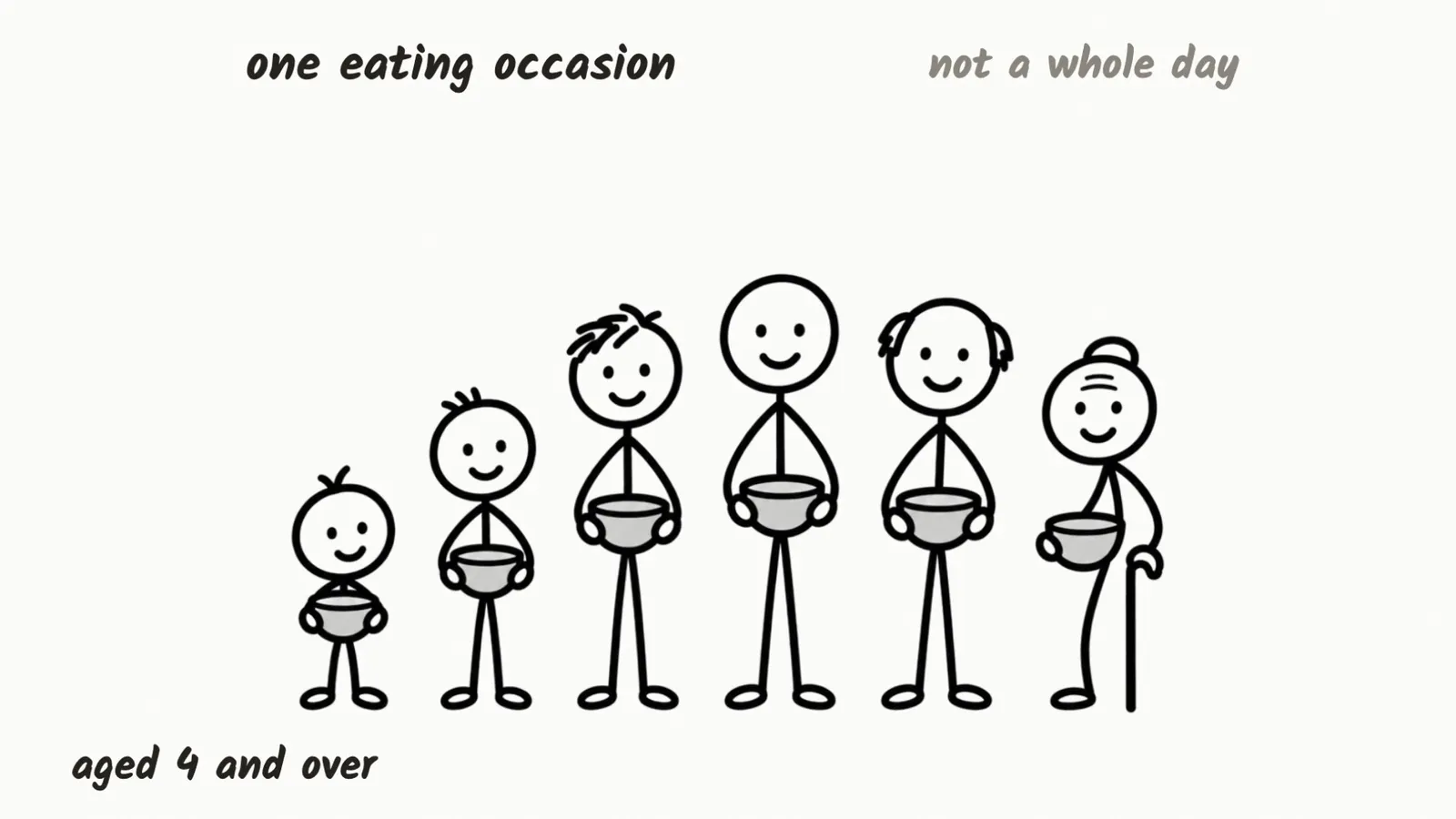
- A crowd's summary. The general amounts cover people aged 4 and over, for one eating occasion, not a whole day. FDA considered the mean, median and mode, and used other information when survey data fell short.
- Reported, not watched. In the surveys behind the 2016 update, people told an interviewer what they had eaten, how much and when, with measuring guides to help. That is careful work, and it still rests on memory.
- Turned into something you can picture. The label shows a household measure such as a cup or slice, followed by grams, so the amount gets translated and rounded, up or down.
Why 28 grams? The snacks row sets the label statement for bulk products such as potato chips as 1 oz (28 g/visual unit of measure). So the 28 grams on many American chip bags is one ounce written in metric. It isn't the 30 g reference amount.
What "about" means. Counts between 2 and 5 servings are rounded to the nearest 0.5, and "about" signals that.
Why did serving sizes change in 2016?
FDA's 2016 final rule checked the 1993 amounts against national surveys from 2003 to 2008. With adequate data, FDA generally updated a reference when median intake differed significantly from it by at least 25 percent. Amounts moved both ways.
| Food | Before | After |
|---|---|---|
| Ice cream | 1/2 cup | 2/3 cup |
| Soda | 8 US fl oz (about 237 mL) | 12 US fl oz (about 355 mL) |
| Yogurt | 8 oz | 6 oz |
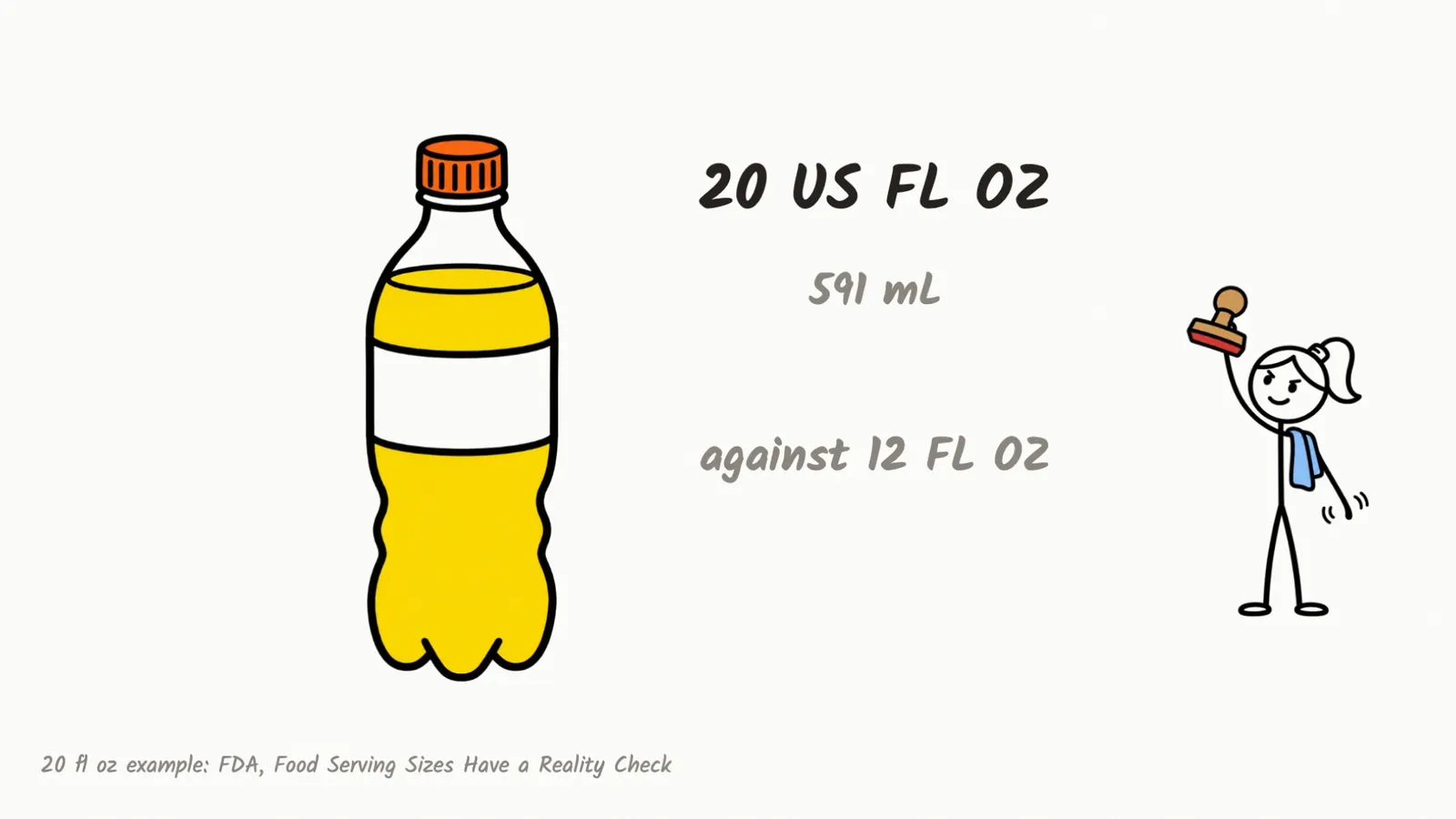
The package rules changed in the same rewrite. A product sold individually with less than 200 percent of its reference amount must now be labelled as one serving, and an older exception letting some makers choose one or two is gone. FDA's own example is a 20 ounce soda. Divide 20 by the old 8 and you get two and a half servings. Against the new 12 it's under twice, so the whole bottle is one.
Packages holding 200 to 300 percent of the reference amount generally add a second column for the whole package, with some exceptions.
Not every amount moved, so some still trace back to the 1993 table, which drew mainly on surveys from 1977 to 1978 and 1987 to 1988. FDA is plain about all of it: the serving size is not a recommendation of how much to eat or drink.
Who decides serving sizes in Australia and the UK?
| United States | Australia and New Zealand | Great Britain | |
|---|---|---|---|
| Who sets the serving | A category reference amount, then label rules | The food business | The maker, if it adds a portion |
| Columns compared in this video | Per serving, per package | Per serving, per 100 g or 100 mL | Per 100 g or 100 mL, per portion |
In Great Britain, the nutrition declaration is expressed per 100 g or 100 ml. A maker may add per-portion figures, if the portion is easily recognisable and quantified, and the number of portions in the pack is stated. We say Great Britain because Northern Ireland's framework differs.
Is a serving size the same as a portion?
No. In NIDDK's definitions, a serving is the amount listed on the label and a portion is how much food you choose to eat at one time. The two may or may not match.
The cook in our video describes what happened instead of counting anything. She tells kcalm, our app, "half the bag", and if the estimate pictured a different bag, she corrects it in the chat. The number it gives back is an estimate.
What this does not mean
- Not a target. A serving, a reference amount and 100 g are not suggestions for how much anyone should eat, more or less.
- Not a plot. These sources don't establish why any company picks a particular serving.
- Not "it's all from the 1970s". The 2016 rule checked the amounts against later surveys and updated some of them.
- Not "one sitting means one serving". The one-serving rule is a size threshold with exceptions.
How we made this
Made by kcalm, an iPhone app for logging food by photo, text or voice. AI narration. Researched from the sources below and checked by a separate AI fact-check; not reviewed by a dietitian. The cook, the stamp and the share bag in the video are drawn, and the bag is an illustration, not a real product. General information, not medical or nutrition advice. Written November 2026. Corrections are welcome at [email protected].
Sources
- FDA. Serving Size on the Nutrition Facts Label. https://www.fda.gov/food/nutrition-facts-label/serving-size-nutrition-facts-label
- FDA. 21 CFR 101.12, Reference amounts customarily consumed per eating occasion. https://www.ecfr.gov/current/title-21/section-101.12
- FDA. 21 CFR 101.9, Nutrition labeling of food. https://www.ecfr.gov/current/title-21/section-101.9
- FDA (2016). Serving Sizes Final Rule, 81 FR 34000. https://www.govinfo.gov/content/pkg/FR-2016-05-27/pdf/2016-11865.pdf
- FDA. Changes to the Nutrition Facts Label. https://www.fda.gov/food/nutrition-food-labeling-and-critical-foods/changes-nutrition-facts-label
- FDA. Food Serving Sizes Have a Reality Check. https://www.fda.gov/consumers/consumer-updates/food-serving-sizes-have-reality-check
- FDA (2018). Serving Sizes: Small Entity Compliance Guide. https://www.fda.gov/media/111144/download
- FDA (2019). Serving Sizes, RACCs, Dual-Column Labeling, and Miscellaneous Topics: Guidance for Industry. https://www.fda.gov/media/133699/download
- CDC/NCHS. NHANES 2007 to 2008 Dietary Interview documentation. https://wwwn.cdc.gov/Nchs/Data/Nhanes/Public/2007/DataFiles/DR1TOT_E.htm
- CDC/NCHS. NHANES 2005 to 2006 Dietary Interview documentation. https://wwwn.cdc.gov/Nchs/Data/Nhanes/Public/2005/DataFiles/DR1TOT_D.htm
- CDC/NCHS. NHANES 2003 to 2004 Dietary Interview documentation. https://wwwn.cdc.gov/Nchs/Data/Nhanes/Public/2003/DataFiles/DR1TOT_C.htm
- FSANZ. Standard 1.2.8, Nutrition information requirements (2026 compilation). https://www.legislation.gov.au/F2015L00395/2026-04-30/2026-04-30/text/original/pdf
- FSANZ. Nutrition information panels. https://www.foodstandards.gov.au/consumer/labelling/panels
- Regulation 1169/2011, UK text, Article 32. https://www.legislation.gov.uk/eur/2011/1169/article/32/data.html
- Regulation 1169/2011, UK text, Article 33. https://www.legislation.gov.uk/eur/2011/1169/article/33/data.html
- Department of Health and Social Care. Nutrition legislation information sheet. https://www.gov.uk/government/publications/nutrition-legislation-information-sources/nutrition-legislation-information-sheet--2
- NIDDK. Food Portions: Choosing Just Enough for You (used for the serving and portion definitions only). https://www.niddk.nih.gov/health-information/weight-management/just-enough-food-portions
Safety guidance we followed in writing this: Mindframe, Reporting and Portrayal of Eating Disorders, hosted by Butterfly Foundation (https://butterfly.org.au/wp-content/uploads/2020/05/MF-guidelines.pdf), and NEDA, Sharing Your Story Publicly (https://www.nationaleatingdisorders.org/sharing-your-story-responsibly/).
Video transcript
The full narration of the video, with its chapter times. Watch it on YouTube: Why Are Serving Sizes So Small? US, UK, Australia
0:00 Why are serving sizes so small?
In 2016, America's Food and Drug Administration made a serving of ice cream a third bigger. Half a cup became two thirds of a cup. Same tub. Same ice cream. Same spoon. So if a serving size is the amount you're supposed to eat, the government just told an entire country to have more ice cream. It didn't, of course. Which leaves the question people ask, squinting at a share bag that says about three servings: why are serving sizes so small? It's tempting to read that number as an instruction, and the cook has a stamp ready: recommended. Before it lands, the paperwork gets a hearing. Start with what the rule calls itself. In America, serving sizes begin in a federal table with a title only a lawyer could love: Reference Amounts Customarily Consumed per Eating Occasion. Customarily consumed. Not recommended. Serving sizes can look small because they were never sized to you: a serving size is the amount the label's numbers describe, not advice, and in the United States it starts from surveys of how much people reported eating at one time, across a whole category of food.
1:01 How is a serving size determined?
The table gives each category of food one starting amount, chips included, so whatever you suspect about marketing departments, the American starting point comes from the rulebook, not the maker. It covers one eating occasion, not a whole day, for everyone aged four and over, a crowd from preschoolers to great-grandparents. And it isn't a plain average: the rule weighed the average, the middle and the most common amount. In the surveys behind the 2016 update, people told an interviewer what they'd eaten, how much and when, with measuring guides to help. Try describing a bowl of pasta in cups, to a stranger, from memory. That's the raw material: careful, never perfect. Then it's turned into something you can picture, a cup, a slice, some pieces, and rounded, up or down. On many American chip bags, that picture is one ounce, which is why the serving says 28 grams: an ounce in a metric costume. Divide our share bag by its serving and you get about three. That word, about, can be the bag admitting it rounded: counts between two and five go to the nearest half. So that small-looking serving is a crowd's summary, at one sitting. Your bag, on your couch, was never in the survey.
2:17 Why did serving sizes change in 2016?
That ice cream scoop grew in 2016, when the regulator checked the old amounts against newer surveys, from 2003 to 2008, and moved some. Soda went from eight American fluid ounces to twelve, roughly 240 millilitres to 355. Not one tub or bottle grew. The paperwork did. So did the calories per serving: the recipe doesn't need to change for the number on the label to rise. The bigger reference also runs into the package rules, updated in the same rewrite: a bottle sold on its own that holds less than twice its reference has to be labelled as one serving. Take a 20 fluid ounce bottle, about 600 millilitres. Against the old eight ounces, its label could count two and a half servings. Against the new twelve, it's under twice, so the whole bottle is one. Same bottle, same drink: two and a half servings became one. Some bigger packages add a second column, for the whole thing. Not every amount moved: without enough data and a real shift, the old one stayed, so some still trace back to the 1993 table and its surveys from the late seventies and eighties. The regulator's own page says it plainly: a serving size is not a recommendation of how much to eat. The stamp is getting heavy.
3:26 Who decides serving sizes in Australia and the UK?
Then the bag goes abroad. In Australia and New Zealand, on packaged food that needs a nutrition panel, the business chooses the serve, so two similar bags can print two different ones. So yes, in Sydney a brand can pick a small serve, which is exactly why the panel adds a second column that never moves: per 100 grams, or 100 millilitres for liquids, so similar products compare on the same amount. And no, 100 grams isn't a suggestion either. It's a ruler, not a plate. In Great Britain, per 100 grams is the main event, and a portion is an optional extra: if the maker adds one, it has to be recognisable, with the number of portions in the pack. So two columns don't always mean the same thing: the American kind sets per serving beside per package, while the others set it beside per 100 grams. Read the headings. Three systems, and in none of them does the serving know anything about you.
4:17 Is a serving size the same as a portion?
Is a serving size the same as a portion, then? No. A serving is the label's unit, a portion is whatever ended up in your bowl, and the two share a bag, not a meaning. On the couch, the share bag is rolled down at half, and that fold is the only line on it that describes what actually happened. We're kcalm, the people behind this video, and our app doesn't make anyone count servings: the cook just tells it "half the bag", and if the estimate pictured a different bag, she sets it straight in the chat. The number it gives back is an estimate. That number on the back explains the label. It doesn't grade your evening. So the stamp stays in the drawer, right next to the measuring cups. The description links the rules from all three systems. kcalm.app, that's us. To watch 100 grams change its meaning, our cooked versus dry rice video is right here.
Ready to track smarter?
Join thousands who use kcalm for calorie tracking. AI-powered food recognition, scientifically-validated calculations, and zero anxiety.