Should You Eat Back Exercise Calories? The Real Math
Whether to eat back exercise calories depends on how your target was built — an activity multiplier already counts your workouts once, so adding a watch's burn on top double-counts them. A 2017 Stanford study of 60 adults across seven devices found energy-expenditure errors of 27 to 93 percent even though heart rate was accurate, and doubly-labelled-water research in 332 adults shows total daily burn plateaus rather than rising step for step with activity. How to match your eat-back rule to your baseline, why fitness trackers and cardio machines overestimate, and a safe default for 2026.
kcalm editorial team
Prepared with AI assistance
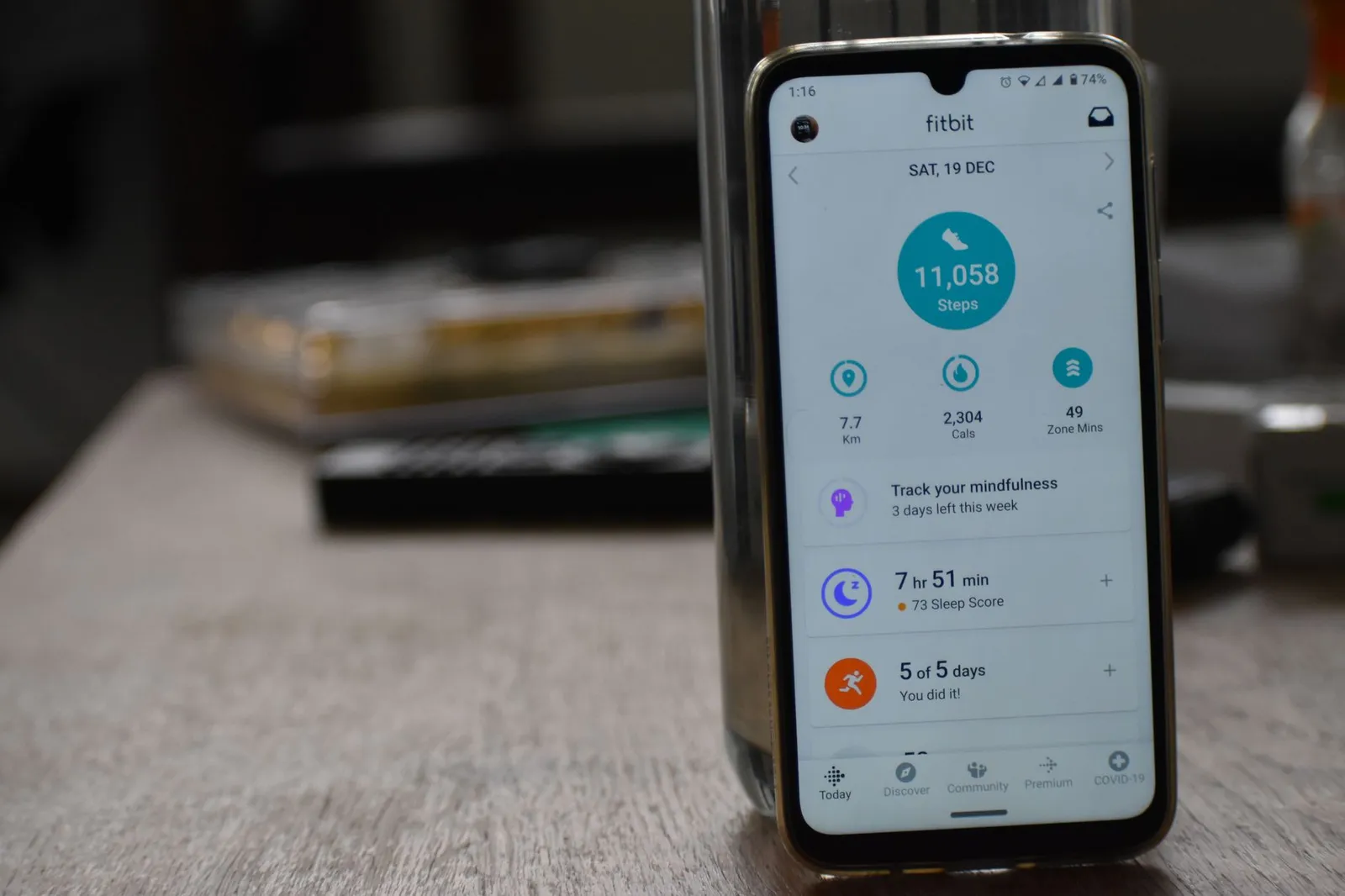
Whether you eat back exercise calories depends entirely on how your daily target was built. If your calorie goal already used an activity multiplier — "lightly active" or "moderately active" — that number counts your workouts once, so adding a watch's exercise calories on top counts them twice. If your goal used a sedentary baseline, some eat-back can make sense, but only a fraction, because fitness trackers overestimate calorie burn badly.
Few settings in a calorie app cause more quiet confusion than the exercise-calorie adjustment. You log a run, your watch syncs 500 kilocalories (about 2,090 kJ) back into the app, and your daily allowance jumps. It feels like a reward — but it may be a maths error that stalls your progress for weeks. The problem is not willpower or effort. It is that two separate parts of your setup are both trying to account for the same exercise, and the synced number they add is far less accurate than it looks.
This guide walks through the double-counting trap, shows what the strongest wearable-accuracy studies actually found, and gives you a simple decision rule so your log reflects reality. The sources are primary: peer-reviewed validation studies of Apple Watch, Fitbit, and five other devices; a Duke-led doubly-labelled-water study of energy expenditure; a metabolic breakdown of total daily energy expenditure; and a calorimetry test of a cardio machine's calorie display.
What does "eating back exercise calories" actually mean?
Eating back exercise calories means adding the energy your workout burned to your food budget for the day, so you are allowed to eat more. It only makes sense when your baseline target excluded exercise. If your target already assumed you exercise, the workout is counted once in the baseline and again when you add it — a double count.
Every calorie target starts from an estimate of your total daily energy expenditure, or TDEE. Most calculators build TDEE by taking your resting needs and multiplying by an activity factor — 1.2 for sedentary, 1.375 for lightly active, 1.55 for moderately active, and so on. That multiplier is meant to fold in all your movement for a typical week, including your training. Our TDEE calculator shows how the factor is applied, and the Mifflin-St Jeor versus Katch-McArdle comparison explains where the resting figure comes from.
So if you told a calculator you were "moderately active" and it handed you 2,400 kcal (about 10,040 kJ), that number already contains your gym sessions. Logging a workout and eating back the burn on top of it credits the same exercise a second time. The MyFitnessPal-style model works the opposite way: it starts you at a sedentary baseline and expects you to add exercise as you do it — which is why that model invites eating calories back, and the multiplier model does not.
Why do fitness trackers overestimate exercise calories?
Fitness trackers estimate energy from heart rate, motion, and body-size assumptions, and those estimates drift widely. In a Stanford study of 60 adults across seven devices, energy-expenditure error ranged from 27 to 93 percent even though heart-rate readings were accurate. No device measured energy within 20 percent of a metabolic reference.
The 2017 Stanford validation study (Shcherbina and colleagues) is the clearest picture we have. Across the Apple Watch, Fitbit Surge, Samsung Gear S2, Microsoft Band, Basis Peak, Mio Alpha 2 and PulseOn, heart rate was reassuringly good — the Apple Watch's median error was about 2 percent. Energy expenditure was a different story: the most accurate device (the Fitbit Surge) still carried a median error of 27.4 percent, and the least accurate (PulseOn) reached 92.6 percent. Not one device came within 20 percent of the reference.
A separate 2019 validation compared the Fitbit Charge HR 2 and Apple Watch against a metabolic cart during a treadmill test. The pooled energy-expenditure error was roughly 20 to 24 percent, and the direction was inconsistent — the Apple Watch overestimated for women and underestimated for men, while the Fitbit underestimated for both. Our guide to wearables and nutrition covers why heart-rate optics work well but calorie algorithms do not.

Gym cardio machines have their own bias: they usually display gross calories (including the resting energy you would have burned anyway) rather than net exercise calories. In a calorimetry study of 34 adults, an elliptical machine overestimated by about 130 kcal (roughly 545 kJ) over a 30-minute moderate session, and the gap widened the longer people exercised. So the number you are tempted to eat back is often inflated at the source.
How much of your workout actually raises your daily burn?
Less than the machine claims, and often less than simple addition predicts. Doubly-labelled-water research shows total daily energy expenditure does not rise linearly with activity — the body compensates by trimming energy elsewhere. In a study of 332 adults, total expenditure plateaued at higher activity levels rather than climbing step for step with exercise.
This is the finding most calorie apps ignore. The intuitive model is additive: burn 300 extra kcal exercising, spend 300 more for the day. But Pontzer and colleagues, measuring 332 adults with doubly-labelled water (the gold standard for real-world energy expenditure), found that total daily burn flattens out as activity climbs. The body quietly offsets some training by reducing movement and metabolic cost elsewhere — a pattern often called the constrained-energy model.
The reason is structural. Your total daily energy expenditure has three main parts, and exercise is the smallest and most variable:
| Component of daily burn | Share of total | How much it varies |
|---|---|---|
| Resting metabolic rate | ~60% | Mostly fixed by body size |
| Thermic effect of food | ~10–15% | Small, stable |
| All physical activity | ~15–30% | Highly variable |
So should you eat back exercise calories or not?
Match your eat-back rule to your baseline. If your target used an activity multiplier above sedentary, consider eating back little or none of your tracked exercise, because it is already included. If your target used a sedentary baseline, eating back roughly half of the tracked burn is a common hedge against overestimation.
Here is a practical way to decide, working from the setup you already have:
- Check which baseline your target used. If you picked "lightly active" or higher in a calculator, your exercise is in the number already — adding it again is the double count.
- If your baseline includes activity, log workouts for insight, not extra food. Watching the burn is useful feedback; treating it as a licence to eat more re-counts it.
- If your baseline is sedentary, eat back a fraction, not the whole figure. Because trackers and machines run 20 to 90 percent high, many people eat back about 50 percent and adjust from results.
- Trust the scale trend over the device. After two to three weeks, your weight trend tells you whether your real intake and burn are balanced — regardless of what any gadget claimed.
- Keep one system, not two. Using a multiplier and eating back synced calories is the classic way to count the same run twice.
None of this means exercise does not matter — it supports mood, health, appetite regulation, and muscle retention on a deficit. It simply means the calorie side of exercise is the least reliable number in your day, so building your plan around your food intake and your weight trend tends to work better than chasing a synced burn figure. If you want to sanity-check the burn side of a specific activity, our walking calorie calculator shows how much pace and incline change the real cost.
What is a safe default if you are unsure?
A low-friction default is to set your calorie target with an honest activity multiplier and then not eat back any tracked exercise. This counts your typical training once, avoids the overestimation problem entirely, and leaves the weight trend to fine-tune your intake over a few weeks.
This default works because it removes the two biggest sources of error at once: the double count, and the inflated synced number. You still log workouts if you find the feedback motivating — you just do not convert that burn into extra food. If your weight is dropping faster than you would like, you nudge intake up; if it stalls, you nudge down. The device becomes a fitness log, and your food total plus your scale trend do the real accounting.
Frequently Asked Questions
Should I eat back exercise calories on MyFitnessPal?
MyFitnessPal uses a sedentary-style baseline and adds exercise as you log it, so its own model does invite eating some back. Because the synced burn is usually 20 to 90 percent too high, many people eat back only about half and let their weight trend over two to three weeks confirm whether that fraction is right for them.
Does my TDEE already include exercise?
If you built your TDEE with an activity multiplier above 1.2 — such as "lightly active" (1.375) or "moderately active" (1.55) — then yes, that number already folds in your typical workouts. Adding tracked exercise calories on top of a multiplier-based target counts the same training twice.
Are Apple Watch and Fitbit calorie counts accurate?
Their heart-rate readings are accurate, often within about 2 percent, but their calorie estimates are not. Validation studies found energy-expenditure errors from roughly 20 percent up to more than 90 percent depending on the device and activity, with no consistent direction, so the calorie figure is best treated as a rough guide.
Why does my treadmill show more calories than my watch?
Machines often display gross calories, which include the resting energy you would have burned anyway, while many wearables try to show only the extra active calories. In one study an elliptical overstated burn by about 130 kcal (545 kJ) per 30 minutes, so the console figure is usually the higher — and less useful — number.
Will eating back exercise calories stop my weight loss?
It can, if the burn is overstated. If a device credits you 500 kcal but the real figure is 300, eating back all 500 erases much of your deficit. Eating back a smaller fraction, or none when your baseline already includes activity, protects your deficit while you confirm the trend on the scale.
Does exercise burn add up the way apps assume?
Not exactly. Doubly-labelled-water research shows total daily burn plateaus at higher activity rather than rising step for step, because the body compensates by reducing movement and metabolic cost elsewhere. The real extra from a workout is usually smaller than an additive app suggests.
Sources
- Shcherbina A, et al. Accuracy in Wrist-Worn, Sensor-Based Measurements of Heart Rate and Energy Expenditure in a Diverse Cohort. Journal of Personalized Medicine, 2017. https://pmc.ncbi.nlm.nih.gov/articles/PMC5491979/
- Reddy RK, et al. Accuracy of Overall Energy Expenditure Measurements for the Fitbit Charge HR 2 and Apple Watch. American Journal of Preventive Medicine, 2019. https://pubmed.ncbi.nlm.nih.gov/31046881/
- Pontzer H, et al. Constrained Total Energy Expenditure and Metabolic Adaptation to Physical Activity in Adult Humans. Current Biology, 2016. https://pubmed.ncbi.nlm.nih.gov/26832439/
- Non-exercise activity thermogenesis (NEAT): a component of total daily energy expenditure. Journal of Exercise Nutrition & Biochemistry, 2018. https://pmc.ncbi.nlm.nih.gov/articles/PMC6058072/
- Caloric Expenditure Estimation Differences between an Elliptical Machine and Indirect Calorimetry. Exercise Medicine, 2018. https://www.exercmed.org/journal/view.php?doi=10.26644%2Fem.2018.008
Ready to track smarter?
Join thousands who use kcalm for calorie tracking. AI-powered food recognition, scientifically-validated calculations, and zero anxiety.