Sugar Alcohol Calories: What Zero Sugar Costs in Your Log
Zero sugar does not mean zero calories. Sugar alcohols carry anywhere from 0 to 3 kcal (0 to 12.6 kJ) per gram, and the label value depends on where the product was made: the US assigns maltitol 2.1 kcal/g while the EU counts it at 2.4, mannitol swings from 1.6 to 2.4 across the same border, and only erythritol earns a genuine zero in both markets. Australia added allulose to its energy tables in August 2024 at 2 kJ per gram — a fifth of sugar. The full per-gram table in kcal and kJ, why the same protein bar can legally show different calories in three markets, how tracker databases inherit the confusion, and a five-step way to log zero-sugar products accurately.

Sophie Carter
Certified Health Coach & Wellness Writer

Zero sugar does not mean zero calories. Sugar alcohols — the sweeteners behind most zero-sugar bars, chocolates, and gummies — carry between 0 and 3 kcal (0 and 12.6 kJ) per gram under US labelling rules, and the same gram can legally show a different calorie value in the US, the EU, and Australia. Only erythritol earns a genuine zero on both sides of the Atlantic, while maltitol, the workhorse of sugar-free confectionery, costs 2.1 to 2.4 kcal per gram — more than half of sugar [1][4].
If you track calories, the zero-sugar aisle is one of the sneakier places for your log to drift. A protein bar can honestly say "no added sugar" on the front and still deliver 180-plus kcal (750-plus kJ), some of it from the very sweeteners that earned the claim. This post lays out the per-gram energy table for every common sugar alcohol in kcal and kilojoules, explains why the same product can carry different calorie labels in different countries — and why your tracker database quietly inherits that confusion — and finishes with a simple way to log zero-sugar products without either overcounting or fooling yourself. It picks up a thread from our looks at how far nutrition labels can legally drift and why nut labels overstate what you absorb: the calorie line is an accounting convention, not a measurement of you.
How many calories do sugar alcohols actually have?
As of September 2026, US labelling rules assign sugar alcohols between 0 and 3.0 kcal per gram: erythritol 0, mannitol 1.6, isomalt and lactitol 2.0, maltitol 2.1, xylitol 2.4, sorbitol 2.6, and hydrogenated starch hydrolysates 3.0 — against 4.0 kcal per gram for sugar [1].
Sugar alcohols (chemists call them polyols) are carbohydrates that your small intestine absorbs incompletely or metabolises only partly, so they deliver less usable energy than sugar. How much less varies a lot by molecule. The US Food and Drug Administration codifies a specific factor for each one in its nutrition-labelling regulation, 21 CFR 101.9 [1]:
| Sweetener | US label value (kcal/g) | kJ/g | Sweetness vs sugar |
|---|---|---|---|
| Erythritol | 0 | 0 | 60–80% |
| Allulose (not a polyol) | 0.4 | 1.7 | below sucrose |
| Mannitol | 1.6 | 6.7 | 50–70% |
| Isomalt | 2.0 | 8.4 | 45–65% |
| Lactitol | 2.0 | 8.4 | 30–40% |
| Maltitol | 2.1 | 8.8 | ~100% |
| Xylitol | 2.4 | 10.0 | ~100% |
| Sorbitol | 2.6 | 10.9 | 50–70% |
| Hydrogenated starch hydrolysates | 3.0 | 12.6 | 40–90% |
| Sucrose (for comparison) | 4.0 | 16.7 | 100% |
Why does the same product show different calories in different countries?
The US assigns each polyol its own measured energy factor, while the EU counts every polyol except erythritol at a flat 2.4 kcal (10 kJ) per gram — so the identical bar can legally declare different calories in Boston and Berlin, and tracker food databases inherit whichever label they were built from [1][4].
The EU's food-information regulation lists one conversion factor for the whole polyol family — 10 kJ, or 2.4 kcal, per gram — with erythritol carved out at zero [4]. The US instead assigns each molecule the value its metabolism studies support [1]. Line the two systems up and the gaps appear:
| Sweetener | US label (kcal/g) | EU label (kcal/g) | Gap per 20 g serve |
|---|---|---|---|
| Erythritol | 0 | 0 | 0 kcal |
| Mannitol | 1.6 | 2.4 | 16 kcal (67 kJ) |
| Isomalt | 2.0 | 2.4 | 8 kcal (33 kJ) |
| Maltitol | 2.1 | 2.4 | 6 kcal (25 kJ) |
| Xylitol | 2.4 | 2.4 | 0 kcal |
| Sorbitol | 2.6 | 2.4 | −4 kcal (−17 kJ) |
| HSH | 3.0 | 2.4 | −12 kcal (−50 kJ) |
For your log, the practical consequence is bigger than the per-serve gaps suggest. Tracker databases are stitched together from user-scanned labels across markets, so the "same" product often exists as three entries with three calorie values, none of them wrong. Research on food-database quality consistently finds entry-to-entry variation of this kind, and it compounds the label tolerances we covered in how accurate nutrition labels really are. If your log feels mysteriously inconsistent, the database entry — not your discipline — may be the variable, a theme familiar from the underreporting math behind stalled logs.

Does erythritol really have zero calories?
Erythritol is the closest thing to a free sweetener in food chemistry: about 90 percent is absorbed in the small intestine but not metabolised, leaving the body unchanged in urine, so both US and EU rules label it 0 kcal per gram — laboratory work puts its true value near 0.2 kcal (0.8 kJ) per gram [2][1][4].
Erythritol is a four-carbon polyol, small enough that the small intestine absorbs most of it before gut bacteria get a chance to ferment it. What is absorbed cannot be broken down by human enzymes, so it exits in urine essentially intact — research puts the metabolised fraction under 10 percent [2]. Its measured glycaemic index is 0, and studies find it does not move blood glucose or insulin, compared with a glycaemic index of about 9 for sorbitol and 13 for xylitol [2]. The European Food Safety Authority's expert panel assessed the polyol family's claim to reduce post-meal blood-glucose responses back in 2011, alongside their tooth-friendly properties — the science behind the "does not promote tooth decay" line on packaging [7].
For logging purposes, a 5 g teaspoon of erythritol in your coffee is a genuine zero the way black coffee is a genuine zero: technically 1 kcal, practically nothing. The nuance worth knowing is that the zero applies to erythritol itself. Blends sold for baking often cut erythritol with maltitol or sorbitol to fix texture, and the blend's calories follow the blend's recipe, not the headline ingredient.
Is allulose a sugar alcohol, and why is it 0.4 calories per gram?
Allulose is not a sugar alcohol — it is a rare sugar with glucose's formula but almost none of its usable energy, and since October 2020 the FDA has allowed it at 0.4 kcal (1.7 kJ) per gram and excluded it from the total and added sugars lines on US labels [5].
Allulose (D-psicose) behaves like erythritol's chemical cousin from the sugar side of the family: absorbed, barely metabolised, excreted. The FDA's 2020 guidance let manufacturers count it at a tenth of sugar's energy and — unusually — leave it out of "Total Sugars" and "Added Sugars" entirely, even though it is, chemically, a sugar [5]. That is why a US ice cream sweetened with allulose can declare 2 g of sugar while containing 15 g of sweet-tasting carbohydrate.
Australia and New Zealand followed in August 2024, when FSANZ approved D-allulose as a novel food for use in beverages, bakery goods, ice cream, confectionery, yoghurt, and breakfast cereals [6]. The FSANZ assessment measured its metabolisable energy at 1.88 kJ per gram and entered a rounded 2 kJ (about 0.5 kcal) per gram into the Food Standards Code's energy tables [6]. So the same spoonful of allulose is 0.4 kcal in Chicago and 0.48 kcal in Sydney — trivial in absolute terms, but a neat illustration that the calorie line is a regulatory convention. Where the energy really goes when your body processes what you absorb is its own arithmetic, which we walked through in the thermic effect of food.
How do you log sugar alcohols in your calorie tracker?
The reliable approach is to log the calorie number printed on the package in your market and resist the urge to subtract sugar alcohols a second time — the label's energy factors have already discounted them [1].
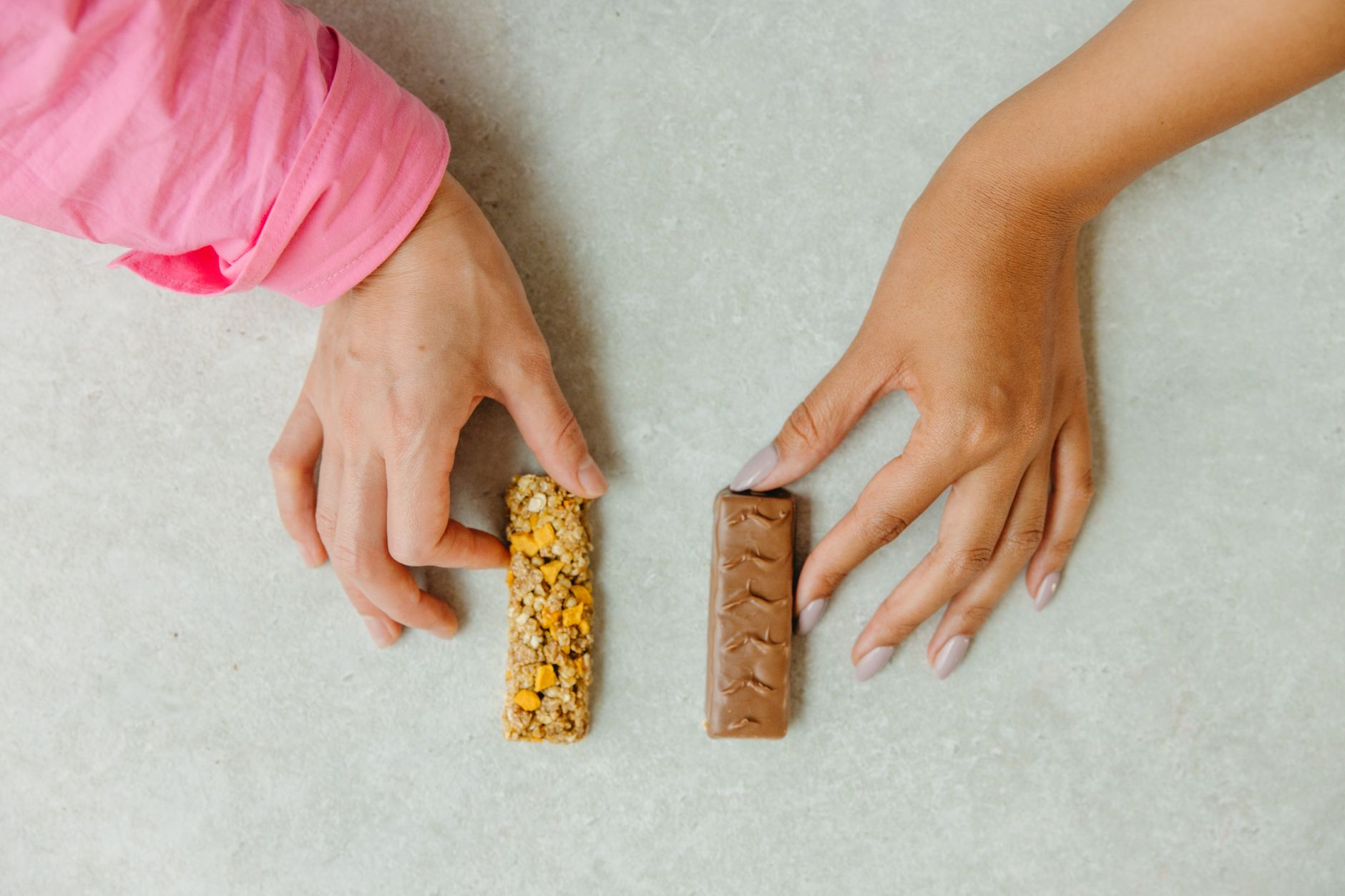
The most common logging mistake with zero-sugar products runs in both directions. Some people see "zero sugar" and round the whole product down, skipping the log entirely — but a typical 60 g zero-sugar protein bar still carries roughly 200 kcal (837 kJ): about 80 kcal from 20 g of protein, 90 kcal from 10 g of fat, and 30-odd kcal from 15 g of maltitol, before fibre adds its share. Others follow keto-style "net carb" habits and subtract the full sugar-alcohol grams from the calorie line as well as the carb line — double-counting a discount the label already applied. A cleaner routine:
- Log the label of the product in your hand. The kcal or kJ printed on your package already uses your market's polyol factors — that number needs no adjustment [1][4].
- Check the database entry against the package once. If your tracker's entry disagrees with the printed panel by more than a few percent, the entry was likely scanned from another market's label; correct it and move on.
- Leave net-carb math out of the energy column. Subtracting sugar alcohols is a blood-glucose convention for people managing diabetes or ketosis, not a calorie correction — the energy discount is already in the label [1].
- Treat pure erythritol and allulose as zeros. At 0 and 0.4 kcal per gram, a teaspoon of either moves your day by less than a stick of celery [1][5].
- Watch the serving size on confectionery. Sugar-free chocolate and gummies are dosed in small serves partly for digestive reasons; eating half the bag can triple both the calories and the consequences below.
That worked bar example is worth pausing on. "Zero sugar" is a statement about one ingredient category, and the products wearing the claim are often calorie-dense for other reasons — nuts, fats, protein, glycerine. Where maltitol does the sweetening, the label maths is direct: at 2.1 kcal per gram against sugar's 4.0, the swap removes only about half of the sugar calories it replaces [1].
Do sugar alcohols cause stomach upset?
Most sugar alcohols draw water into the gut and ferment in the colon, and the research review literature puts meaningful digestive thresholds at roughly 20 to 50 g for sorbitol, around 90 g for maltitol, and 10 to 30 g in a single sitting for unadapted xylitol — while erythritol is tolerated at far higher doses [3].
The same incomplete absorption that lowers the calorie count leaves unabsorbed molecules in the intestine, where they pull in water osmotically and feed colonic bacteria — the mechanism behind the warning "excess consumption may have a laxative effect" that several markets print on polyol-sweetened products [3]. A review in the International Journal of Dentistry collects the measured thresholds: sorbitol produced osmotic diarrhoea at 20 to 50 g, maltitol at around 90 g, and xylitol single doses of 10 to 30 g were generally tolerated, with regular users adapting to 20 to 70 g per day over time [3]. Erythritol again is the outlier — because it is absorbed high in the gut rather than fermented, studies found bolus doses of 0.66 to 0.80 g per kilogram of body weight (roughly 45 to 55 g for a 70 kg adult) were tolerated without the diarrhoea that equivalent sorbitol or xylitol doses produce [2][3].
Individual tolerance varies widely, and it tends to improve with regular exposure [3]. If you enjoy zero-sugar products, you may find it useful to note where your own threshold sits and portion accordingly — half a bag of maltitol gummies contains enough polyol to matter for most people. None of this makes sugar alcohols something to fear; like the fermentable fibres we covered in the fibre trend explainer, the gut effects are dose-dependent physiology, not toxicity.
Frequently Asked Questions
Do sugar alcohols count toward calories?
Yes, most of them. Under US rules, only erythritol counts as 0 kcal per gram; the rest range from 1.6 kcal (mannitol) to 3.0 kcal (hydrogenated starch hydrolysates) per gram, and EU labels count all polyols except erythritol at 2.4 kcal per gram [1][4]. The package calorie line already includes them at those discounted values.
Do sugar alcohols count as carbohydrates?
Yes. Sugar alcohols appear in total carbohydrate on both US and EU labels — they are carbohydrates chemically, just incompletely absorbed ones. What they are excluded from is the sugars line, which is why a bar full of maltitol can read "1 g sugar" [1][4].
Do sugar alcohols raise blood sugar?
Much less than sugar, and unevenly. Erythritol's measured glycaemic index is 0, sorbitol's about 9, and xylitol's about 13, against glucose at 100 — the property behind EFSA-assessed claims that replacing sugar with polyols reduces the post-meal glucose rise [2][7]. Maltitol produces the largest glycaemic response of the common polyols, another reason its "sugar-free" halo deserves scepticism.
Why does my tracker show different calories for the same zero-sugar product?
Because tracker databases mix entries built from different markets' labels. A maltitol-sweetened bar carries a lower declared energy in the US (2.1 kcal/g for the maltitol) than in the EU (2.4 kcal/g), and Australian entries convert from kilojoules — so three correct entries can disagree [1][4]. Checking the entry against your physical package once settles it.
Can I subtract sugar alcohols from calories for keto or net carbs?
Subtract them from carbs if your eating approach uses net carbs, but not from calories. The net-carb convention estimates glycaemic impact; the calorie line has already been discounted with each polyol's energy factor, so subtracting again undercounts real energy intake [1].
Is allulose the same as erythritol?
No. Both are low-calorie and mostly excreted unmetabolised, but erythritol is a sugar alcohol labelled at 0 kcal per gram, while allulose is a rare sugar labelled at 0.4 kcal per gram in the US and 2 kJ (about 0.5 kcal) per gram in Australia since FSANZ's August 2024 approval [1][5][6]. Blends increasingly pair them, since both handle heat and freezing better together.
Sources
- Cornell Law School Legal Information Institute. 21 CFR § 101.9 — Nutrition labeling of food (caloric conversion factors for sugar alcohols, §101.9(c)(1)(i)(F)). https://www.law.cornell.edu/cfr/text/21/101.9
- Regnat K, Mach RL, Mach-Aigner AR. Erythritol as sweetener — wherefrom and whereto? Applied Microbiology and Biotechnology. 2018;102:587–595. https://pmc.ncbi.nlm.nih.gov/articles/PMC5756564/
- Mäkinen KK. Gastrointestinal Disturbances Associated with the Consumption of Sugar Alcohols with Special Consideration of Xylitol. International Journal of Dentistry. 2016. https://pmc.ncbi.nlm.nih.gov/articles/PMC5093271/
- Regulation (EU) No 1169/2011 on the provision of food information to consumers, Annex XIV — Conversion factors. https://www.legislation.gov.uk/eur/2011/1169/annex/XIV
- US Food and Drug Administration. The Declaration of Allulose and Calories From Allulose on Nutrition and Supplement Facts Labels — Guidance for Industry (Federal Register, 19 October 2020). https://www.govinfo.gov/content/pkg/FR-2020-10-19/html/2020-22901.htm
- Food Standards Australia New Zealand. Application A1247 — D-allulose as a novel food (approved 7 August 2024). https://www.foodstandards.gov.au/food-standards-code/applications/A1247-D-allulose-as-a-novel-food
- EFSA Panel on Dietetic Products, Nutrition and Allergies (NDA). Scientific Opinion on health claims related to the sugar replacers xylitol, sorbitol, mannitol, maltitol, lactitol, isomalt, erythritol and others: tooth mineralisation and reduction of post-prandial glycaemic responses. EFSA Journal. 2011. https://pmc.ncbi.nlm.nih.gov/articles/PMC13129610/
Ready to track smarter?
Join thousands who use kcalm for calorie tracking. AI-powered food recognition, scientifically-validated calculations, and zero anxiety.
Related Articles
Standing Desk Calories: The Real Number Is 9 Per Hour
Standing at your desk burns about 9 extra kcal (38 kJ) per hour compared with sitting — 0.15 kcal per minute for a 65 kg adult, per a meta-analysis of 46 studies and 1,184 participants — roughly one-sixth of the 30-to-50 kcal figure desk vendors advertise. Replacing six hours of sitting with standing adds about 54 kcal a day, while one easy 30-minute lunchtime walk adds roughly the same as standing all afternoon. Where the vendor number goes wrong, the measured MET table for desk tasks, why standing occupations really do double occupational burn, and how to handle standing time in your calorie log.
ScienceHow Many Calories Does an Ice Bath Burn? The Real Math
A typical 10-to-15-minute ice bath burns roughly 20 to 80 extra kcal (85 to 335 kJ) — less than a single banana, and an order of magnitude below the 250 to 500 kcal that plunge marketing claims. The measured literature is consistent: an 18 degree cooling suit raised energy expenditure by 250 kcal across three full hours, the 88-minute world-record ice immersion roughly doubled heat production from 169 to 321 watts, and a meta-analysis of 10 randomised trials put mild cold exposure at 188 extra kcal per day. Even six weeks of two-hours-daily cold acclimation lifted cold-induced thermogenesis to only 289 kcal a day. Real physiology, trivial energy cost — the protocol-by-protocol table, the shivering math behind the vendor claims, and how to log a plunge honestly.
ScienceCan You Only Absorb 30g of Protein Per Meal? The Data
The claim that your body can only absorb 30 g of protein per meal fails on both halves. Your gut absorbs virtually all the protein you eat — the real question is how much your muscle uses — and the best-measured feeding study to date answered it: 100 g of milk protein kept muscle protein synthesis elevated for more than 12 hours, beating a 25 g dose by roughly 40 percent in the 4-to-12-hour window, with almost none of the extra oxidised away. Where the 30 g figure came from, what the dose-response trials from 20 g to 100 g actually show, the per-meal targets by body weight, and what it all means for how you log protein.