Dessert Stomach: Why You Still Want Cake When Full
Full but still want cake? Not a second stomach: the food you ate loses some of its appeal while dessert keeps its own. What the studies measured.
kcalm editorial team
Prepared with AI assistance
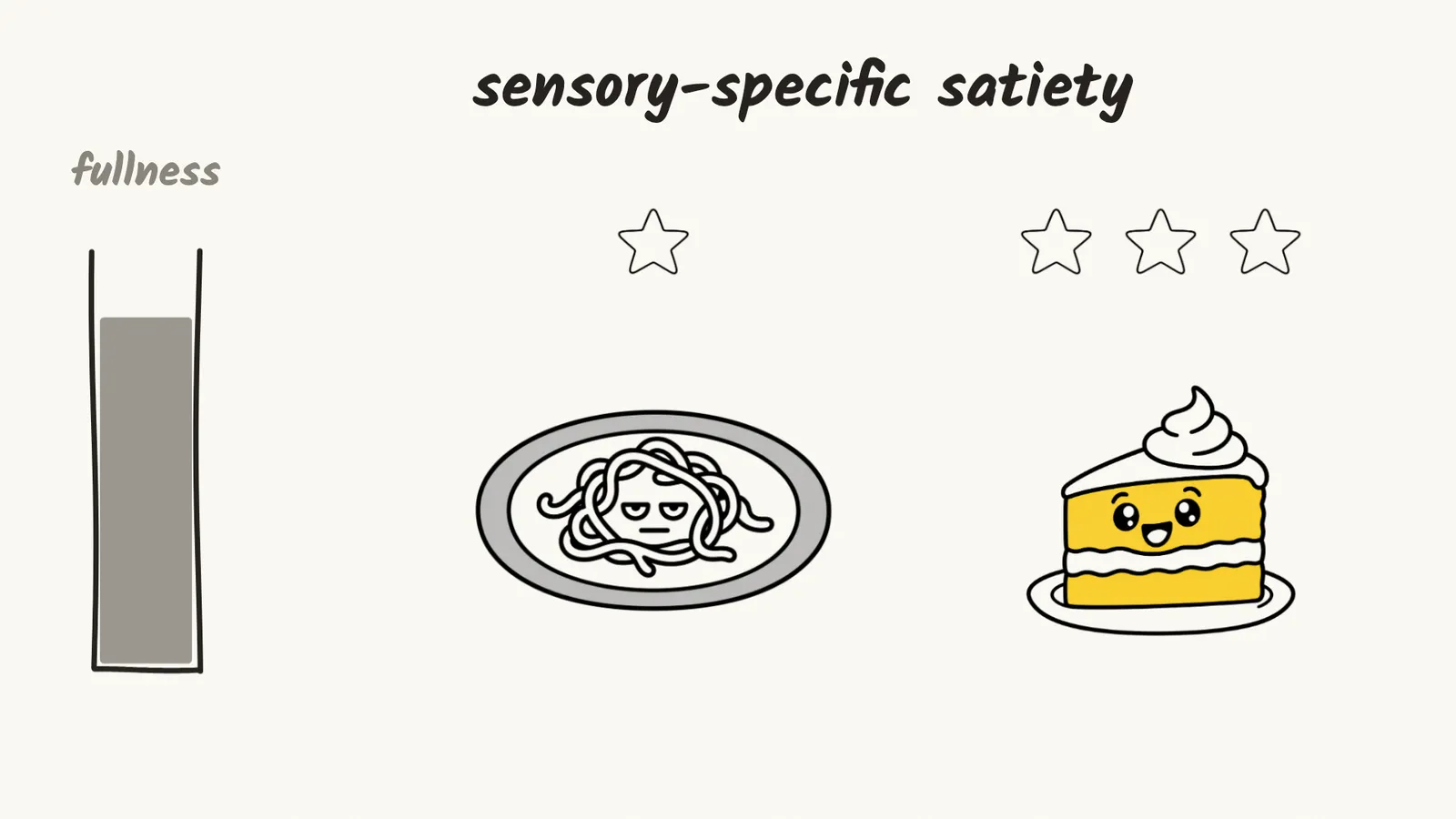
Is the dessert stomach real? Not as a second stomach. You can feel full and still want dessert because the food you've been eating loses some of its appeal while a food you haven't touched keeps more of its own, an effect called sensory-specific satiety. It is an ordinary part of appetite, not a failure.
Why do you still want dessert when you are full?
At the end of a big pasta dinner you could not manage another forkful of pasta, yet a slice of cake still sounds good. Fullness and the appeal of each food do not always move together: fullness rises as you eat, while the food you have been eating loses more of its appeal than foods you have not touched.
What is sensory-specific satiety?
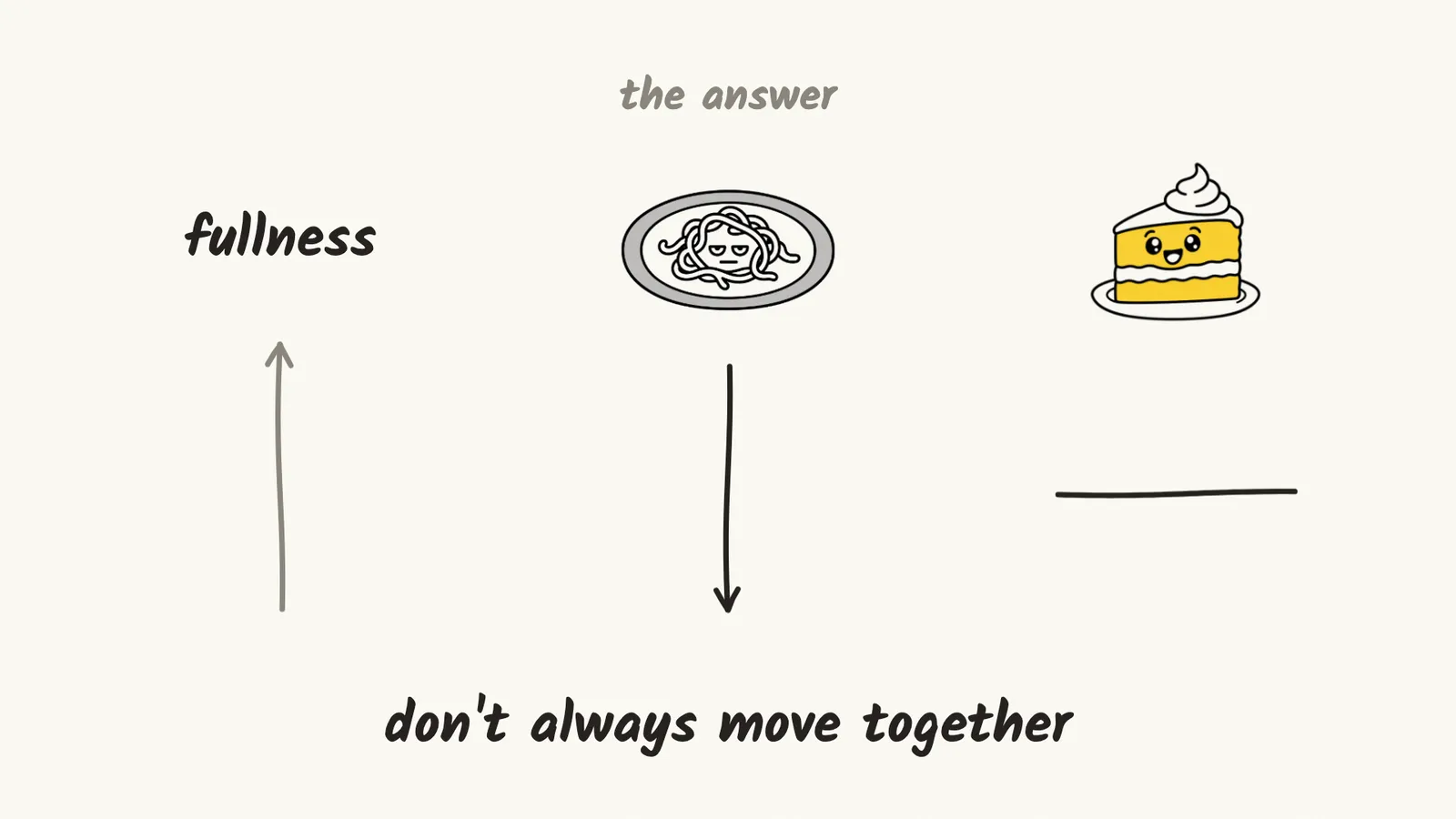
It is the name for a change in enjoyment, not in stomach space: the particular food you have been eating, its taste, smell and texture, becomes less enjoyable compared with other foods. Picture two sliders for how good a food sounds right now. At the start of dinner, pasta and cake both sit near the top. As you eat the pasta, its slider drops; the cake's barely moves. That gap helps explain why dessert can still sound good. The sliders are a metaphor: the studies measured how pleasant people rated each food.
What did scientists actually measure?
Barbara Rolls, Edmund Rolls and colleagues showed this in people in a study published in 1981 (Rolls et al., 1981; accessible paper). In their first experiment, 32 people rated how pleasant eight foods tasted, ate one of them until they felt satisfied, then rated all eight again. The eaten food dropped in pleasantness more than the others. In a second experiment with 24 people, those drops in liking were linked to how much of each food people ate in an unexpected second course, a correlation within one lab meal.
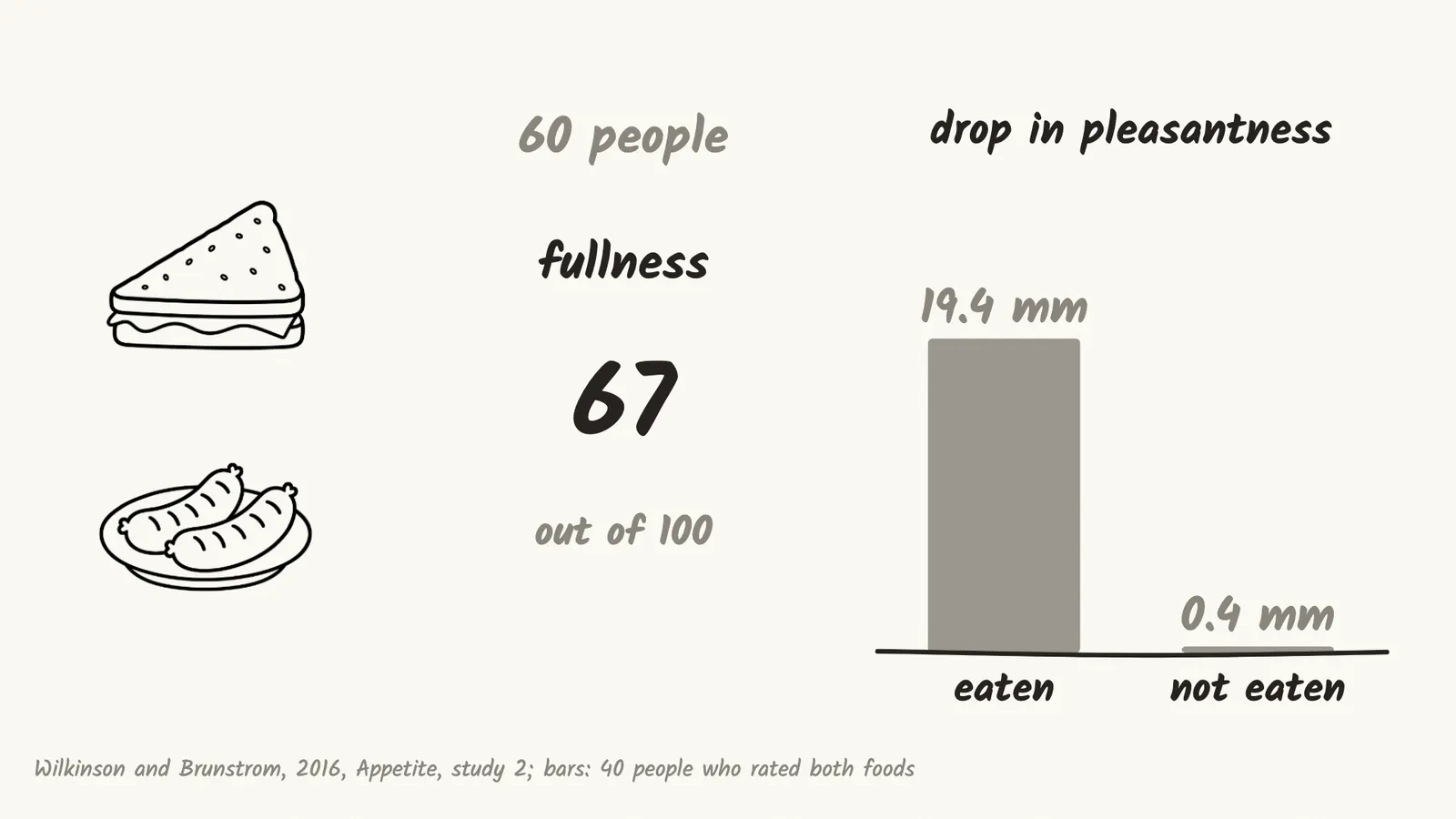
Laura Wilkinson and Jeffrey Brunstrom later put numbers on the gap (Wilkinson and Brunstrom, 2016). Everyone ate a set portion of one food. Among the 40 people who rated both foods before and after, on a 100 millimetre line, the eaten food fell by 19.4 millimetres on average and the uneaten food by 0.4. Across all 60 participants, average fullness rose from about 21 to about 67 on a separate 100 millimetre scale.
Is it only about sweet food?
No. That 2016 study used two savoury foods, cheese sandwiches and sausages.
A 2021 systematic review in the American Journal of Clinical Nutrition included a meta-analysis of 30 studies and found that, on average, people eat more at a meal with more variety (Embling et al., 2021; abstract). The effect was small to medium, results varied widely between studies, and the authors rated the risk of bias as high. It describes appetite in groups of people; it is not a rule, and not a reason to make meals boring.
Is the dessert stomach real?
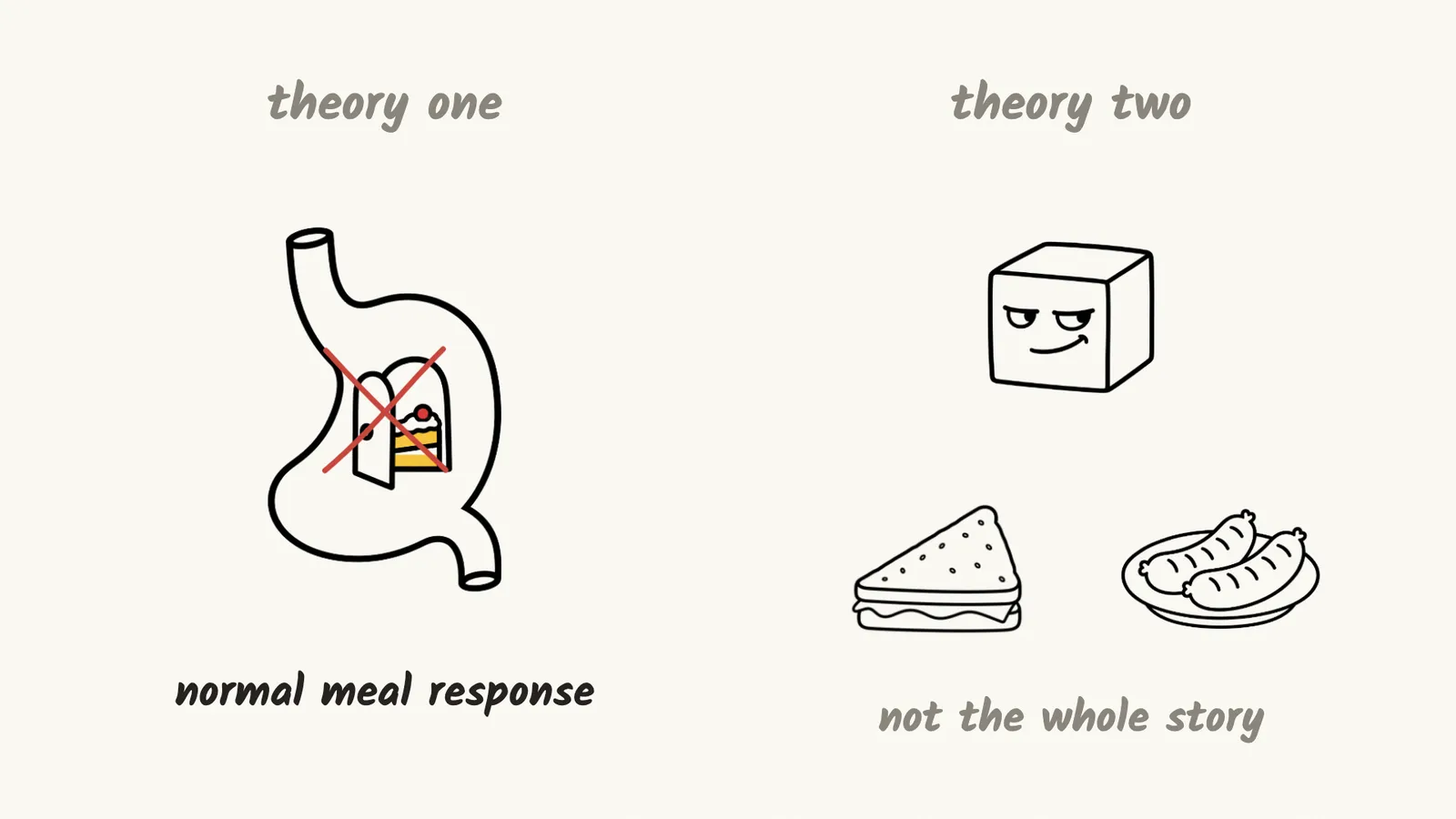
Not as a second stomach. The upper part of the stomach does relax as a meal comes in, to make room for it. This reflex is called gastric accommodation, and it is a normal response to eating, not something special for dessert. In a small study of 11 healthy adults, the sight and smell of a meal alone did not clearly trigger it (Vanden Berghe et al., 2009). So this research gives no support to the idea that looking at cake opens up a special space.
What did the mouse study find?
In 2025, Marielle Minère, Henning Fenselau and colleagues at the Max Planck Institute for Metabolism Research in Cologne published a study in Science (Minère et al., 2025; accessible abstract). In mice that were already full, the brain cells that signal fullness, called POMC neurons, also released beta-endorphin, one of the body's own opioids, when sugar was involved. According to the Max Planck Society, in these experiments this happened with sugar but not with regular or fatty food. Blocking the pathway made full mice eat less sugar; in hungry mice, the researchers did not see the same reduction.
Brain scans of volunteers given a sugar solution showed the matching brain region responding. That is a hint, not proof, that people work the same way. It is also a separate finding from sensory-specific satiety in people.
Is wanting dessert a problem?
Not by itself. Wanting dessert when you are full is not a sign that anything is wrong; it is an ordinary appetite effect seen again and again in studies with people. If dessert sounds good, you can enjoy it. If you are comfortably full and it does not, that is fine too. Enjoying dessert is not a failure, and it is not something you need to make up for.
If eating ever feels distressing or out of control, you deserve support without judgement: Butterfly Foundation (Australia) 1800 33 4673; ANAD (United States) 1-888-375-7767, or call or text 988 in a crisis; Beat (England) 0808 801 0677, with other UK numbers on Beat's support page.
What this does not mean
- Not that there is literally always room for dessert. These are average effects in lab meals, and people differ.
- Not that dessert resets hunger or that sugar stretches the stomach.
- Not that scientists have found a dessert switch in the human brain. The pathway was shown in mice.
- Not that wanting dessert is an addiction, and not advice to remove variety or resist dessert.
Frequently Asked Questions
Does your stomach expand to make room for dessert?
It makes room for meals in general, not for dessert in particular. The upper stomach relaxes as a meal comes in (gastric accommodation), which is a normal response to eating, not a special space for dessert.
Is it only about sugar?
No. Sensory-specific satiety also shows up between savoury foods: in a 2016 study, people who ate a set portion of cheese sandwiches or sausages rated the food they ate much less pleasant, while the other food barely changed.
Is it normal to want something sweet after dinner?
Wanting dessert after a full meal is a common appetite effect and, on its own, not a sign that anything is wrong. Enjoying dessert is not a failure and not something you need to make up for, and if it doesn't sound good, that's fine too. If eating feels distressing or out of control, you deserve support without judgement (helplines above).
How we made this
Made by kcalm, an iPhone app for logging food by photo, typing or voice. The video uses an AI voice. The script was researched from the sources below and checked against them by an AI fact-checker; it has not been reviewed by a dietitian. General information, not medical or nutrition advice. Published October 2026. Spot an error? Tell us at [email protected] and we will correct it.
Sources
- Rolls BJ, Rolls ET, Rowe EA, Sweeney K. Sensory specific satiety in man. Physiology and Behavior, 1981;27(1):137-142. https://doi.org/10.1016/0031-9384%2881%2990310-3 (accessible paper: https://www.ssib.org/web/classics/Rolls%20Sensory%20specific%20satiety%20in%20man.pdf)
- Wilkinson LL, Brunstrom JM. Sensory specific satiety: More than "just" habituation? Appetite, 2016;103:221-228. https://pmc.ncbi.nlm.nih.gov/articles/PMC4910838/
- Embling R, Pink AE, Gatzemeier J, Price M, Lee MD, Wilkinson LL. Effect of food variety on intake of a meal: a systematic review and meta-analysis. American Journal of Clinical Nutrition, 2021;113(3):716-741. https://pmc.ncbi.nlm.nih.gov/articles/PMC7948867/ (abstract: https://pubmed.ncbi.nlm.nih.gov/33515033/)
- Vanden Berghe P, Janssen P, Kindt S, Vos R, Tack J. Contribution of different triggers to the gastric accommodation reflex in humans. American Journal of Physiology, Gastrointestinal and Liver Physiology, 2009;297(5):G902-G906. https://pubmed.ncbi.nlm.nih.gov/19846891/
- Minère M, Wilhelms H, Kuzmanovic B, et al., Fenselau H. Thalamic opioids from POMC satiety neurons switch on sugar appetite. Science, 2025;387(6735):750-758. https://doi.org/10.1126/science.adp1510 (accessible abstract: https://weizmann.elsevierpure.com/en/publications/thalamic-opioids-from-pomc-satiety-neurons-switch-on-sugar-appeti/)
- Max Planck Society. Dessert stomach emerges in the brain. 13 February 2025. https://www.mpg.de/24159607/0211-neur-dessert-stomach-emerges-in-the-brain-153735-x
Video transcript
The full narration of the video, with its chapter times. The video is coming soon.
0:00 Why is there always room for dessert?
Here's a riddle. You've just finished a huge bowl of pasta, and someone offers you one more forkful. No way. You couldn't possibly. Thirty seconds later, out comes the cake, and suddenly, it sounds amazing. Same stomach, same minute. So why is there always room for dessert?
0:17 Is the dessert stomach real?
The famous theory is a secret dessert stomach: a little side room that only opens for cake. Sadly, no. Your stomach does relax to make room as you eat, but it does that for meals in general, not as a favour to dessert. Theory two: it's the sugar. But sugar can't be the whole story, because people who fill up on cheese sandwiches still find sausages just as tasty. And nobody has a sausage tooth.
0:42 Why do you still want dessert when you're full?
So look at the pasta again. It didn't just fill you up. Bite by bite, it got less delicious. Picture every food with its own star rating in your head. As you eat the pasta, its stars drop away, one by one, while your fullness climbs. But the cake hasn't been touched, so its stars barely budge. Scientists call this sensory-specific satiety. So here's the answer. You can be full and still want dessert because fullness and appeal don't always move together: the food you've been eating loses more of its appeal than a food you haven't touched.
1:16 How scientists measured sensory-specific satiety
And it's been measured for decades. In a classic 1981 experiment, 32 people rated how pleasant eight foods tasted, ate one of them until they were satisfied, then rated all eight again. The one they'd eaten dropped the most. Then, in 2016, researchers tested it with those sandwiches and sausages. 60 people ate a set portion of one of them, and their fullness shot up, from about 21 to 67 on a 100 millimetre scale. Among the 40 who rated both foods, the one they'd eaten fell about 19 millimetres in pleasantness. The other one? Less than half a millimetre. Fuller by a mile, but the other food tasted almost as good.
1:52 Is it normal to want something sweet after dinner?
Which also helps explain the buffet. To your appetite, five different dishes are five fresh sets of stars. An analysis of 30 studies found that, on average, people eat more at meals with more variety, though results varied a lot. That's how appetite works, not a reason to make dinner boring. So "I'm stuffed" followed by "ooh, cake" isn't a contradiction, and on its own, it isn't a sign that anything is wrong. If dessert sounds good, enjoy it. If it doesn't, that's fine too. Either way, there's nothing to make up for.
2:23 Sometimes full really does mean full
The fine print: these are averages from lab meals, and people differ. Sometimes full really does mean full, so "always" isn't literal. And if eating ever feels distressing, you deserve support. Helplines are in the description. So, the riddle. Too full for one more forkful, but not for cake? Both were true. You were full, and done with pasta. But the cake still had all its stars. This is Food, Explained, from kcalm.app. Next time: does one big meal need making up for? Spoiler: no.
Ready to track smarter?
Join thousands who use kcalm for calorie tracking. AI-powered food recognition, scientifically-validated calculations, and zero anxiety.