Why Do Nuts Have So Many Calories? The Feeding Trial Table
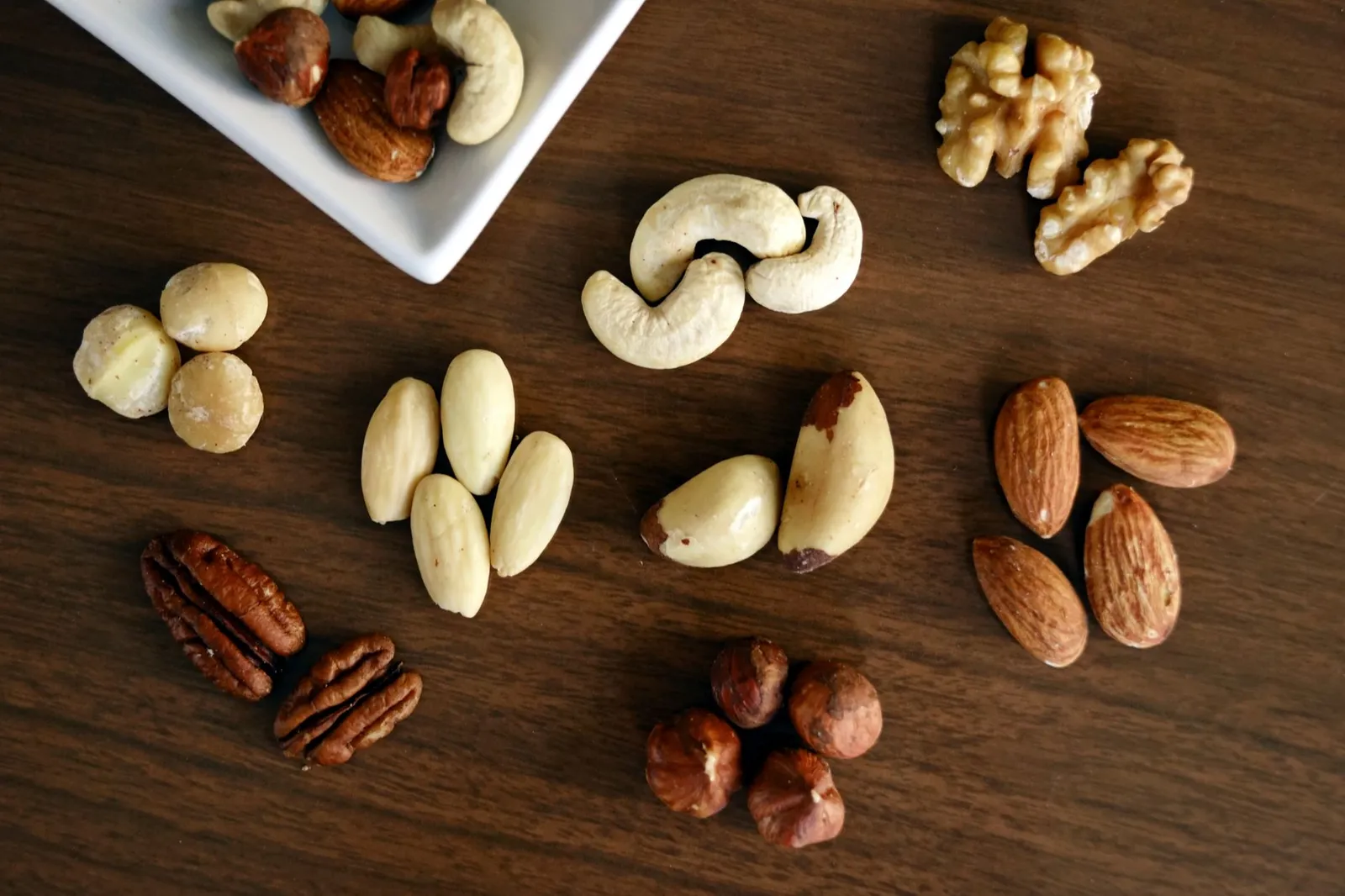
Nuts like almonds have so many calories because they're about half fat and almost no water. USDA feeding trials also measured less usable energy than the standard calculation predicted for the nuts tested: per 28 g, whole almonds 129 kcal against 168 to 170, walnuts 146 against 185, cashews about 137 against 163, and pistachios about 151 against about 160. Almond butter came out similar to its prediction. These are study averages, not a correction for a food log.
kcalm editorial team
Prepared with AI assistance
The 5-minute video goes live on 17 November.
In USDA feeding trials, measured usable energy came in below the standard calculation by about 24 percent for whole almonds, 21 percent for walnuts, 16 percent for cashews and about 5 percent for pistachios. A 28 g serve of whole almonds predicted at 168 to 170 kcal (703 to 711 kJ) measured 129 kcal (540 kJ) on average.
If you have ever weighed out a careful 28 g serve of almonds and logged the 170 kcal your app returned, you logged a standard estimate, like every other food in your log. The number on the pack estimates usable energy. US rules allow several calculation methods, including general and food-specific factors.
Between 2012 and 2019, a USDA team at the Beltsville Human Nutrition Research Center tested that estimate the hard way: controlled feeding trials in which adults ate precisely weighed diets with and without nuts while everything going in and coming out was bomb-calorimetered. For the almonds eaten whole, the walnuts, the cashews and the pistachios, the standard calculation ran high. This page explains the trial results, how food structure affects usable energy, and what the findings mean for food logging.
Why do nuts have so many calories?
Mostly because of fat and missing water. USDA's reference entry for raw almonds (SR28, NDB 12061) lists 49.93 g of fat and 4.41 g of water per 100 g, with 579 kcal (2,423 kJ) [7]. By the general factors, fat carries about 9 kcal a gram, against about 4 for protein and 4 for carbohydrate, so that fat comes to about 450 kcal [10]. USDA's 579 is built with food-specific factors instead (our arithmetic reproduces it with 3.47, 8.37 and 4.07 kcal a gram), which puts the fat nearer 418 kcal. Either way, fat is most of the total.
Rice shows each half. Cooked long-grain white rice lists 68.44 g of water and 130 kcal (544 kJ) per 100 g, so matching the 162 kcal in 28 g of almonds takes about 125 g of cooked rice, about 4.5 times the weight [9]. Dry white rice lists 11.62 g of water, nearly as dry as an almond, and 0.66 g of fat, and reaches 365 kcal (1,527 kJ) per 100 g [8]. Protein doesn't explain the difference, because by the general factors it carries the same 4 kcal a gram as carbohydrate [10].
Not every nut is built like this. Raw peeled European chestnuts list 52 g of water, 44.17 g of carbohydrate and 1.25 g of fat per 100 g, for 196 kcal (820 kJ) [7].
Why would a seed be built this way?
An almond is the seed inside the shell of a fuzzy green fruit [14], and the almond tree is a close relative of the peach [15]. A seedling depends on energy stored in the seed [16] until its leaves can make their own, which is why the video draws it as a packed lunch for a baby tree.
Why did the standard calculation run high for these nuts?
In these feeding trials, the nuts tested provided less usable energy than their calculated or reference values. Cell walls that keep some fat enclosed help explain the difference.
The Atwater system dates to work by Wilbur Atwater around 1900. Its general factors multiply grams of protein, fat and carbohydrate by 4, 9 and 4 kcal (17, 37 and 17 kJ). In the United States, the label rules allow several calculation methods, including general and food-specific factors [13]. Allowed and accurate are different questions. The general factors, for example, were derived from average digestibility across mixed diets.
The nuts in these trials are one documented case. The correct quantity, metabolizable energy, is gross energy minus everything lost in stool and urine, and measuring it takes a study most labs cannot run: participants eat a fully controlled diet for weeks, every food is chemically analysed, and fecal and urine output is collected and burned in a bomb calorimeter. The USDA Beltsville group ran studies of that kind repeatedly: 18 adults for almonds in 2012, 16 for pistachios, 18 for walnuts in 2016, 18 for cashews in 2019 [1][2][3][4]. Because intake and output were both measured directly, the nut's usable energy is calculated from the difference between the diets with and without it.
See also: how far labels can legally drift.
How many calories are actually in almonds, walnuts, cashews, and pistachios?
A 28 g serve of whole almonds delivers a measured 129 kcal (540 kJ) against a calculated 168 to 170 kcal; walnuts deliver 146 kcal (611 kJ) against 185; cashews 137 kcal (573 kJ) against 163; and pistachios 151 kcal (633 kJ) against 160, on average, per USDA controlled feeding trials.
Here is the measured-versus-calculated table across the four nuts the Beltsville trials have covered:
| Nut, per 28 g | Calculated or reference energy | Measured usable energy | Measured below that value |
|---|---|---|---|
| Almonds [1] | 168–170 kcal (703–711 kJ) | 129 kcal (540 kJ) | about 24 percent |
| Walnuts [2] | 185 kcal (774 kJ) | 146 kcal (611 kJ) | 21 percent |
| Cashews [3] | 163 kcal (682 kJ) | 137 kcal (573 kJ) | 16 percent |
| Pistachios [4] | 160 kcal (669 kJ) | 151 kcal (633 kJ) | about 5 percent |
Two details keep the table honest. First, the direction of the percentage depends on which end you divide from: almonds measured 24 percent below their prediction, which means the prediction sits 32 percent above the measurement. Both phrasings describe the same 40 kcal. The measured figures are study averages; individual results varied. The cashew trial, for example, reported a participant range of 105 to 151 kcal per serve [3], so your personal number is not exactly anyone else's.

Pistachios measured about 5 percent below their accepted value [4]. Methods varied across the studies, so these numbers aren't a ranking of nuts.
How was the 129 measured?
The 2012 trial fed 18 adults controlled diets in three 18-day phases at 0, 42 or 84 g of natural whole almonds a day [1]. Twelve people had all three doses, 3 repeated the 0 g phase and 3 repeated the 84 g phase. For the last 9 days of each phase, the lab collected all urine and faeces and measured the energy in the food and in what left. The 129 kcal per 28 g is scaled from the 4.6 kcal per gram worked out from those daily amounts; nobody was fed one 28 g serve. Strictly, this is not absorption, since urine losses count too, so we call the result usable energy.
Who ran these trials?
The almond, walnut and cashew trials share one USDA research team, so they are not separate labs confirming each other. Support came from USDA alongside nut industry groups: the Almond Board of California on the 2012 trial [1] and the almond form trial [5], the California Walnut Commission on the walnut trial's grant record [2], and the Global Cashew Council on the cashew trial [3]. The 2012 paper says the Almond Board played no role in its design, analysis or interpretation [1].
Why don't the food table and the trial match?
A food table says about 579 kcal per 100 g of almonds, which works out to about 162 kcal per 28 g [7]. The 2012 trial's almonds were predicted at 168 to 170 kcal per 28 g and measured at 129 [1]. The food table and the trial used different almonds and methods, so the 162 and the 168 to 170 are separate calculations. Neither is a number for any one person.
Why did whole nuts measure below the calculation?
Some of the fat in nuts sits inside plant cell walls that chewing and digestion don't always open. In the cashew trial, adding 42 g of cashews a day took whole-diet fat digestibility from 97.8 to 96.1 percent.
A nut is not a homogeneous lump of macronutrients. Its fat is stored in droplets, lipid bodies, inside cells enclosed by rigid, fibre-rich walls. Chewing splits open the cells along each break, and digestion reaches some of the cells deeper in. Some stay closed, with fat still inside.
What did the cell-wall study actually see?
In a small study, Ellis and colleagues studied almond digestion in 3 adults over 3 days of eating almonds, and found intact almond cells with fat still inside in their stool [11]. A 2023 review gives that design, reports no energy value from the study and shows that the walls are barriers, not safes: fat release rises through the stages of digestion, deeper cell layers released nutrients over 12 hours, and gut bacteria were seen eroding walls [12]. So some fat stays enclosed, not all of it.
The feeding studies point the same way in the digestibility arithmetic. With cashews added to the diet, overall energy digestibility fell from 94.9 to 92.9 percent and fat digestibility from 97.8 to 96.1 percent [3]. With 84 g of almonds daily, whole-diet energy digestibility fell by 5 percentage points, from 90.5 to 85.5 percent [1].
Oil outside intact cells is easier for digestive enzymes to reach. Food structure helps explain the difference.
See also: oil-absorption math for homemade meals.
Does roasting or grinding change nut calories?
In one USDA trial, measured usable energy differed by almond form: whole unroasted 4.42 kcal/g, whole roasted 4.86, chopped roasted 5.04 and almond butter 6.53, which was similar to its calculated value.
Whole natural almonds measured below whole roasted ones, possibly because they are harder and break into fewer, larger pieces. Whole roasted and chopped roasted did not differ significantly, and both measured below butter. The authors put butter's higher value down to extensive cell wall disruption during grinding [5].
| Almond form (same nut) | Measured energy | Against the calculated value |
|---|---|---|
| Whole, unroasted | 4.42 kcal/g (18.5 kJ/g) | roughly 25 percent below |
| Whole, roasted | 4.86 kcal/g (20.3 kJ/g) | 19 percent below |
| Chopped, roasted | 5.04 kcal/g (21.1 kJ/g) | 17 percent below |
| Almond butter | 6.53 kcal/g (27.3 kJ/g) | similar to the calculated value (no significant difference) |
What does this change about a food log?
Nothing to type in. These are study averages. They do not tell you to change how you eat or subtract from your log. Trials like these show one reason every number in a food log is an estimate, though they can't say how far off any other food's number is, label or app. In kcalm, you say or type what you had, get an estimate and can check the portion in the chat. kcalm made this page, so weigh that as you read it.
See also: TDEE derived from your own log and weight trend and underreported intake.
What this does not mean
- These are study averages, not a personal number. Individual results varied: in the cashew trial, from 105 to 151 kcal per 28 g [3].
- They do not tell you to change how you eat or subtract from your log.
- The trials tested particular nuts, forms and people. They say nothing about how far off any other food's number is, on a label or in an app.
- The almond butter result is a test of an explanation, not a menu. Grinding doesn't create energy, and no form of almond is being recommended.
- Nothing here ranks nuts or foods, and these trials tested usable energy, not whether nuts cause weight loss.
How we made this section
Made by kcalm, which makes a food-logging app, so we are not neutral about food logging. The video uses AI narration. Sources are listed on this page. Not reviewed by a dietitian. Checked 8 November 2026. Corrections welcome at [email protected].
Frequently Asked Questions
Do nuts have fewer calories than the label says?
For the nuts tested, on average, yes. USDA feeding trials measured whole almonds about 24 percent below the standard calculation, walnuts 21 percent, cashews 16 percent and pistachios about 5 percent [1][2][3][4]. Almond butter came out similar to its prediction [5].
Which nuts have been measured?
Whole almonds, walnuts, cashews and pistachios have human feeding trials measuring usable energy, each below its calculated or reference value. Methods varied, so this isn't a ranking [1][2][3][4].
Does this mean nuts help with weight loss?
These trials tested usable energy, not whether nuts cause weight loss. They are study averages, not a reason to eat more or less of anything.
Why have nut labels not been updated with the measured numbers?
In the United States, the label rules allow several calculation methods, including general and food-specific factors, and they don't require a feeding trial for each food. We checked the US rules only.
Do peanuts and peanut butter follow the same pattern?
That isn't known yet. No human feeding study has reported a measured usable energy value for peanuts, so the trials on this page can't be carried over to them.
What do feeding trials show per 30 g?
Nuts for Life, the Australian nut industry's nutrition body, summarises feeding-trial averages per 30 g as roughly 555 kJ (133 kcal) for almonds against 760 kJ calculated, 654 kJ (156 kcal) for walnuts against 828, 615 kJ (147 kcal) for cashews against 730, and 678 kJ (162 kcal) for pistachios against 711 [6].
Sources
- Novotny JA, Gebauer SK, Baer DJ. Discrepancy between the Atwater factor predicted and empirically measured energy values of almonds in human diets. American Journal of Clinical Nutrition. 2012;96(2):296–301. https://pmc.ncbi.nlm.nih.gov/articles/PMC3396444/
- Baer DJ, Gebauer SK, Novotny JA. Walnuts consumed by healthy adults provide less available energy than predicted by the Atwater factors. Journal of Nutrition. 2016;146(1):9–13 (USDA ARS publication record). https://www.ars.usda.gov/research/publications/publication/?seqNo115=320185
- Baer DJ, Novotny JA. Metabolizable energy from cashew nuts is less than that predicted by Atwater factors. Nutrients. 2019;11(1):33. https://pmc.ncbi.nlm.nih.gov/articles/PMC6356908/
- Baer DJ, Gebauer SK, Novotny JA. Measured energy value of pistachios in the human diet. British Journal of Nutrition. 2012;107(1):120–125. https://www.cambridge.org/core/journals/british-journal-of-nutrition/article/measured-energy-value-of-pistachios-in-the-human-diet/301A8C1A28E73425E799E32B008D76CE
- Gebauer SK, Novotny JA, Bornhorst GM, Baer DJ. Food processing and structure impact the metabolizable energy of almonds. Food & Function. 2016;7(10):4231–4238. https://escholarship.org/content/qt9h9452qv/qt9h9452qv.pdf
- Nuts for Life (Australian nut industry nutrition body). Are all kilojoules in nuts absorbed? https://www.nutsforlife.com.au/resource/are-all-kilojoules-in-nuts-absorbed/
- USDA. SR28 (2015, revised 2016), Nut and Seed Products report: almonds, NDB 12061 (PDF page 18); chestnuts, European, raw, peeled (PDF page 95). https://www.ars.usda.gov/ARSUserFiles/80400525/Data/SR/SR28/reports/sr28fg12.pdf
- USDA FoodData Central. Rice, white, long-grain, regular, raw, enriched. SR Legacy, FDC 168877. https://fdc.nal.usda.gov/food-details/168877/nutrients
- USDA FoodData Central. Rice, white, long-grain, regular, enriched, cooked. SR Legacy, FDC 168878. https://fdc.nal.usda.gov/food-details/168878/nutrients
- USDA (2024). FoodData Central: Foundation Foods Documentation. https://fdc.nal.usda.gov/Foundation_Foods_Documentation/
- Ellis PR et al. (2004). Role of cell walls in the bioaccessibility of lipids in almond seeds. American Journal of Clinical Nutrition. https://kclpure.kcl.ac.uk/portal/en/publications/role-of-cell-walls-in-the-bioaccessibility-of-lipids-in-almond-se/
- Nikodijevic CJ et al. (2023). The Metabolizable Energy and Lipid Bioaccessibility of Tree Nuts and Peanuts: A Systematic Review with Narrative Synthesis of Human and In Vitro Studies. Advances in Nutrition. https://pmc.ncbi.nlm.nih.gov/articles/PMC10334117/
- US FDA. 21 CFR 101.9, Nutrition labeling of food, paragraphs (c)(1)(i) and (g)(5). https://www.ecfr.gov/current/title-21/section-101.9
- Utah State University Extension. Tree Browser: almond. https://extension.usu.edu/treebrowser/catalog/almond
- Velasco D et al. (2016). Evolutionary Genomics of Peach and Almond Domestication. G3. https://pmc.ncbi.nlm.nih.gov/articles/PMC5144968/
- Oregon State University, Forage Information System. Germination and Seedling Emergence. https://forages.oregonstate.edu/regrowth/how-does-grass-grow/developmental-phases/vegetative-phase/germination-and-seedling
Video transcript
The full narration of the video, with its chapter times. Watch it on YouTube: Why Do Nuts Have So Many Calories? Inside an Almond
0:00 Why do nuts have so many calories?
A small handful of almonds fits in one corner of a lunchbox. The same calories of cooked rice weigh four and a half times as much and fill the rest of the box. Why do nuts have so many calories? And when scientists measured what people actually got from whole almonds, why did it come in under the standard number? An almond is the seed from inside the stone of a fuzzy green fruit, a cousin of the peach. With a peach you eat the fruit; with an almond you toss the fruit and eat the seed. And a seed is a packed lunch for a baby tree, to live on until it can grow leaves. The baby tree won't be getting it back. It's packed by two rules. First, leave out the water, which has no calories. An almond holds about 4 grams of water in every 100; the rice in that box is about two thirds water. Second, pack the fuel as fat. Nuts like almonds have so many calories because they're about half fat and almost no water, and fat carries about 9 calories a gram, more than twice the 4 in protein or carbohydrate.
1:02 Why are almonds so high in calories?
Cooked rice has been sitting in a bath, though. Dry, it's about 12 grams of water per 100, nearly as dry as an almond. Yet it only reaches about 365 calories per 100 grams, against the almond's 580. Nor is it the protein nuts are famous for: it carries the same 4 calories a gram as starch. It's the fat. Rice has hardly any; almonds pack about 50 grams per 100, which supplies most of their calories. Not every nut, though: chestnuts are mostly starch and water. Rice packs like it's off on a picnic. Almonds pack like someone flying budget, who somehow fits a week in one carry-on. But that 9 assumes the fat gets digested like typical fat. Does almond fat?
1:47 Do you absorb all the calories in almonds?
Now unpack it, because the tree did something sneakier than packing light. Inside, an almond is a patchwork of cells, each a little box with its own wall and droplets of oil tucked inside. Teeth break an almond into pieces, and the cells along each break split open. But every piece still holds cells the break never reached. Digestion gets into some of those too: the walls are barriers, not safes. Some still hold out. In a small study, three people ate almonds for three days, and researchers examined what came out the other end. Somebody had to. They found intact almond cells, fat still inside. Every lunchbox has one container that comes home unopened. Almonds send home a few. In 2012, an American government team put a number on it. Eighteen adults ate controlled diets for three 18-day stretches, with and without almonds, and for the last 9 days of each, the lab measured the energy in everything they ate, minus what left in urine and faeces. Strictly, that isn't absorption, since urine counts too, so call what's left usable energy. For a 28 gram serving of whole almonds, the standard calculation, which already allows for what digestion typically loses, predicted about 170 calories. Scaled to that serving from the almonds people ate each day, the trial measured 129. Part of that gap is fat that stayed sealed inside cells that never opened.
3:08 Are nut calories counted correctly?
If sealed cells are part of the reason, other nuts should come in under their standard numbers too, and almonds with far more cells broken open should come in close. The same team checked both. Walnuts: 146 measured per 28 grams, where 185 was predicted. Cashews: about 137, against 163. And almond butter, where grinding breaks open far more of those cells, came out close to its prediction, while whole almonds stayed below theirs. Grinding didn't create extra energy. Breaking the structure made more of the energy already there available. For the walnuts, cashews and whole almonds tested, the standard count ran high. That tests the explanation. It doesn't rank the nuts.
3:50 How many calories are actually in almonds?
How many calories are actually in almonds? A standard food table says about 580 per 100 grams. The 2012 trial's almonds were predicted at about 170 per 28 grams and measured at 129. The food table used different almonds from the trial, and different methods. Is the almond label wrong, then? In the United States, the standard calculation is a method the label rules allow, but allowed and accurate are different questions. And these trials share one government team, part-funded by nut industry groups: not separate labs confirming each other. Which number is yours? Neither number has ever met you. These are study averages. They do not tell you to change how you eat or subtract from your log. That gap is one reason every number in a food log is an estimate, and no trial here says how far off any other food's is. kcalm makes this channel, and in our app the cook says what she had, a small handful of almonds, gets an estimate and can check the portion in the chat. She keeps it as it is. The trials are in the description, and the name on the lid is ours: kcalm.app. The tree packed its lunch with almost no water and about half fat, which is how one corner of a lunchbox matches the rest of the box. Then it put every drop behind its own little lid. The baby tree never did get its lunch. People did, and some of those lids never came off.
Ready to track smarter?
Log a meal with a photo or a few words. kcalm estimates calories and nutrients, so you can review the foods, portions and daily totals in one place.