Skip Breakfast After a Big Dinner? No Need
Should you skip breakfast after a big dinner? No need: keep to your regular meals and snacks, or your treatment plan. What a big dinner does overnight.
kcalm editorial team
Prepared with AI assistance
Should you skip breakfast after a big dinner? No need. Keep to your regular meals and snacks, or your treatment plan if you have one. A big dinner adds energy, usually more than an ordinary meal; your body goes on digesting it for hours, then draws on stored energy overnight, and it doesn't need that energy back where it started by morning.
Should you skip breakfast after a big dinner?
Picture the end of a birthday dinner. The host cooked for eight because six were coming, so there is still half a chicken on the board, and she had a big dinner herself. Rinsing the roasting tin, she wonders whether she should skip breakfast tomorrow.
The answer comes before any science: there's no need. Keep to your regular meals and snacks, or follow your treatment plan if you have one. That is also the advice of Butterfly Foundation, Australia's eating-disorder charity. Its Easter tips, written for people living with or recovering from an eating disorder and for the people who support them, say "Do your best to stick to your usual meal routines/plans" and "there's no need to compensate either" (Butterfly Foundation, 2022).
Compensating here means trying to cancel food out afterwards: skipping the next meal, eating less than usual or exercising to counter it. The US National Eating Disorders Association lists meal skipping and compensatory exercise among disordered eating patterns (NEDA). Some people do well eating when they feel hungry, and others need the structure of set meal times; if a care team has given you a plan, the plan comes first.
We think that advice matters more than anything a graph could show. A big dinner is still a real event for your body, though, so here is what goes on while you sleep.
What happens to a big dinner overnight?
Digestion doesn't stop when you leave the table. Food moves on through your stomach and small intestine, where most nutrients are absorbed, over the hours after a meal (NIDDK). Your body uses some of the energy it absorbs straight away and stores the rest. Between meals and through the night it keeps using energy, for your heartbeat and breathing among other things, and draws on those stores (Hall and colleagues, 2012).
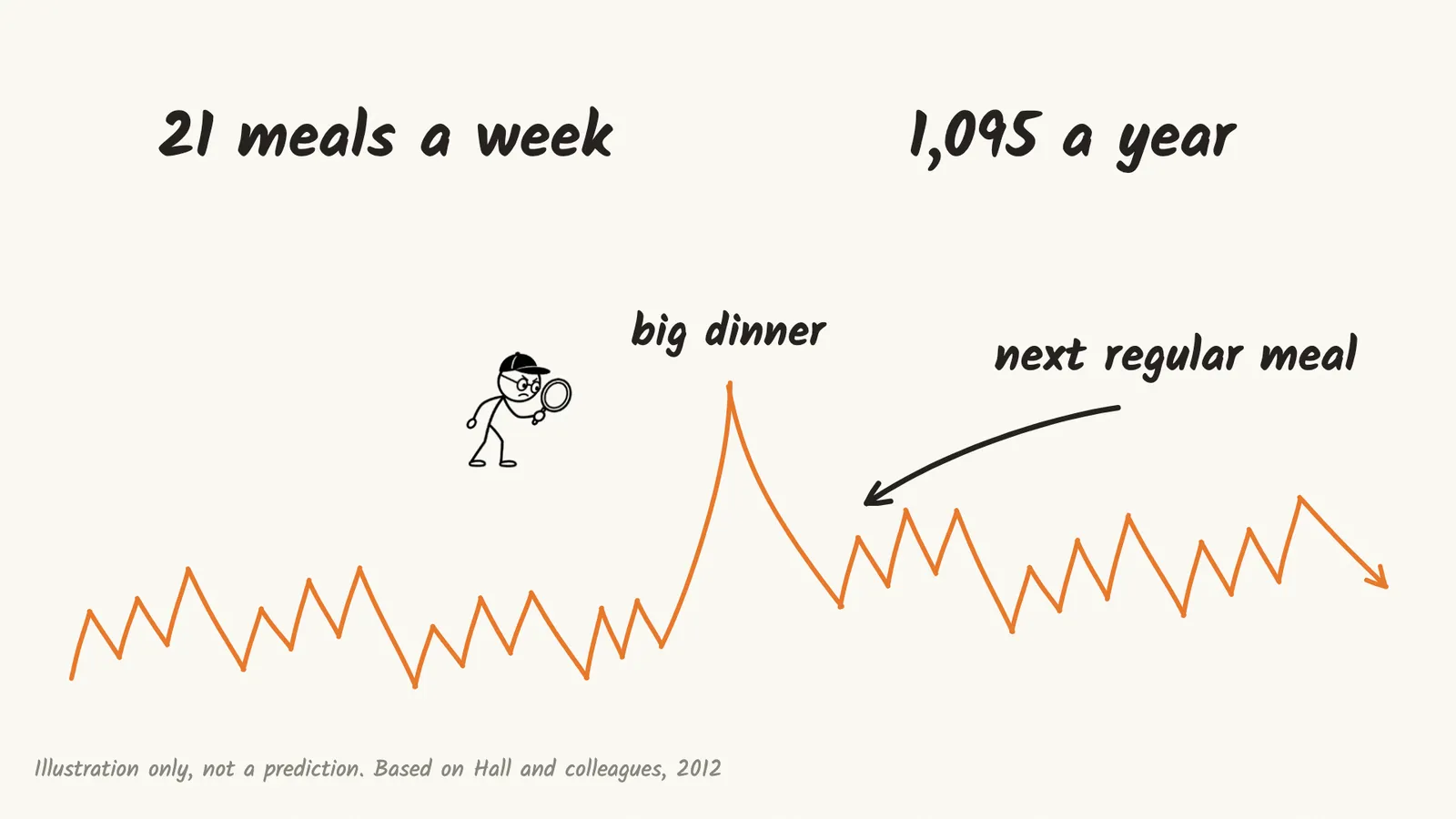
So after a big dinner, stored energy keeps climbing for a while after you've left the table, and higher than after an ordinary dinner, because more came in. Once the dinner is absorbed, it slopes down slowly until morning.
In the video we draw this as a line with no numbers, on purpose. It is a sketch of how stored energy moves, not a measurement of anyone. It doesn't show the dinner being cancelled overnight, and it can't tell you where your own stores will be when you wake up.
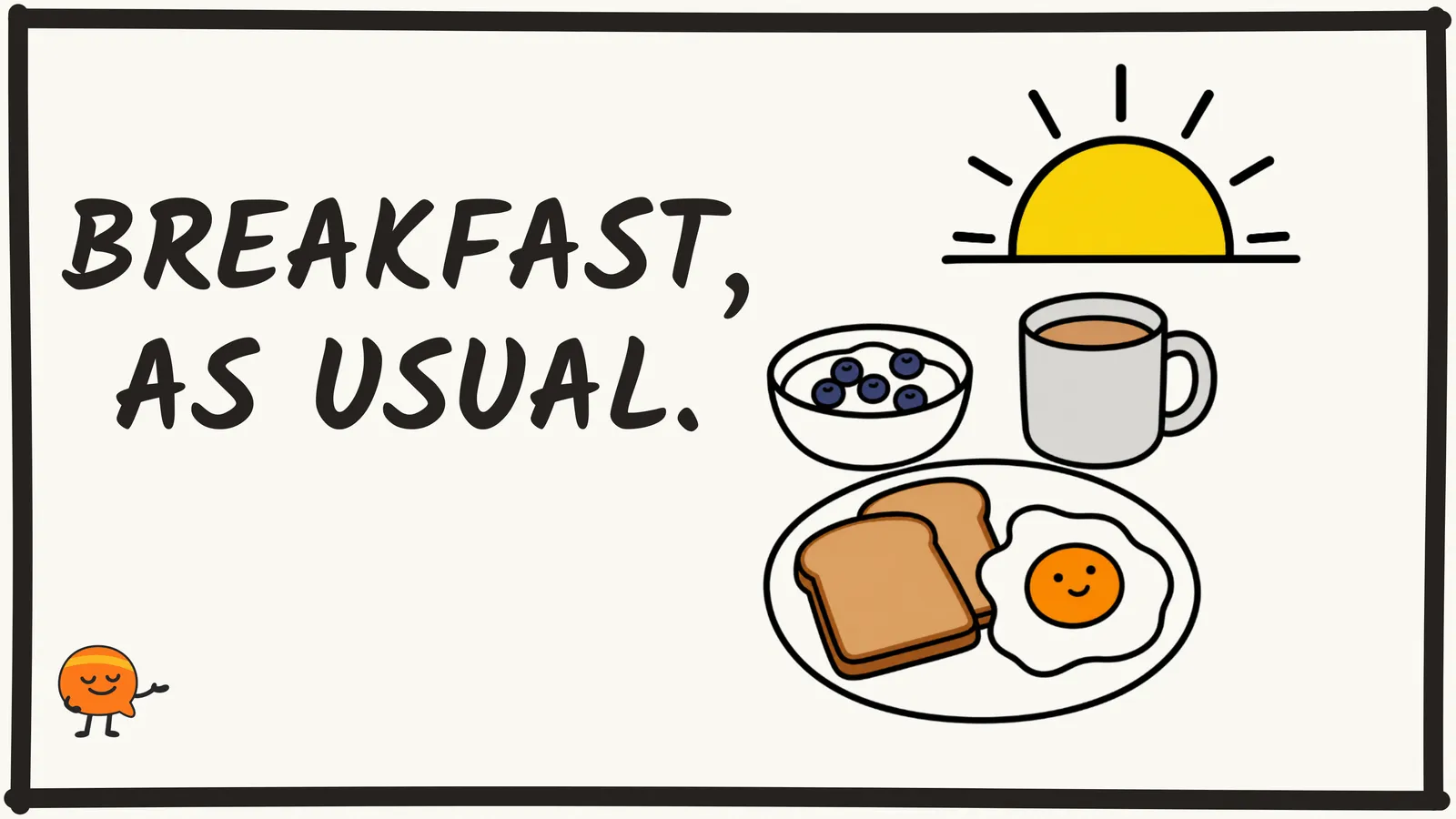
There is also no checkpoint. Your body doesn't need stored energy back where it started by midnight, or by breakfast. Hall and colleagues describe energy intake and expenditure matching only over longer periods; within a day, stored energy rises after meals and falls between them. Breakfast the next morning is not a correction to anything. It's breakfast: in the video, eggs on toast, a bowl of yoghurt and tea in the good mug.
Does a big dinner still count?
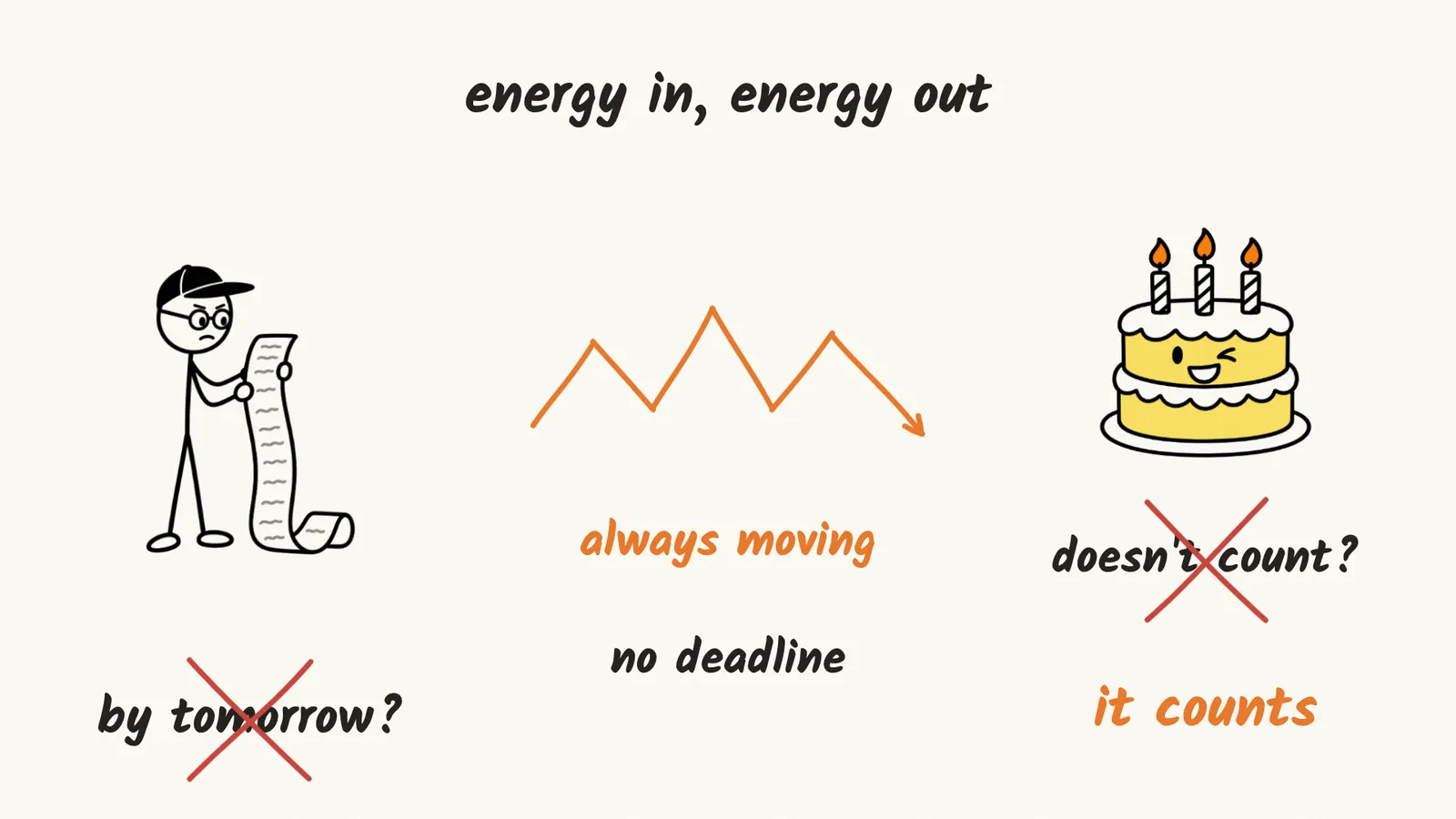
Yes. A big dinner adds energy, usually more than an ordinary meal. It counts, like every meal does, and pretending otherwise would be its own mistake.
Zoom out to a week and the line rises with every meal and slopes down in between. The birthday dinner makes the tallest rise. Over the next few days come the usual meals, including a few lunches made from the leftovers. Zoom out again, to a year, and there are other big dinners in it too: birthdays, holidays, long lunches with friends. Each one is followed by a morning, and by a breakfast.
That is the pattern worth seeing. Big dinners are an ordinary part of a year of eating, and so is breakfast the morning after.
Does being kind to yourself help?
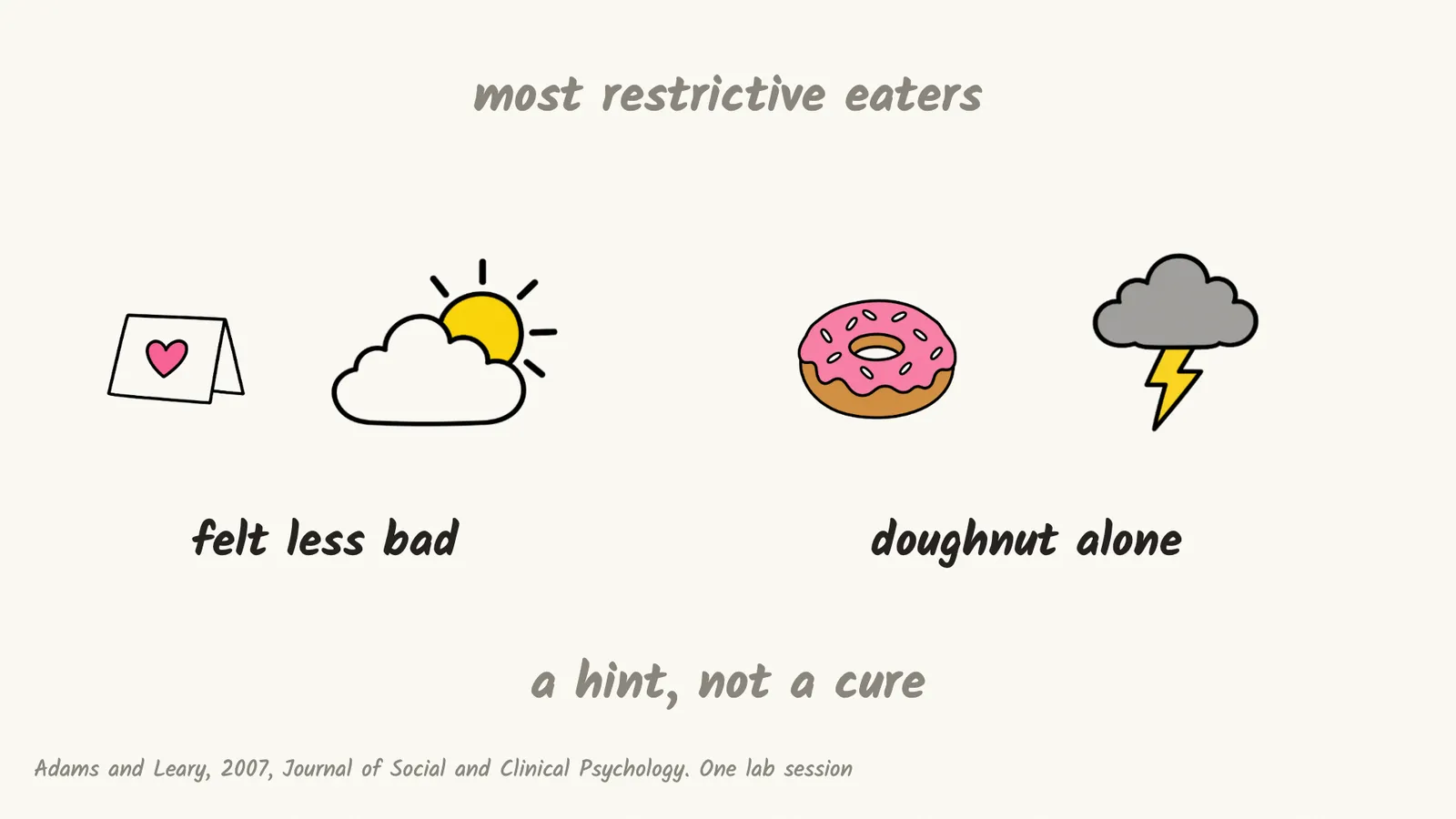
The morning after can come with a harsh inner voice, so one study is worth knowing about. In a 2007 study by Claire Adams and Mark Leary, 84 female undergraduate students took part, and some were asked to eat a doughnut. Some of the doughnut eaters then heard a short, kind message from the researcher, roughly: everyone eats like this sometimes, so don't be hard on yourself. Among women with high restrictive eating scores, those who heard it reported feeling less bad than those who only had the doughnut (Adams and Leary, 2007).
It was one laboratory session, and women diagnosed with or treated for an eating disorder in the past three years were excluded, so it is a hint, not a cure. Results for later candy eating were less clear, which is fine: kindness is not a technique for eating less. It is a gentler way to start the next day.
What this does not mean
- It does not mean a big dinner has no effect. It adds energy, like every meal.
- It does not mean the line in the video describes your body. It is a sketch with no numbers.
- It does not mean self-compassion is a way to eat less.
- It does not mean a big meal is a binge, or that distressing loss-of-control eating should be brushed off.
- It is general information, not medical or nutrition advice. For advice about your own health, talk to your doctor or an accredited dietitian.
Frequently Asked Questions
I ate a lot last night. Should I skip breakfast?
No need. Keep to your regular meals and snacks, or your treatment plan if you have one; Butterfly's advice for people living with an eating disorder says there's no need to compensate.
Does a big dinner still count?
Yes. It adds energy, usually more than an ordinary meal. Your body goes on digesting it for hours, then draws on stored energy overnight, and it doesn't need that energy back where it started by morning.
What if the morning after still feels hard?
You deserve support. A professional experienced in eating disorders can help, and the helplines are listed below.
If the morning after feels hard
If the morning after still feels hard, or eating often brings distress, a loss of control or pressure to compensate, you deserve support. A professional experienced in eating disorders can help.
- Australia: Butterfly National Helpline 1800 33 4673 (1800 ED HOPE), 8 am to midnight Australian Eastern time, seven days a week except national public holidays, or webchat at butterfly.org.au. Lifeline 13 11 14, 24 hours.
- United States: ANAD Helpline 1-888-375-7767, Monday to Friday, 9 am to 9 pm Central time, except listed holiday closures, including Thanksgiving and the day after; check ANAD's website. National Alliance for Eating Disorders 1-866-662-1235, weekdays 9 am to 7 pm Eastern time. 988 Suicide and Crisis Lifeline: call or text 988, 24 hours.
- In an emergency, call 000 in Australia or 911 in the US.
How we made this
Made by kcalm, the iPhone food-logging app from 14a0 Pty Ltd in Sydney, with an AI narration voice. Researched from the sources below and fact-checked by an AI model with web search; not reviewed by a dietitian. Checked 21 October 2026. Corrections are welcome at [email protected].
Sources
- Butterfly Foundation (2022). Tips for Easter while living with an eating disorder.
- Hall KD and colleagues (2012). Energy balance and its components: implications for body weight regulation. American Journal of Clinical Nutrition 95(4):989-994.
- National Institute of Diabetes and Digestive and Kidney Diseases. Your digestive system and how it works.
- National Eating Disorders Association. Disordered eating vs. eating disorders.
- Adams CE and Leary MR (2007). Promoting self-compassionate attitudes toward eating among restrictive and guilty eaters. Journal of Social and Clinical Psychology 26(10):1120-1144.
- Helplines: Butterfly National Helpline, Lifeline, ANAD Helpline, National Alliance for Eating Disorders, 988 Suicide and Crisis Lifeline.
Video transcript
The full narration of the video, with its chapter times. Watch it on YouTube (public from 27 October): Skip Breakfast After a Big Dinner? No Need
0:00 Should you skip breakfast after a big dinner?
At the door, the cook hands her sister the birthday leftovers in her best container, the one with the lid that still fits. She cooked for eight because six were coming, so there's still half a chicken on the board, and she had a big dinner herself. Running the roasting tin under the tap, she wonders: should she skip breakfast tomorrow? There's no need to skip breakfast after a big dinner: keep to your regular meals and snacks, or your treatment plan if you have one. In its Easter advice for people living with an eating disorder, Butterfly, Australia's eating-disorder charity, recommends keeping to usual meal routines and says there's no need to compensate. We think that advice matters more than anything a graph could show.
0:39 What happens to a big dinner overnight?
We drew one anyway. Lights off, the kitchen's closed, and her gut is on the late shift. It goes on digesting the dinner for hours, and her body uses some of what it absorbs straight away and stores the rest. So her stored energy keeps climbing for a while after she's left the table, and higher than after her usual dinner, because this one brought in more. We've drawn that as a line with no numbers on purpose: it's a sketch of how stored energy moves, not a measurement of her. Her heartbeat and breathing use energy all night, so once the dinner is absorbed, the line slopes down slowly until morning. At no point, at midnight or at breakfast, does her body need that line back where it started. In the morning, she has eggs on toast, a bowl of yoghurt, and tea in the good mug.
1:24 Does a big dinner still count?
Zoom out to her whole week, and the line rises with every meal and slopes down in between. The birthday dinner makes the tallest rise, so it gets the candle. It counts, like every meal does. Over the next few days, she has her regular meals, with chicken sandwiches until about Thursday. Zoom out again, to a year of her meals, and there are other big dinners in it too: a birthday here, a holiday there, and every time, a breakfast on the morning after.
1:52 Where can you get support?
If the morning after still feels hard, or eating often brings distress, a loss of control or pressure to compensate, you deserve support. Butterfly and the other helplines are on screen and in the description. The references for this video are there too, and in the article at kcalm.app. Over breakfast, her sister texts to ask if she can keep the container. That one might take a few more breakfasts.
Ready to track smarter?
Log a meal with a photo or a few words. kcalm estimates calories and nutrients, so you can review the foods, portions and daily totals in one place.