Why Do You Weigh Less in the Morning?
While you sleep, water leaves through your breath and skin and you are not drinking, so you can wake up lighter. Neither change shows how much fat changed.
kcalm editorial team
Prepared with AI assistance
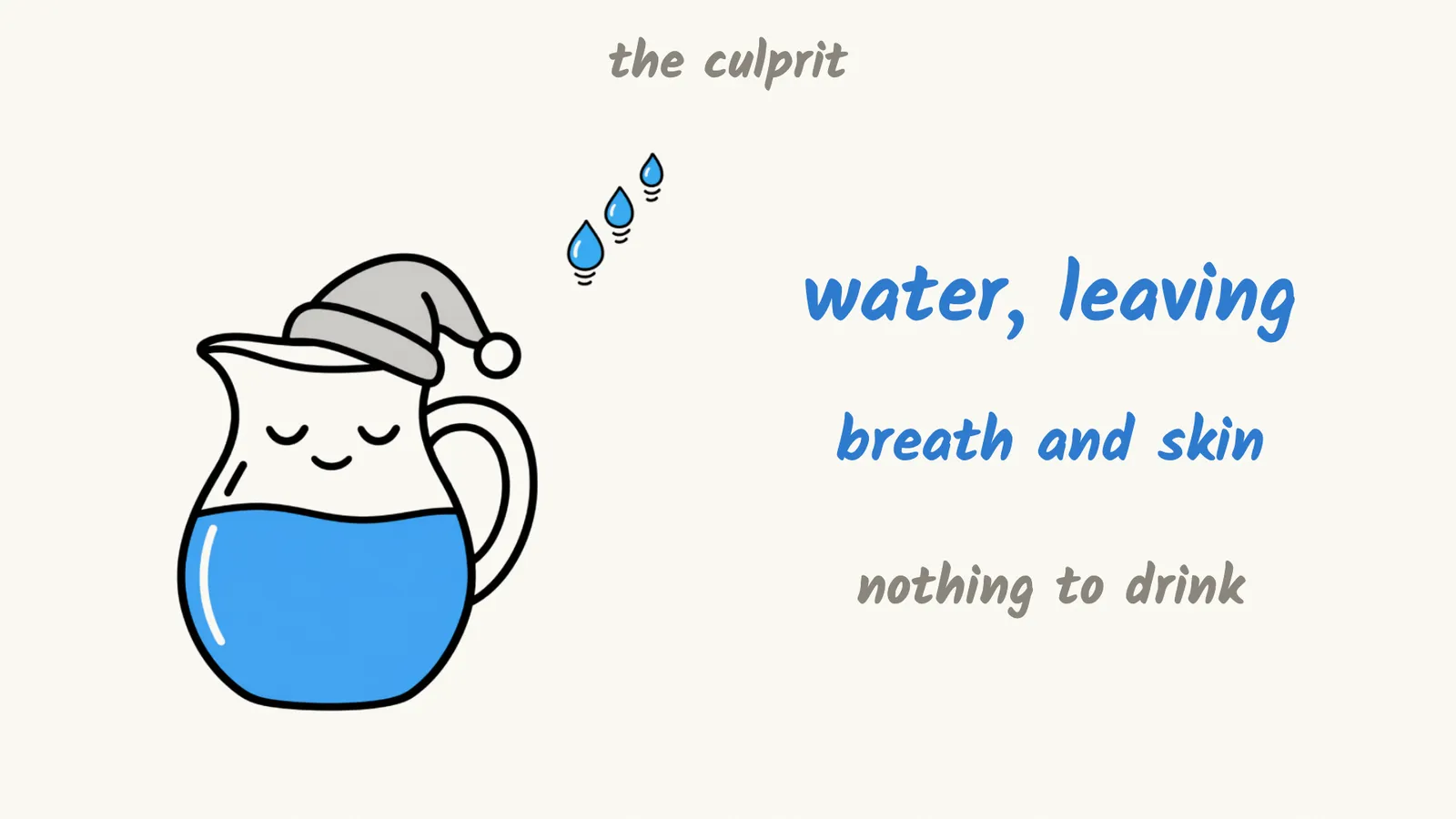
Why do you weigh less in the morning? While you sleep, water keeps leaving through your breath and skin and you aren't drinking, so you can wake up lighter; food and drink can add weight back during the day. Neither change tells you how much body fat changed.
Where does your weight go overnight?
Breathe on a cold window and a patch of fog appears. That fog is water from your breath: the cold glass turns some of the water vapour back into tiny droplets for a moment, and then they evaporate back into the room (USGS). Every breath out carries water the same way, and a resting adult takes roughly 12 to 20 breaths a minute (MedlinePlus), so a night adds up to thousands of them.
Your skin lets water out too. Some water passes through the skin all the time and evaporates as it goes, without any sweating, so there is usually nothing to feel. The Institute of Medicine's report on water treats breathing, this passive loss through the skin and secreted sweat as separate routes. For people who are not very active it puts breathing losses at about 250 to 350 millilitres a day, and it gives about 450 millilitres a day through the skin for the average adult. Together that is about 700 to 800 millilitres, roughly three quarters of a litre, before any sweat. On these estimates the skin lets out more water than the breath does, even though only the breath ever fogs a window.
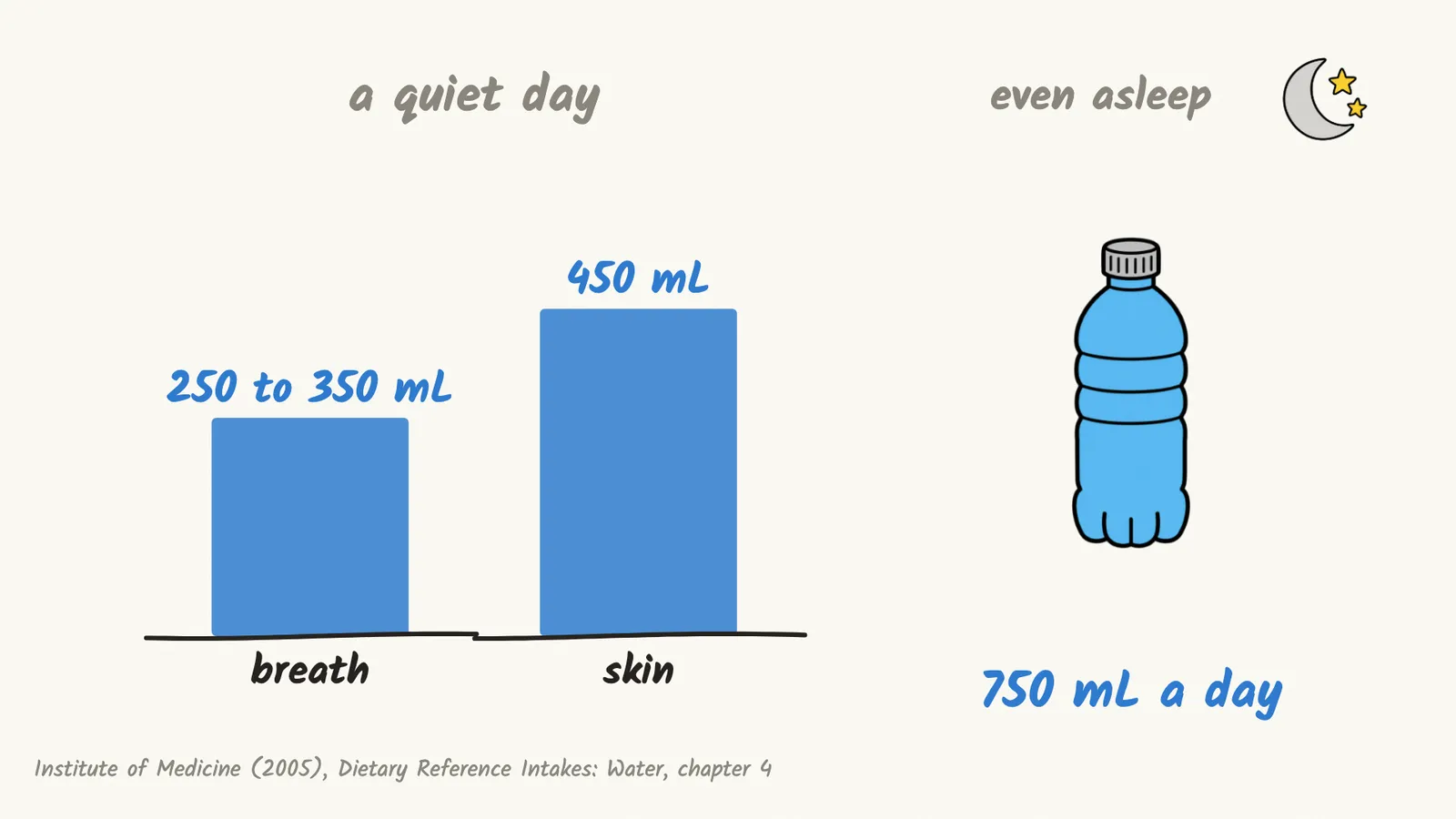
These are daily estimates. Actual losses depend on activity and conditions, and the report gives no amount for one night, so the figures cannot tell you how much left anyone during a particular night. What they do explain is the direction: while you sleep, water keeps leaving and you are not drinking anything to replace it.
The beads you sometimes find on a bedroom window in the morning are part of the same story. People breathing and their skin add moisture to the air of a closed room, and cold glass is where some of that moisture condenses (Australian Building Codes Board). The beads show that water left; they cannot show how much.
Why is your weight higher at night?
Food and drink add weight the moment you swallow them, and digestion doesn't make that weight vanish. As NIDDK explains, the body absorbs water and nutrients along the way and stores what is left until it leaves later. Absorbing food moves it from the gut into the rest of the body; it does not make it disappear. Going to the bathroom does remove some weight, as urine and stool leave the body.
So the evening total includes the day's food and drink: breakfast, lunch, a glass of water, dinner. Water also keeps leaving during the day, so there is no fixed evening rise either. The total simply holds whatever has come in and not yet gone out.
Why can the total shift from day to day?
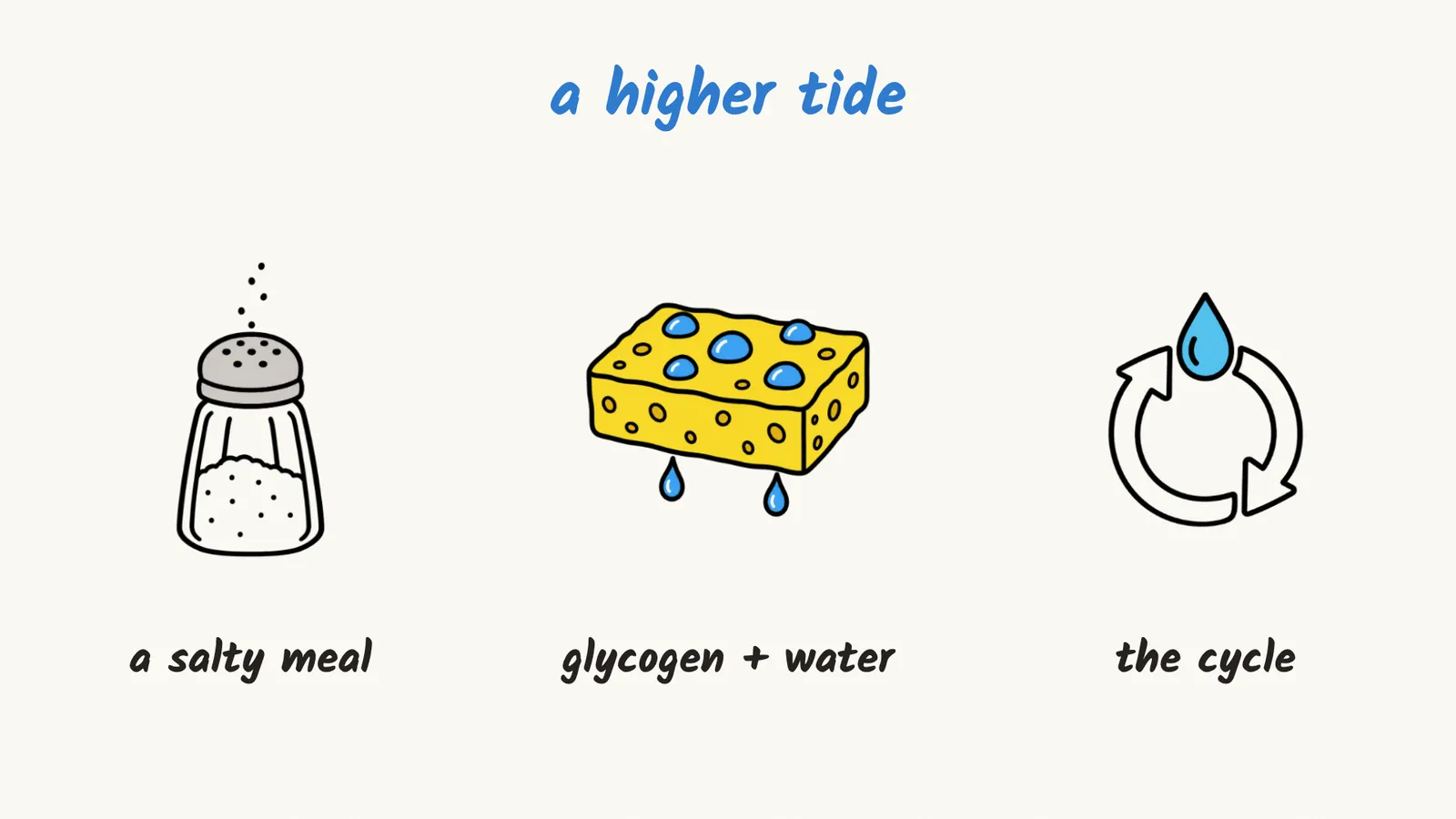
How much water a body holds can shift from day to day. Your kidneys keep adjusting how much water you keep; the Institute of Medicine notes that urine output varies with the salt and water load, so a saltier meal can change that balance for a while. How much, and for how long, differs from person to person.
The menstrual cycle can matter too. In a year-long study of 62 women across 765 cycles, White and colleagues found that self-reported fluid retention peaked, on average, on the first day of the period. That was diary-reported bloating, not measured water, and an average; individual patterns differ. A 2023 study by Kanellakis and colleagues of 42 young women, which estimated body water with bioimpedance over one cycle, found more extracellular water on the first day of menstruation than roughly a week later. Those are group averages, and individual patterns differ.
Is an overnight weight change fat?
The body uses stored fuel through the night, and body fat can change within a day too. But water and food are changing at the same time, so a change in the total cannot tell you how much of it was fat. Body weight is one total of water, food on its way through, bone, muscle, body fat and everything else, and it does not come with a breakdown. Models of how body weight responds to energy balance, such as Hall and colleagues (2011), treat fat, lean tissue and water as different parts with different dynamics, which is why a single reading cannot separate them.
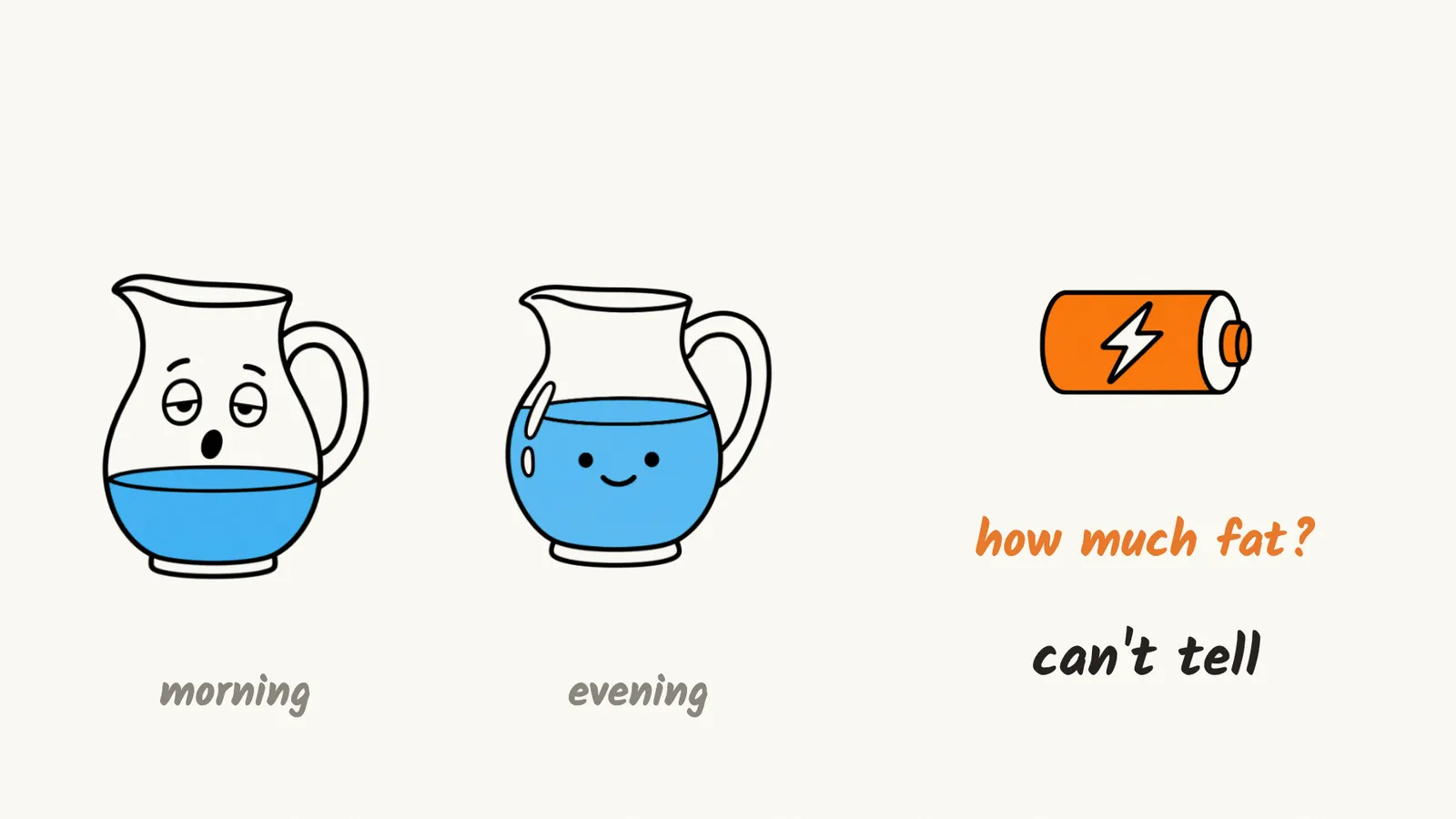
A lower morning number isn't a prize, and none of this is a reason to check more often or to change your next meal. If a care team has given you a plan, theirs comes first.
When does swelling need medical help?
Held water can show up as swelling, and swelling sometimes needs medical help. Get urgent medical help for swelling that is sudden, severe or painful, or for swelling in one leg with no clear reason. Swelling with breathing trouble or chest pain needs emergency help: call 000 in Australia or 911 in the US (NHS).
What this does not mean
- It does not mean fat cannot change within a day. One total just cannot isolate it.
- It does not give an amount for one night. The water figures above are daily estimates, and they depend on activity and conditions.
- It does not give a "normal" range. Studies that tracked day-to-day changes looked at specific groups, such as active men exercising in the heat or one man followed for decades, so they cannot set a range for anyone else.
- It is not a reason to check more often, or to change what you eat or drink, how much salt you use, or how much you sweat. These mechanisms are explanations, not levers.
- It does not mean every change is harmless water. Swelling that is sudden, severe, painful or in one leg needs medical help, as above.
Frequently Asked Questions
Why do I weigh less in the morning?
While you sleep, water keeps leaving through your breath and skin and you are not eating or drinking, which helps explain why you can wake up lighter. That change does not tell you how much body fat changed.
Why is my weight higher at night?
Food and drink add weight when you swallow them, and digestion does not make that mass vanish: absorbed water and nutrients move into the rest of the body and the rest leaves later. So the evening total includes the day's meals and drinks.
How much water do you lose through breathing and skin?
The Institute of Medicine gives about 250 to 350 millilitres a day through breathing for people who are not very active, and about 450 millilitres a day through the skin for the average adult, not counting sweat. These are daily estimates; actual losses depend on activity and conditions.
Can you gain body fat overnight?
Body fat can change within a day, but water and food are changing at the same time, so a change in the total alone cannot tell you how much was fat.
When does swelling need medical help?
Swelling that is sudden, severe or painful, or in one leg for no clear reason, needs urgent medical help; with breathing trouble or chest pain, it needs emergency help: call 000 in Australia or 911 in the US. If a care team has given you a plan, theirs comes first.
Free support
If thoughts about food, eating or weight feel distressing, free support is available. In Australia, the Butterfly National Helpline is 1800 33 4673 (1800 ED HOPE); it is not an emergency service. In the US, the ANAD Helpline is 1-888-375-7767; check its website for current hours. In a crisis, call 000 or Lifeline on 13 11 14 in Australia, or call or text 988 in the US (988 Suicide and Crisis Lifeline).
How we made this
This article and its video were made by kcalm, the team behind the kcalm food-logging app. The app can't tell you why your weight changed overnight, and nothing here is a reason to use it. The video is narrated by an AI voice. The research was drafted with an AI research assistant from the sources below and fact-checked by a second AI model; no dietitian or doctor has reviewed it. It is general information, not medical or nutrition advice. Published October 2026. Spotted a mistake? Tell us at [email protected].
Sources
- Institute of Medicine (2005). Dietary Reference Intakes for Water, Potassium, Sodium, Chloride, and Sulfate, chapter 4: Water. https://www.nationalacademies.org/read/10925/chapter/6
- Australian Building Codes Board (2023). Condensation in buildings handbook. https://www.abcb.gov.au/sites/default/files/resources/2023/Condensation-in-buildings-handbook.pdf
- USGS Water Science School. Condensation and the Water Cycle. https://www.usgs.gov/water-science-school/science/condensation-and-water-cycle
- MedlinePlus. Rapid shallow breathing (normal resting breathing rate). https://medlineplus.gov/ency/article/007198.htm
- NIDDK. Your Digestive System and How It Works. https://www.niddk.nih.gov/health-information/digestive-diseases/digestive-system-how-it-works
- White CP et al. (2011). Fluid Retention over the Menstrual Cycle: 1-Year Data from the Prospective Ovulation Cohort. Obstetrics and Gynecology International. https://pubmed.ncbi.nlm.nih.gov/21845193/
- Kanellakis S et al. (2023). Changes in body weight and body composition during the menstrual cycle. American Journal of Human Biology. https://pubmed.ncbi.nlm.nih.gov/37395124/
- Hall KD et al. (2011). Quantification of the effect of energy imbalance on bodyweight. The Lancet. CDC record: https://stacks.cdc.gov/view/cdc/33652
- NHS. Swollen ankles, feet and legs (oedema). https://www.nhs.uk/conditions/oedema/
- Cheuvront SN et al. (2004). Daily body mass variability and stability in active men undergoing exercise-heat stress. International Journal of Sport Nutrition and Exercise Metabolism. https://pubmed.ncbi.nlm.nih.gov/15673099/
- Schneditz D et al. (2023). Day-to-day variability in euvolemic body mass. Renal Failure. https://pubmed.ncbi.nlm.nih.gov/37955103/
Video transcript
The full narration of the video, with its chapter times. Watch it on YouTube (public from 29 October): Why Do You Weigh Less in the Morning?
0:00 Why do you weigh less in the morning?
Before bed, the cook leans close to the cold bedroom window and breathes on the glass, purely for science. A little cloud of fog blooms where her breath lands, then shrinks from the edges until the glass is clear. That fog was water from her breath, caught by the cold glass for a moment before it evaporated back into the room. Lights out. She won't eat or drink another thing until morning, and she can still wake up lighter than she went to bed. What could possibly leave someone who's sound asleep?
0:30 Where does your weight go overnight?
Start with the one thing she does all night without trying: breathing. Every breath out carries water, just like the fog, and she'll let out thousands of them before it gets light. Her skin is in on it too. Water passes out through it all night and evaporates before there's anything to feel. No sweat required. For an adult who isn't very active, the daily estimates for breath and skin add up to about three quarters of a litre, sweat not included. Those are figures for a whole day, though, so they can't say how much left her tonight. We'd give the skin more of the credit. On these estimates it lets out more water than the breath does, and it gets no patch of fog to show for it. By the small hours, the corners of the window have started to mist over. You can weigh less in the morning because water keeps leaving through your breath and skin while you sleep, and you aren't drinking anything to replace it.
1:20 Why is your weight higher at night?
When she gets up, the glass is beaded with water. All night, her breath and skin added moisture to the air in the room, and the cold glass caught some of it. Her first trip to the bathroom takes some weight with it as well. We'll leave that door closed. Then the kettle goes on. Coffee and toast add weight the moment she swallows them, and digestion doesn't make that weight vanish. Lunch, a glass of water, dinner: the evening total includes the day's food and drink. How much water a body holds can shift from day to day, too, after a salty meal, say, or with the menstrual cycle, by amounts that differ from person to person. Held water can show up as swelling, and swelling sometimes needs medical help. Swelling that's sudden, severe or painful, or in one leg for no clear reason, needs urgent medical help, and with breathing trouble or chest pain, emergency help.
2:10 Is an overnight weight change fat?
Her body used stored fuel through the night, and body fat can change within a day too. But water and food change at the same time, so a change in the total can't tell you how much of it was fat. It's one number, and it doesn't come with a breakdown. A lower morning number isn't a prize, and we don't think any of this is a reason to check more often or to change your next meal. Her lunch goes ahead as usual. If a care team has given you a plan, theirs comes first. And if thoughts about food or weight are distressing right now, free support lines are in the description. Every source for this video is at kcalm.app.
Ready to track smarter?
Log a meal with a photo or a few words. kcalm estimates calories and nutrients, so you can review the foods, portions and daily totals in one place.