Standing Desk Calories: The Real Number Is 9 Per Hour
Standing at your desk burns about 9 extra kcal (38 kJ) per hour compared with sitting — 0.15 kcal per minute for a 65 kg adult, per a meta-analysis of 46 studies and 1,184 participants — roughly one-sixth of the 30-to-50 kcal figure desk vendors advertise. Replacing six hours of sitting with standing adds about 54 kcal a day, while one easy 30-minute lunchtime walk adds roughly the same as standing all afternoon. Where the vendor number goes wrong, the measured MET table for desk tasks, why standing occupations really do double occupational burn, and how to handle standing time in your calorie log.

Dr. Maya Patel
Registered Dietitian, M.S. Nutrition Science

Standing at your desk burns about 9 extra kcal (38 kJ) per hour compared with sitting — 0.15 kcal per minute for a 65 kg (143 lb) adult, according to a Mayo Clinic-led meta-analysis of 46 studies and 1,184 participants. That is roughly one-sixth of the 30-to-50 kcal per hour that desk vendors advertise. Standing for six hours adds about 54 kcal (226 kJ) to your day — less than half a medium apple — while a single easy 30-minute lunchtime walk adds roughly the same as standing all afternoon [1][2][3].
Sit-stand desks are sold on two promises: your back will thank you, and the calories will quietly take care of themselves. The first promise is between you and your physiotherapist. The second one has been measured — repeatedly, with indirect calorimetry, across dozens of laboratory studies — and the measured number is an order of magnitude smaller than the marketing number. This post works through the real arithmetic in kcal and kilojoules: what standing actually adds, where the inflated vendor figures come from, and what a desk worker who cares about energy balance may want to do instead. It continues a theme from our looks at why activity multipliers overestimate desk workers and what MET values really say about calorie burn: the numbers attached to everyday movement are usually gentler than the ones in the ads.
How many calories does standing burn compared to sitting?
As of September 2026, the best-measured difference between sitting and standing is 0.15 kcal per minute — about 9 kcal (38 kJ) per hour for a 65 kg adult — from a systematic review and meta-analysis of 46 studies covering 1,184 participants [1].
The meta-analysis, led by researchers at the Mayo Clinic and published in the European Journal of Preventive Cardiology, pooled every study that had measured energy expenditure in both postures. The mean difference came out at 0.15 kcal per minute, with a tight 95 percent confidence interval of 0.12 to 0.17 [1]. The gap was larger in men (0.19 kcal per minute) than in women (0.10 kcal per minute), which the authors attribute to greater muscle mass doing the postural work [1].
Because the difference scales with body size, your number moves with your weight:
| Body weight | Extra burn standing, per hour | Per 8-hour standing day |
|---|---|---|
| 60 kg (132 lb) | ~8 kcal (35 kJ) | ~66 kcal (276 kJ) |
| 65 kg (143 lb) | ~9 kcal (38 kJ) | ~72 kcal (301 kJ) |
| 70 kg (154 lb) | ~10 kcal (41 kJ) | ~78 kcal (326 kJ) |
| 80 kg (176 lb) | ~11 kcal (46 kJ) | ~89 kcal (372 kJ) |
| 90 kg (198 lb) | ~12 kcal (52 kJ) | ~100 kcal (418 kJ) |
| 100 kg (220 lb) | ~14 kcal (58 kJ) | ~111 kcal (464 kJ) |
Where does the 50 calories an hour claim come from?
The 30-to-50 kcal figure comes from calculators that assign standing a 1.8 MET value against 1.3 for sitting and multiply the 0.5-MET gap across your body weight; direct laboratory measurement puts quiet standing at 1.59 METs against 1.45 for seated typing — a real gap of about 10 kcal per hour at 70 kg [2][3].
MET tables are the engine behind almost every online calorie calculator, including the ones on desk-vendor sites. A MET is a multiple of resting metabolic rate, and the conversion is simple: kcal = MET × body weight in kg × minutes ÷ 60 [3]. Feed in standing at 1.8 METs versus sitting at 1.3, and a 100 kg user gets exactly 50 extra kcal an hour — the number that ends up in the headline.
The problem is what those catalogue values describe. The standing entries near 1.8 METs reflect standing tasks with movement — filing, tidying, fidgeting between positions — not holding still at a keyboard. When a 2015 study in BMC Public Health measured 51 adults doing actual desk activities with indirect calorimetry, the postures nearly converged [2]:
| Desk task, measured | METs | kcal per hour at 70 kg | kJ per hour |
|---|---|---|---|
| Sitting, watching TV | 1.33 | ~93 | ~389 |
| Sitting, typing | 1.45 | ~102 | ~427 |
| Standing still | 1.59 | ~111 | ~464 |
| Walking at 2.6 km/h (treadmill-desk pace) | 3.22 | ~225 | ~941 |
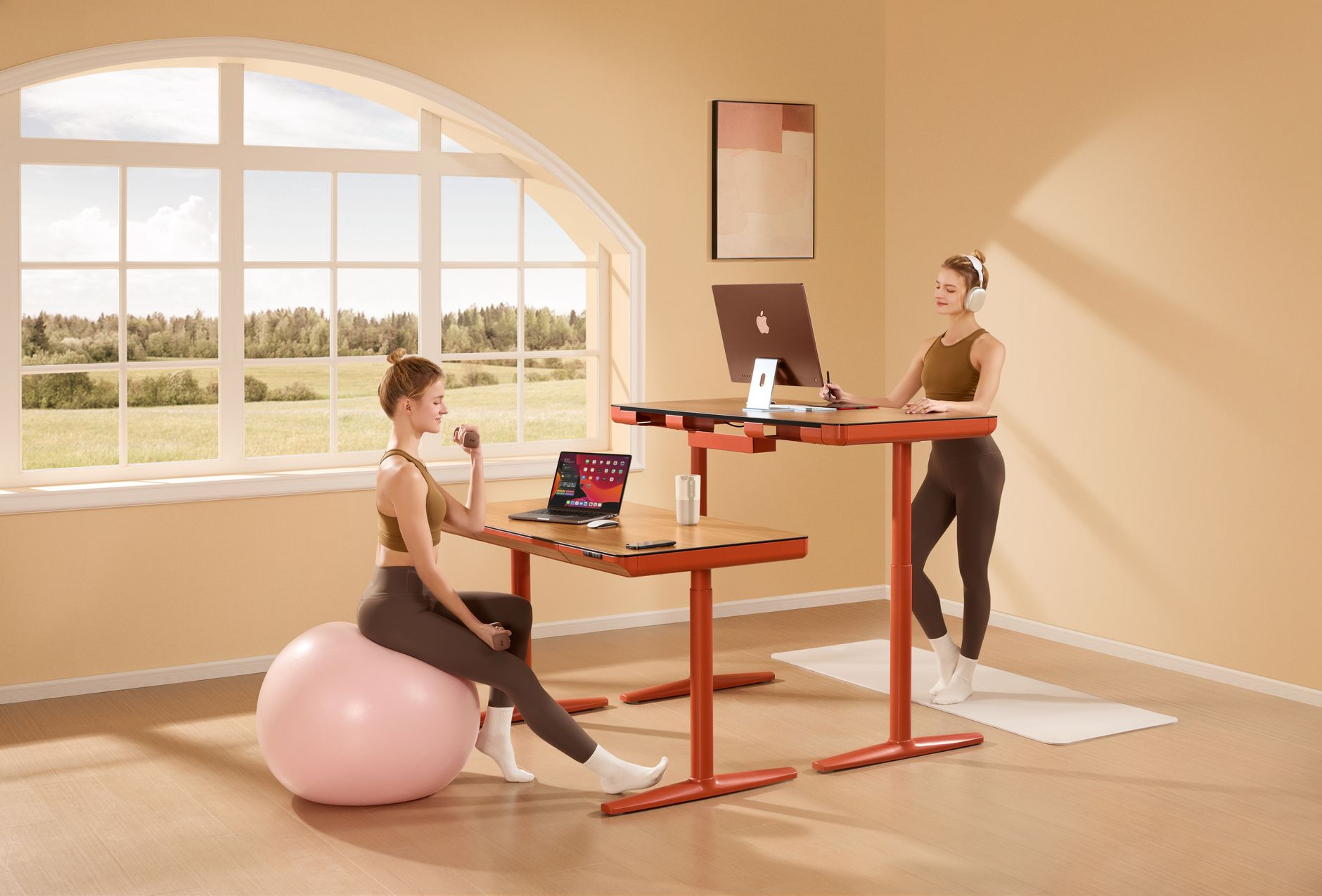
Does a standing desk help you lose weight?
A standing desk alone produces a small, slow effect: replacing six hours of sitting with standing adds about 54 kcal (226 kJ) a day for a 65 kg adult, which extrapolates to the energy content of roughly 2.5 kg of body fat over a full year — if food intake stays constant [1][5].
That extrapolation comes straight from the meta-analysis authors, and both halves of it deserve a look. The daily number is real but tiny: 54 kcal is about two squares of chocolate, and it sits comfortably inside the day-to-day noise of food logging. The yearly number — about 2.5 kg of fat mass, or the 5.5 lb figure Harvard Health quotes for the same scenario [1][5] — only materialises if you stand for six hours every single workday and your appetite does not quietly compensate. Research on energy balance suggests intake tends to drift up alongside expenditure, and a 54 kcal margin is erased by one absent-minded biscuit.
None of that makes the desk pointless. Harvard Health notes that in older adults, sitting fewer than three hours a day was associated with a 33 percent lower risk of cardiovascular mortality compared with sitting more than seven [5]. Less sitting appears genuinely good for you — the honest framing is that the benefit arrives through cardiovascular and metabolic channels, not through the calorie line of your log. And if midlife weight change is the worry, the drivers are intake and daily movement, not a slowing metabolism — the doubly-labelled-water data in our post on whether metabolism slows with age is clear on that.
Is a walking break better than a standing desk for burning calories?
One easy 30-minute lunchtime walk burns about 47 extra kcal (198 kJ) for a 70 kg adult — the same as standing at your desk for five to six hours — because slow walking runs at 2.8 METs while working postures sit between 1.45 and 1.59 [2][3].
The 2024 Adult Compendium of Physical Activities assigns walking at 3.2 to 3.9 km/h — a genuinely easy amble — a value of 2.8 METs, roughly double quiet standing [3]. Movement, not posture, is what separates the sedentary band (1.0 to 1.5 METs) from light activity (1.6 to 2.9 METs) in the Compendium's own classification [3]. Here is a 70 kg desk worker's day, expressed as extra energy versus sitting the whole time:
| Strategy, 8-hour workday | Extra kcal | Extra kJ |
|---|---|---|
| Stand 2 hours | ~19 | ~81 |
| Stand 4 hours | ~39 | ~163 |
| Stand 6 hours | ~58 | ~243 |
| One 30-minute easy walk (2.8 METs) | ~47 | ~198 |
| 30 minutes at treadmill-desk pace (3.22 METs, measured) | ~62 | ~259 |
| Stand 4 hours + one 30-minute walk | ~86 | ~361 |

Why do standing jobs burn so much more than standing desks?
Occupations spent mainly on your feet can roughly double occupational energy expenditure — up to about 1,400 kcal a day against a ceiling near 700 kcal for seated work — because standing jobs involve near-constant walking, lifting, and shifting between positions, not motionless standing at a fixed desk [4].
This is the paradox that keeps the standing-desk myth alive. The NIH-hosted Endotext chapter on non-exercise activity thermogenesis (NEAT) reports that predominantly seated occupations cap out around 700 kcal a day of occupational NEAT, while comparable workers in mainly standing roles reach up to 1,400 kcal, and agricultural work runs to 2,000 kcal or more [4]. Between two adults of similar size and age, total NEAT can differ by as much as 2,000 kcal a day [4].
A retail worker and a desk worker with a sit-stand desk are both "standing," but only one of them is walking the floor, restocking shelves, and pacing between tasks for eight hours. The energy difference lives in the movement — the thousands of steps and posture changes — not in the upright posture itself [2][4]. Buying a standing desk purchases the posture; it does not purchase the movement. That distinction is also why generic activity multipliers routinely overestimate desk workers, a problem we unpacked in the activity multiplier reality check.
How do you log standing time in a calorie tracker?
The most accurate log entry for desk standing is zero: at roughly 9 kcal an hour, even a long standing session sits inside the noise of food-label tolerances and portion estimates, so logging it as exercise mostly licenses snacks the burn cannot cover [1].
A workable protocol for a sit-stand desk owner:
- Leave standing time out of your exercise log. An entry worth 9 to 14 kcal an hour is smaller than the rounding error on a single sandwich, and counting it as a workout invites compensatory eating that swamps it many times over.
- Keep your activity setting honest. If your tracker asks for an activity level, a desk job with a standing desk is still sedentary-to-light. Standing does not move you up a multiplier band — walking does [3][4].
- Bank walking instead. Two 15-minute walk breaks add more energy expenditure than six hours of standing, and they come with step counts your watch can actually verify [2][3].
- Judge results by your weight trend, not the burn estimate. Two to four weeks of logged intake against the scale tells you your real energy balance — the method from our guide to finding your real TDEE from your food log.
- Keep the desk for the reasons that hold up. Less sitting tracks with better cardiovascular outcomes in the research [5]; comfort and focus are worth having even at 9 kcal an hour.
Frequently Asked Questions
How many calories does standing burn per hour?
For a 65 kg (143 lb) adult, standing burns about 9 kcal (38 kJ) more per hour than sitting — 0.15 kcal per minute, per a meta-analysis of 46 studies with 1,184 participants [1]. Total burn while standing still is around 100 to 130 kcal per hour depending on body weight; the figure people care about is the extra over sitting, and that extra is small.
Do standing desks count as exercise?
No — quiet standing measures 1.59 METs, which sits in the light-activity band only barely above the 1.5 MET sedentary threshold [2][3]. Exercise-level energy expenditure starts around 3 METs, roughly where slow-to-moderate walking lands. A standing desk changes your posture, not your activity level.
Is standing for eight hours a day good for weight loss?
A full eight-hour standing day adds roughly 70 to 110 kcal (300 to 460 kJ) depending on your weight — helpful at the margin, but one flat white with whole milk cancels most of it. Research suggests the stronger benefits of less sitting are cardiovascular and metabolic rather than weight-related [1][5], and prolonged static standing brings its own comfort trade-offs, so many people find alternating postures more sustainable.
Why does my smartwatch credit more than 9 kcal an hour for standing?
Most devices and calculators use catalogue MET values, where standing entries near 1.8 METs describe standing tasks with movement — tidying, filing, shifting about — rather than holding still at a keyboard [3]. Measured with indirect calorimetry, working postures converge: seated typing is 1.45 METs and standing still is 1.59, a gap of about 10 kcal per hour at 70 kg [2].
Do men burn more extra calories standing than women?
Yes — in the meta-analysis, the sitting-to-standing difference averaged 0.19 kcal per minute in men versus 0.10 in women, roughly a twofold gap the authors attribute to greater muscle mass performing the postural work [1]. Heavier bodies of either sex also burn more, since the difference scales with the mass being held upright.
Is a treadmill desk better than a standing desk for calories?
For energy expenditure, clearly: walking at even 2.6 km/h measured 3.22 METs against 1.59 for standing still — roughly 115 extra kcal (480 kJ) per hour at 70 kg, versus about 10 for standing [2]. A treadmill desk delivers in one hour what a standing desk delivers in a fortnight of afternoons, though typing accuracy and meeting etiquette are separate negotiations.
Sources
- Saeidifard F, Medina-Inojosa JR, Supervia M, et al. Differences of energy expenditure while sitting versus standing: A systematic review and meta-analysis. European Journal of Preventive Cardiology, 2018. https://europepmc.org/article/MED/29385357
- Mansoubi M, Pearson N, Clemes SA, et al. Energy expenditure during common sitting and standing tasks: examining the 1.5 MET definition of sedentary behaviour. BMC Public Health, 2015. https://pmc.ncbi.nlm.nih.gov/articles/PMC4448542/
- Herrmann SD, Willis EA, Ainsworth BE. Promoting public health through the 2024 Compendium of Physical Activities. Journal of Sport and Health Science, 2024. https://pmc.ncbi.nlm.nih.gov/articles/PMC11336313/
- von Loeffelholz C, Birkenfeld AL. Non-Exercise Activity Thermogenesis in Human Energy Homeostasis. Endotext, NCBI Bookshelf. https://www.ncbi.nlm.nih.gov/books/NBK279077/
- Harvard Health Publishing. Standing vs. sitting: Fewer pounds, less heart disease? https://www.health.harvard.edu/heart-health/standing-vs-sitting-fewer-pounds-less-heart-disease
Ready to track smarter?
Join thousands who use kcalm for calorie tracking. AI-powered food recognition, scientifically-validated calculations, and zero anxiety.
Related Articles
How Many Calories Does an Ice Bath Burn? The Real Math
A typical 10-to-15-minute ice bath burns roughly 20 to 80 extra kcal (85 to 335 kJ) — less than a single banana, and an order of magnitude below the 250 to 500 kcal that plunge marketing claims. The measured literature is consistent: an 18 degree cooling suit raised energy expenditure by 250 kcal across three full hours, the 88-minute world-record ice immersion roughly doubled heat production from 169 to 321 watts, and a meta-analysis of 10 randomised trials put mild cold exposure at 188 extra kcal per day. Even six weeks of two-hours-daily cold acclimation lifted cold-induced thermogenesis to only 289 kcal a day. Real physiology, trivial energy cost — the protocol-by-protocol table, the shivering math behind the vendor claims, and how to log a plunge honestly.
ScienceCan You Only Absorb 30g of Protein Per Meal? The Data
The claim that your body can only absorb 30 g of protein per meal fails on both halves. Your gut absorbs virtually all the protein you eat — the real question is how much your muscle uses — and the best-measured feeding study to date answered it: 100 g of milk protein kept muscle protein synthesis elevated for more than 12 hours, beating a 25 g dose by roughly 40 percent in the 4-to-12-hour window, with almost none of the extra oxidised away. Where the 30 g figure came from, what the dose-response trials from 20 g to 100 g actually show, the per-meal targets by body weight, and what it all means for how you log protein.
ScienceSwimming Calorie Calculator: Stroke, Pace, and Watch Math
Swimming burns roughly 340 to 970 kcal (1,420 to 4,060 kJ) per hour for a 70 kg adult, and the spread is set by stroke and pace: the 2024 Adult Compendium of Physical Activities puts recreational backstroke at 4.8 METs, slow freestyle at 5.8, medium-pace crawl at 8.0, and butterfly at 13.8 — while your watch struggles to see any of it. In the key validation study, a wrist device that read heart rate within 4 percent on land drifted to a 30 percent mean error in the pool, its correlation with a chest strap collapsing from 0.95 to 0.26. The stroke-by-stroke MET tables in kcal and kJ, the pace math from elite-swimmer energy-cost data, why optical sensors fail in water, and a five-step way to log a swim your weight trend can verify.