Rucking Calorie Calculator: The Load-Carriage Math 2026
Rucking burns 10 to 40 percent more calories than unloaded walking at the same pace, not the 2 to 3 times rucking sites claim. The Pandolf load-carriage equation — built by US Army researchers in 1977 and still the reference model — puts a 70 kg walker at 250 kcal (1,050 kJ) per hour on flat pavement and 291 kcal (1,220 kJ) with a 15 kg ruck. Add a 5 percent grade and the same hour costs 461 kcal; loose sand multiplies the pace term by 2.1. The full load, body-weight, terrain, and grade tables in kcal and kJ, the equation itself, why your watch cannot see the weight on your back, and how to log a ruck honestly.
kcalm editorial team
Prepared with AI assistance
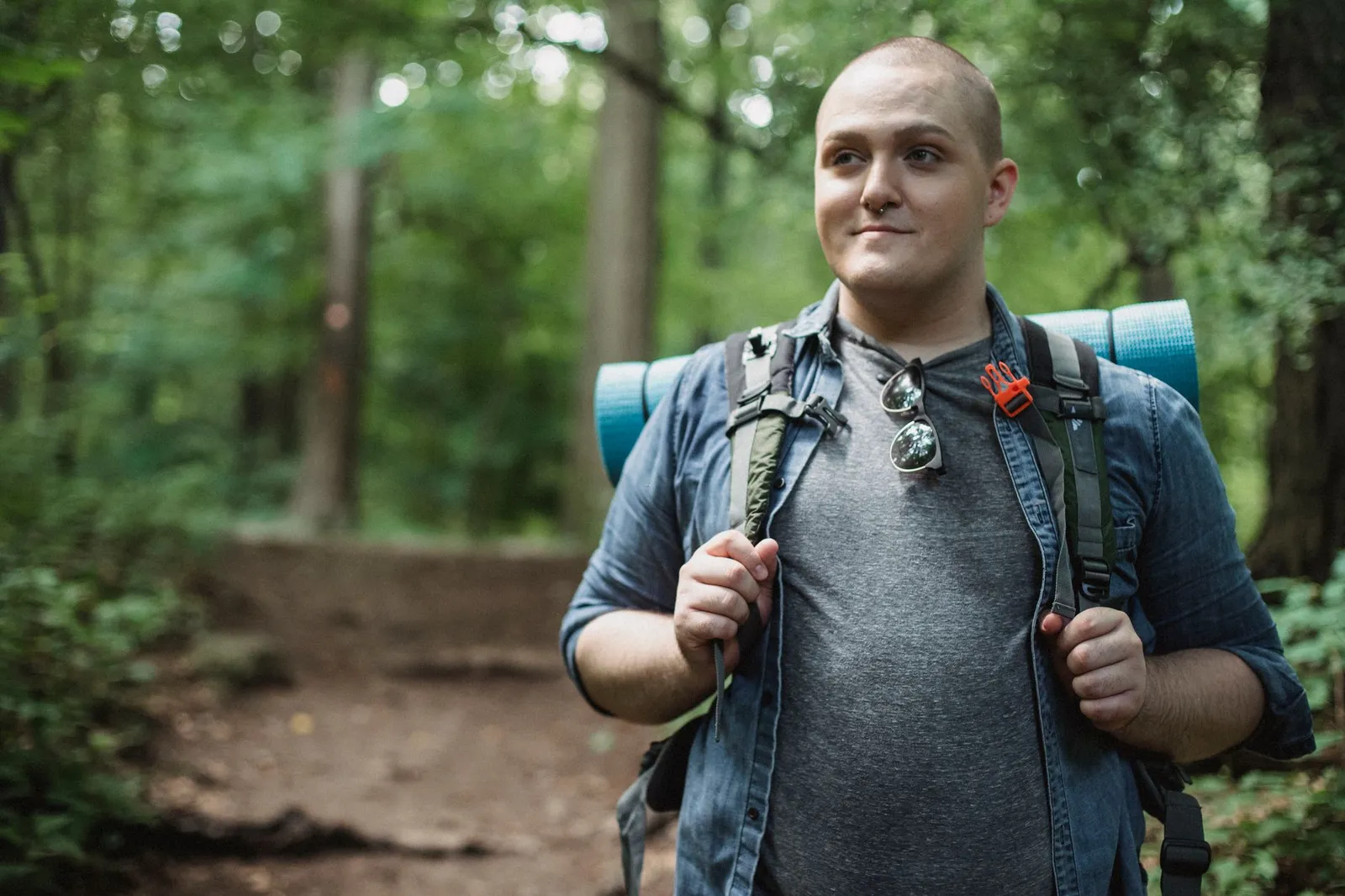
Rucking burns roughly 10 to 40 percent more calories than unloaded walking at the same pace — not the 2 to 3 times some rucking calculators imply. As of August 2026, the Pandolf load-carriage equation puts a 70 kg (154 lb) walker at 250 kcal (1,050 kJ) per hour on flat pavement and 291 kcal (1,220 kJ) with a 15 kg (33 lb) ruck. The inputs your watch cannot see — load, grade, and terrain — decide the rest.
Rucking — walking with a weighted pack or vest — has moved from military training into mainstream fitness, and the calorie claims have travelled with it. The number your watch shows for a ruck is a guess built from heart rate and arm swing; it has no idea there is 15 kg on your back. The number a rucking brand's marketing page shows tends to run in the other direction, crediting the pack with doubling or tripling your burn [5].
There is a better tool, and it has been sitting in the exercise-physiology literature since 1977. US Army researchers Pandolf, Givoni, and Goldman published an equation that predicts the metabolic cost of carrying a load from five inputs: your body mass, the load, your speed, the grade, and the surface underfoot. It remains the reference model that newer military equations are tested against [1][2]. This post works the math in kcal and kJ, shows what a ruck actually adds at realistic loads, and covers where the equation runs low — and why your watch runs lower.
How many calories does rucking burn?
A 70 kg (154 lb) adult rucking with a 15 kg (33 lb) pack at 4.8 km/h (3.0 mph) on flat pavement burns about 291 kcal (1,220 kJ) per hour by the Pandolf equation — 16 percent more than the 250 kcal (1,050 kJ) the same walk costs unloaded. As of August 2026, load raises flat-ground burn by roughly 10 to 40 percent across common pack weights.
Here is the load table for that 70 kg walker at 4.8 km/h on a flat, paved surface, computed from the Pandolf equation [6]:
| Ruck load | kcal per hour | kJ per hour | vs unloaded walking |
|---|---|---|---|
| None | 250 | 1,050 | — |
| 10 kg (22 lb) | 276 | 1,155 | +10% |
| 15 kg (33 lb) | 291 | 1,220 | +16% |
| 20 kg (44 lb) | 308 | 1,290 | +23% |
| 30 kg (66 lb) | 350 | 1,465 | +40% |
Body weight moves the numbers more than most people expect, because you are the largest load you carry. The same 15 kg ruck at 4.8 km/h:
| Body weight | kcal per hour | kJ per hour |
|---|---|---|
| 60 kg (132 lb) | 257 | 1,075 |
| 70 kg (154 lb) | 291 | 1,220 |
| 80 kg (176 lb) | 326 | 1,365 |
| 90 kg (198 lb) | 361 | 1,510 |
| 100 kg (220 lb) | 396 | 1,655 |

These are gross figures — they include the roughly 70 kcal (295 kJ) per hour your body would burn resting anyway. If you log exercise on top of a daily target that already covers resting burn, the honest number to add is the difference, a distinction covered in our running calculator post.
What is the Pandolf equation?
The Pandolf equation, published by US Army researchers in 1977, predicts the metabolic cost of load carriage in watts from body mass, load mass, walking speed, grade, and a terrain factor. It remains the standard reference model for rucking energy expenditure, and newer military equations are still validated against it [1][2].
The full form is:
M = 1.5W + 2.0(W + L)(L/W)² + η(W + L)(1.5V² + 0.35VG)
where M is metabolic rate in watts, W is body mass in kg, L is load in kg, V is speed in metres per second, G is grade in percent, and η (eta) is a terrain factor [6]. Multiply watts by 0.86 to get kcal per hour, and kcal by 4.184 to get kJ.
The three terms have physical meaning: the first is the cost of standing with your own body, the second is the cost of supporting a load (rising with the square of the load-to-body ratio), and the third is the cost of moving both masses at speed V up grade G, scaled by how much the surface fights you.
The terrain factor is the input every consumer calculator quietly sets to 1.0. Here is what the surface does to a 70 kg walker with a 15 kg ruck at 5.6 km/h (3.5 mph) [6]:
| Surface | Terrain factor (η) | kcal per hour | kJ per hour |
|---|---|---|---|
| Pavement or treadmill | 1.0 | 363 | 1,520 |
| Dirt road | 1.1 | 389 | 1,630 |
| Light brush | 1.2 | 416 | 1,740 |
| Heavy brush | 1.5 | 496 | 2,075 |
| Loose sand | 2.1 | 655 | 2,740 |
Does rucking burn 2 to 3 times more calories than walking?
No — on flat ground at common pack weights, rucking burns 10 to 40 percent more than unloaded walking, not 2 to 3 times more. As of August 2026, the multiples quoted by rucking brands only appear when load is combined with steep grades, soft surfaces, or both — conditions where unloaded walking would also burn far more.
GORUCK's own calculator page states that rucking "can burn 2x to 3x more calories than just walking" when you add weight, speed, and hills [5]. Run the numbers above again and you can see what is doing the work in that sentence: it is the hills and the pace, not the pack. A 70 kg walker doubling their flat 250 kcal hour needs a 10 percent grade or a sand beach — and an unloaded walker on that same grade or sand is burning far more too. On level pavement, no realistic pack weight doubles your burn; even 30 kg — a third of body weight, more than most recreational ruckers carry — adds 40 percent.
The honest version of the claim is still a good one. A 16 to 23 percent premium for 15 to 20 kg is a real increase at zero extra time cost, it scales with every hill you add, and the load stimulus works muscles that flat walking does not. Rucking does not need inflated math to be worth doing.
There is a genuine correction in the other direction, though. Laboratory validation studies consistently find the original Pandolf equation runs low for modern load carriage. A study that walked seven men in a 34 kg bomb-disposal ensemble found the equation significantly underestimated the metabolic cost at every speed tested, because bulky, distributed loads change gait mechanics in ways a backpack model misses [3]. US Army researchers at USARIEM reached the same conclusion for heavy backpacks and published a successor in 2022 — the Load Carriage Decision Aid (LCDA) backpacking equation, built on 30 adults carrying up to 66 percent of body mass, which tracked measured burn with essentially zero average bias [2]. GORUCK's calculator now applies an upward adjustment of up to about 27 percent at maximum load and pace for the same reason [5]. The practical reading: treat the Pandolf numbers in this post as a floor, with the true cost for heavy or awkward loads sitting up to 10 to 20 percent higher — and note that this correction still does not rescue the 2 to 3 times claim.
Why doesn't your watch count the ruck weight?
Your watch estimates calories from heart rate, motion, and the body weight in your profile — there is no input for a 15 kg pack, so the load's mechanical cost never enters the model. As of August 2026, no mainstream wrist wearable accepts carried load as a variable, and field tests show even unloaded walking estimates vary widely between equations and devices.
Wrist wearables infer energy expenditure from heart rate and accelerometry. Rucking breaks both signals: the added load barely changes your arm swing, and while heart rate does rise with load, the response is individual and confounded by heat and dehydration — the same drift problem that makes wrist-device calorie estimates miss by 27 to 93 percent in validation testing.
Even purpose-built laboratory equations disagree with each other once you leave the treadmill. A 2021 field study that walked subjects over a 6.4 km outdoor course with GPS-measured speeds and grades — unloaded and carrying 30 percent of body weight — found that four published walking equations differed from each other by up to 37 percent on identical inputs, with the Pandolf/Santee model overshooting the measured field cost by 13 to 17 percent in those conditions even as it undershoots heavy-load treadmill data [1]. Estimation error of 10 to 20 percent in either direction is simply the state of the art, a theme our walking calculator post covers for unloaded walking.
The upshot: for rucking, an equation with the load as an explicit input beats a sensor that cannot see the load. Your watch is the right tool for heart-rate zones and the wrong tool for ruck calories.
How do you log rucking in a calorie tracker?
Log a ruck as its Pandolf estimate minus resting burn, and treat the result as an estimate with a 10 to 20 percent margin rather than a measured fact. As of August 2026, no consumer app computes load carriage natively, so a manual entry from the tables above is the accurate route.
A worked routine you can copy:
- Compute the gross hourly cost from the tables above, or from the equation directly, using your body weight, pack weight, average pace, and a realistic terrain factor and grade.
- Subtract resting burn — roughly 1 kcal per kg of body weight per hour, per the standard MET convention [4] — so a 70 kg rucker subtracts about 70 kcal (295 kJ) from a 291 kcal hour, leaving roughly 220 kcal (920 kJ) of true exercise cost.
- Log the net number as a manual exercise entry against the actual minutes rucked, not the round hour. A 40-minute ruck at that rate is about 147 kcal (615 kJ).
- Decide once whether your daily target already includes your training, using the double-counting logic from our eat-back post — if your activity multiplier already assumes regular workouts, eating back the full ruck counts it twice.
- Sanity-check monthly against your own data. If you track intake and weight consistently, your real TDEE from your log will absorb any systematic error in the estimate — which is the property that makes precise per-session accuracy matter less than consistency.
One tracking note on the scale: a loaded ruck is sweaty work, and a hard session can drop 0.5 to 1 kg of water that returns as soon as you rehydrate. Weigh under consistent conditions before reading anything into the day after a long ruck.
Frequently Asked Questions
How many calories does a 30-minute ruck burn?
About half the hourly figures above: a 70 kg (154 lb) adult with a 15 kg (33 lb) pack at 4.8 km/h burns roughly 145 kcal (610 kJ) in 30 minutes on flat pavement, rising to about 230 kcal (960 kJ) at a 5 percent grade. Heavier bodies, heavier packs, faster paces, and rougher surfaces all push the number up.
Is rucking better than running for burning calories?
Per minute, running usually burns more: level running costs roughly 1 kcal per kg per km regardless of pace, so a 70 kg runner covering 8 km in an hour burns around 560 kcal (2,340 kJ) against 291 kcal (1,220 kJ) for a 15 kg ruck at 4.8 km/h. Rucking closes the gap on hills and carries lower impact forces, which is why many people can ruck far longer than they can run.
Does a weighted vest burn the same calories as a backpack?
The Pandolf math treats any carried mass as load, so a 10 kg vest and a 10 kg backpack model identically. Measured costs for bulky, distributed loads tend to run slightly higher than backpack predictions because they alter gait mechanics — the bomb-disposal-ensemble study found the equation underestimated at every speed for exactly this reason [3].
Why does my watch show fewer calories for rucking than a Pandolf calculator?
Because the watch cannot see the pack. Its model runs on heart rate, motion, and your profile body weight, so the mechanical cost of the extra 10 to 20 kg never enters the estimate; heart-rate drift from heat can partially mask the gap, but the structural blindness remains. An equation with load as an explicit input is the better tool for this specific activity.
How much weight do people typically ruck with?
Common recreational loads run 10 to 20 percent of body weight — 7 to 15 kg (15 to 33 lb) for most adults — while military standards run heavier. The research ceiling is high: the 2022 LCDA backpacking equation was validated on loads up to 66 percent of body mass [2], but the load-squared term in the math means cost per kilogram climbs as packs get heavier relative to you.
Does rucking count toward strength or cardio?
Both, partially. The energy cost profiled in this post is aerobic — sustained, sub-maximal walking work — while the load adds a postural and lower-body strength stimulus that unloaded walking lacks. It does not replace progressive resistance training, but it is meaningfully more than a walk.
Sources
- Weyand PG, et al. Real-world walking economy: can laboratory equations predict field energy expenditure? Journal of Applied Physiology, 2021. https://pmc.ncbi.nlm.nih.gov/articles/PMC8560389/
- Looney DP, et al. Modeling the Metabolic Costs of Heavy Military Backpacking. Medicine and Science in Sports and Exercise, 2022 (US Army DEVCOM / USARIEM, via OSTI.gov). https://www.osti.gov/pages/biblio/1905049
- Bach AJE, Borg DN, Costello JT, Stewart IB. Predicting the metabolic cost of walking while wearing explosive ordnance disposal protective clothing. Extreme Physiology and Medicine, 2015. https://pmc.ncbi.nlm.nih.gov/articles/PMC4580919/
- Herrmann SD, et al. 2024 Adult Compendium of Physical Activities: A third update of the energy costs of human activities. Journal of Sport and Health Science, 2024. https://pmc.ncbi.nlm.nih.gov/articles/PMC10818145/
- GORUCK. Rucking Calorie Calculator. https://www.goruck.com/pages/rucking-calorie-calculator
- Wikipedia. Pandolf equation — equation form and terrain factor table, with citations to Pandolf, Givoni, and Goldman (1977) and Soule and Goldman (1972). https://en.wikipedia.org/wiki/Pandolf_equation
Ready to track smarter?
Join thousands who use kcalm for calorie tracking. AI-powered food recognition, scientifically-validated calculations, and zero anxiety.
Related Articles
Afterburn Effect: How Many Extra Calories Does EPOC Burn?
Explore the afterburn effect with measured EPOC calories, kcal and kJ comparisons, research limitations and practical advice for your calorie log.
ScienceSauna Calories Burned: What the Studies Really Measure
Explore sauna calories burned, what heat studies actually measured, why water loss differs from fat loss and how to handle uncertain numbers in your food log.
ScienceFood Scale vs Measuring Cups: Portion Errors Explained
Compare food scales, measuring cups and eyeballing using portion-size research, practical logging steps and worked calorie examples in kcal and kilojoules.