Homemade Meal Calories: Oil Absorption and Cooking Yields
A home-cooked meal is one of the most accurately trackable things you eat — or one of the least, depending on three numbers your app rarely asks about: the oil the food soaks up, the weight it gains or loses during cooking, and whether you log each ingredient or a generic serve. Deep-frying can leave 8 to 25 percent of a food's final weight as fat, and up to 30 to 50 percent for thin, starchy items, while USDA cooking-yield data show a chicken breast loses roughly a quarter of its raw weight and dry rice can triple. How to build an oil-absorption estimate by cooking method, why cooking yields move the weight but not the calories, and a five-step way to log a homemade dish within a few percent.

James Nakamura
Sports Nutritionist & Meal Prep Coach
The calories in a homemade meal are decided by three things your app rarely asks about: the oil the food soaks up, the weight it gains or loses during cooking, and whether you log each ingredient or a single generic "serve." Get those right and a home-cooked dish is one of the most accurately trackable meals you eat. Get them wrong — almost always by forgetting the oil — and one ordinary stir-fry can read 300 calories lighter than it really is.
Home cooking is where calorie tracking should be easiest. You control every ingredient, you can weigh each one, and nothing is hidden behind a restaurant kitchen door. Yet it is also where logs quietly drift, because the act of cooking changes food in two ways a barcode never captures: it adds fat that soaks in, and it moves water in or out so the weight on your plate no longer matches the raw ingredient in the database.
This guide covers both. We will walk through how much oil different cooking methods actually leave behind, how cooking yields shift a food's weight without touching its calories, and a simple five-step method to log a home-cooked dish within a few percent of the truth. It is a direct companion to our raw versus cooked weighing conversion guide — that piece covers water-weight changes, this one adds the fat and recipe maths. Every figure below is grounded in a primary source listed at the end.
How much cooking oil does food actually absorb?
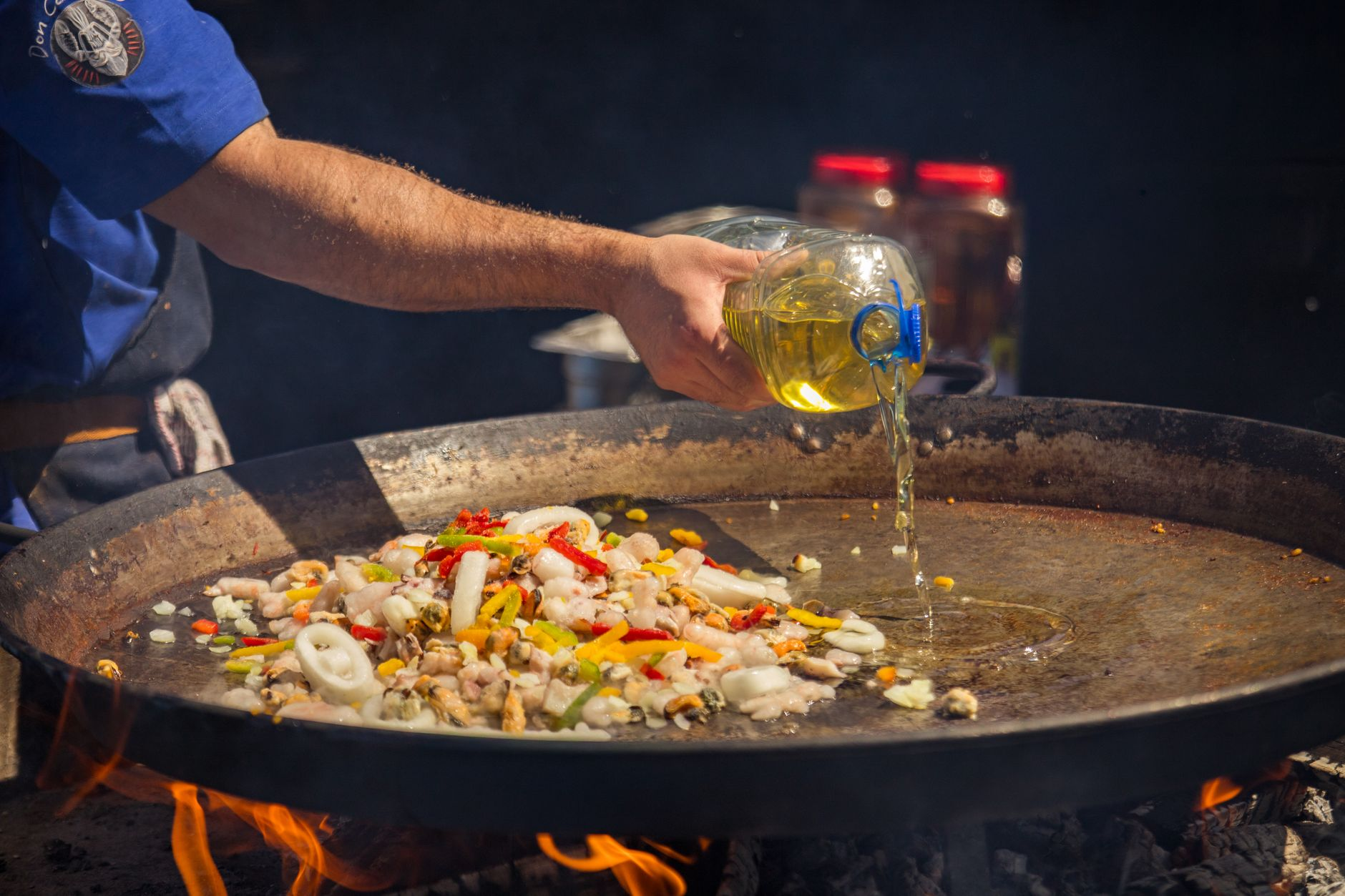
More than almost anyone estimates. Deep-frying leaves roughly 8 to 25 percent of a food's final weight as absorbed fat, rising to 30 to 50 percent for thin, starchy items like chips. Shallow pan-frying and sautéing transfer less — commonly 10 to 15 percent of the oil you add — while roasting with a light coating absorbs closer to 5 to 10 percent.
Oil absorption is the single biggest reason a homemade meal reads low. A tablespoon of olive oil is about 120 kcal (500 kJ), and most of it does not evaporate — it ends up in the food or the pan sauce you scrape onto the plate. Research on frying shows the fat does not just sit on the surface. A 2025 study of fried products in the journal Molecules measured fat content of 22.5 percent at 160°C and 26.5 percent at 180°C of the finished weight, and found that the rapid loss of water during cooking increases the food's porosity so oil can move into the spaces the steam leaves behind.
A useful and slightly counter-intuitive point from the frying literature: most of the oil is taken up not during frying but during cooling, as the food's surface cools and draws oil inward. A 2020 review in Critical Reviews in Food Science and Nutrition describes oil uptake as governed by pretreatment, oil type, temperature and the food's structure rather than cooking time alone — which is why draining and blotting a fried food while it is still hot measurably lowers the fat it keeps.
Here is a working estimate you can apply by method. These are ranges, not precise readings, but they are far closer than logging a bare "grilled chicken and veg" entry that assumes no added fat at all.
| Cooking method | Approximate fat absorbed | Practical logging note |
|---|---|---|
| Deep-frying, thin or starchy (chips, crumbed items) | 30 to 50 percent of final weight | Log a generous oil allowance; the food itself is a minority of the calories |
| Deep-frying, general | 8 to 25 percent of final weight | Count the food plus a meaningful share of the oil |
| Shallow / pan-frying, sautéing | ~10 to 15 percent of the oil added | Log the oil you put in the pan, then subtract what stays behind |
| Roasting or oven-baking with a light coat | ~5 to 10 percent of the oil added | Log the full drizzle if it pools on the tray and you eat it |
| Boiling, steaming, poaching, air-frying dry | close to 0 percent | No added-fat entry needed |
Do cooking yields change the calories or just the weight?
Only the weight. Cooking moves water and renders some fat, so a food's mass changes while its calories stay put — meaning your log is only accurate if you weigh in the same state (raw or cooked) that your database entry describes. USDA cooking-yield data show a roasted beef cut can finish at about 84 percent of its raw weight after losing roughly 22 percent of its moisture.
This is the second half of homemade accuracy, and it trips up even careful trackers. When you cook a chicken breast, no calories leave the meat except the small amount of fat that drips off — but a large amount of water does, so 100 grams of raw breast becomes roughly 70 to 75 grams on the plate. If you weigh that cooked 70 grams against a raw database entry, you under-log. Weigh raw against a raw entry, or cooked against a cooked entry, and the numbers line up.
The USDA Table of Cooking Yields for Meat and Poultry catalogues this weight change cut by cut; its beef tri-tip roast entry, for example, finishes at 84.0 percent of raw weight with a 22.4 percent moisture loss. Starchy foods move the other way — they absorb water and gain weight. The pattern below shows the typical direction and size of the shift.
| Food | Raw to cooked weight change | What moves |
|---|---|---|
| Chicken breast, roasted or grilled | 100 g raw becomes ~70 to 75 g | Water lost, small fat drip |
| Beef mince, pan-browned and drained | 100 g raw becomes ~70 to 75 g | Water and rendered fat lost |
| Beef roast (USDA tri-tip example) | 84 percent yield, ~22 percent moisture loss | Water lost |
| White rice, dry | 100 g dry becomes ~250 to 300 g | Water absorbed |
| Pasta, dry | 100 g dry becomes ~220 to 250 g | Water absorbed |
What is the most accurate way to log a homemade meal?
Weigh and log every ingredient raw, including the oil, then weigh the finished dish and divide your portion into it by weight. This "recipe" method captures the fat and the cooking yield in one step and, with a food scale and a reliable database, lands within a few percent of a dish's true calories — far tighter than any generic entry.
You do not need to do this for every meal. It pays off most for the dishes you cook and eat regularly — the weeknight stir-fry, the batch curry, the tray bake — because a saved recipe means you only do the work once. Here is the process:
- Weigh each ingredient raw and log it. Use grams on a digital scale rather than cups or spoons; a "tablespoon" of peanut butter or oil can carry 100 kcal of error on its own.
- Log the oil and fats you cook with, not just the food. This is the step almost everyone skips. Put the bottle on the scale or count the tablespoons going into the pan.
- Weigh the whole finished dish. Note the total cooked weight of everything in the pot — this is your denominator.
- Portion by weight, not by eye. Your portion's calories equal (portion weight ÷ total cooked weight) × total recipe calories. A 380 g serve of a 1,900 g batch is exactly one-fifth of it.
- Save the recipe. Next time you cook it, you log one entry and adjust only what changed.
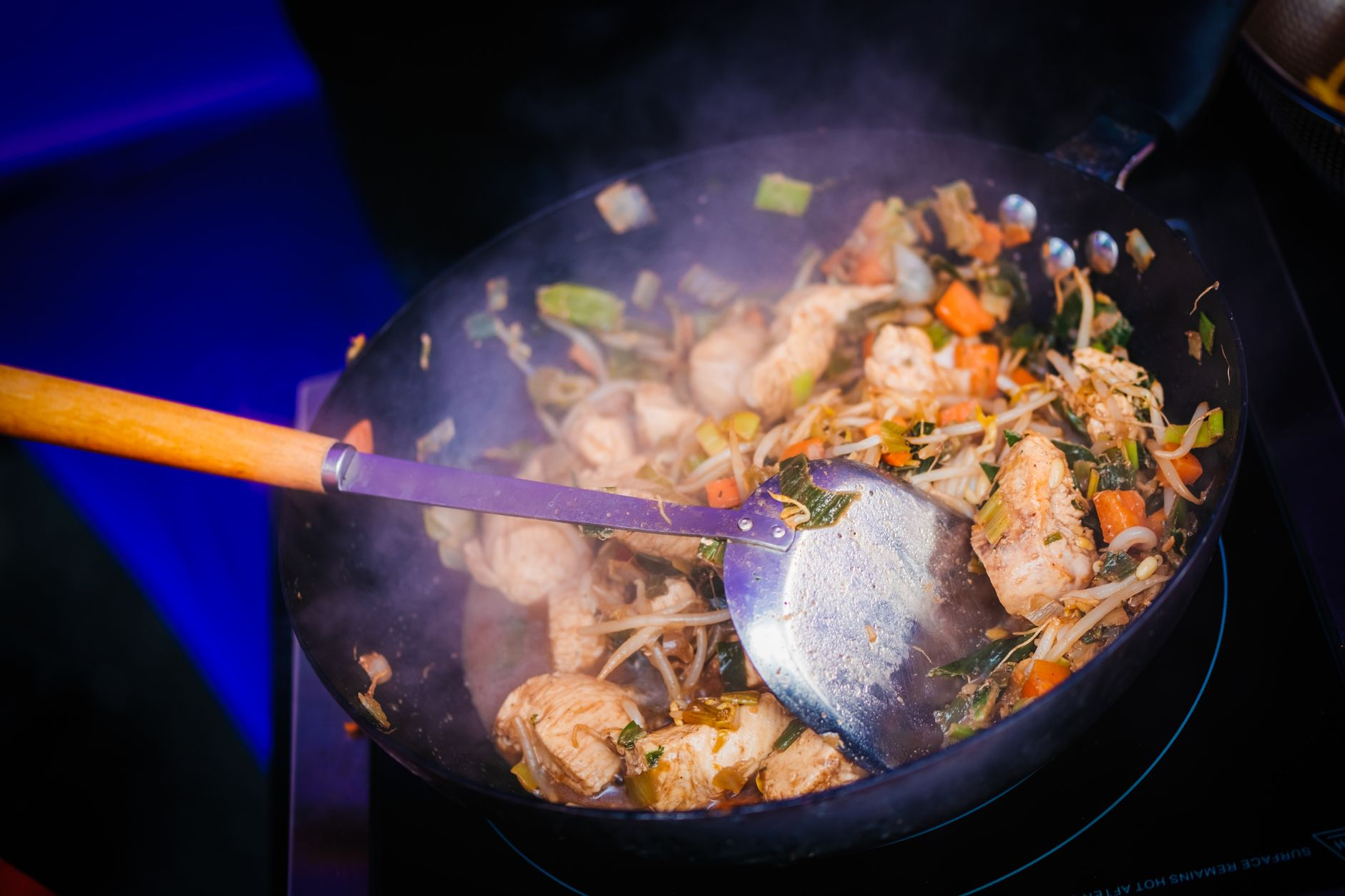
To see why the oil step matters so much, here is the same simple chicken-and-vegetable stir-fry logged three ways. The food is identical; only the logging method differs.
| How the same stir-fry is logged | Estimated energy |
|---|---|
| Generic "chicken & veg stir-fry, 1 serve" database entry | 380 kcal (1,590 kJ) |
| Per-ingredient, cooking oil left out | 480 kcal (2,008 kJ) |
| Per-ingredient plus 2 tablespoons of oil counted | 720 kcal (3,013 kJ) |
Which homemade dishes are easiest to get wrong?
Anything fried, oil-roasted, or built around a sauce, plus batch dishes portioned by eye rather than weight. These combine the two biggest error sources — uncounted absorbed fat and an unknown finished weight — so a curry, a tray of roast vegetables, or a fried-rice pan can drift 200 to 400 kcal per serve without the cook noticing.
The riskiest dishes share a signature: fat you cannot see and portions you cannot easily count. Research suggests people underestimate the cooking oil they use several-fold, so a dish that hides oil in a sauce or a crumb is where logs slip most. Casseroles, curries, stir-fries, fried rice, and oil-roasted vegetables all qualify. Simple grilled or steamed foods, by contrast, are among the most accurately logged things you can eat, because there is no absorbed fat and the weight change is small and predictable.
Practically, the move is to weigh the oil and portion these dishes by grams. You do not have to be perfect — you have to be consistent, so that whatever small error remains is the same each week and your progress trend still tells the truth.
Frequently Asked Questions
Do I count the oil left in the pan after cooking?
Only the oil that ends up on your plate counts. If you sauté in a tablespoon of oil and a visible film stays in the pan, you can reasonably log a little less than the full amount. For stir-fries and roasts where the oil coats the food and you eat it, count all of it. When in doubt, count the full amount — under-logging oil is the more common and more costly error.
Should I weigh food before or after cooking?
Weigh it in whichever state matches your database entry. Raw ingredients weighed raw against raw entries are the most reliable, because cooked weight varies with how long and how hot you cooked. For dry staples like rice and pasta, weighing dry is far more consistent than weighing cooked.
How accurate can home-cooked calorie tracking really be?
With a digital scale, a reliable food database, and the oil counted, per-ingredient logging typically lands within a few percent of a dish's true calories — more accurate than most restaurant or packaged estimates. The main sources of remaining error are database entry variation and unmeasured oil, not the method itself.
Does boiling or steaming add any calories?
No. Boiling, steaming, poaching, and dry air-frying add no fat, so the only change is water weight. A boiled or steamed food gains or loses water but keeps its calories, which makes these methods the easiest of all to log accurately.
Why does my homemade meal have more calories than the restaurant version's listed figure?
It often does not — but restaurant figures are frequently under-stated, and your home version may simply use more oil. If you cook with a generous drizzle and count it honestly, your number can legitimately come out higher than a menu board that rounds down. The fix is to weigh your oil rather than assume the restaurant used less.
Do I need to do this for every single meal?
No. Reserve full per-ingredient logging for dishes you cook and eat often, then save them as recipes so you only do the work once. For one-off or simple meals, a good estimate with the oil counted is close enough to keep your weekly trend honest.
Sources
- Tokarczyk G, Bienkiewicz G, Biernacka P, et al. Effect of Frying Temperature on Lipid Binding, Fatty Acid Composition, and Nutritional Quality of Fish Crackers. Molecules, 2025. https://pmc.ncbi.nlm.nih.gov/articles/PMC11901817/
- Asokapandian S, Swamy GJ, Hajjul H. Deep fat frying of foods: A critical review on process and product parameters. Critical Reviews in Food Science and Nutrition, 2020. https://pubmed.ncbi.nlm.nih.gov/31729249/
- USDA Agricultural Research Service. USDA Table of Cooking Yields for Meat and Poultry, Release 2. 2012. https://www.ars.usda.gov/ARSUserFiles/80400525/data/retn/usda_cookingyields_meatpoultry.pdf
- Food Standards Australia New Zealand. Australian Food Composition Database. https://www.foodstandards.gov.au/science-data/food-composition-databases
- Macros Inc. How to Calculate Calories in Homemade Food. https://macrosinc.net/blog/how-to-calculate-calories-in-homemade-food/
Ready to track smarter?
Join thousands who use kcalm for calorie tracking. AI-powered food recognition, scientifically-validated calculations, and zero anxiety.
Related Articles
Find Your Real TDEE From Your Food Log: Weight-Trend Math
Your most accurate TDEE is not a formula's output — it is the number your food log and weight trend already contain. Average your logged intake over 2 to 4 weeks, convert your weight-trend change to energy at roughly 7,700 kcal (32,200 kJ) per kilogram, and the arithmetic returns the maintenance number your body actually runs on. Static formulas drift: the classic 3,500-kcal rule overpredicted real weight loss by 7.4 lb in about nine weeks in one validation study, and Hall's energy-balance work shows the "constant" itself shifts with body composition. The worked method, the noise sources to filter, and when to recalculate.
GuidesRaw vs Cooked Weight: The Food-Weighing Conversion Table
Cooking changes a food's weight, not its calories, so the accuracy of your log depends on weighing in the same state your database lists — raw or cooked. USDA cooking-yield data show 100 g of raw chicken breast becomes roughly 70 to 75 g cooked, while dry rice swells to about 250 to 300 g and pasta to 220 to 250 g. A printable raw-to-cooked conversion table for meat, rice, pasta, oats, legumes, and vegetables, plus why the kilojoules stay the same and how to stop double-logging water weight.
GuidesHow to Track Calories for Global Cuisines: A Practical Guide
Tracking Asian, Mediterranean, Latin American, Indian, or African meals? Learn portion estimation tricks, ingredient swaps, and AI logging tips that work beyond Western food databases.