How Many Calories Does an Ice Bath Burn? The Real Math
A typical 10-to-15-minute ice bath burns roughly 20 to 80 extra kcal (85 to 335 kJ) — less than a single banana, and an order of magnitude below the 250 to 500 kcal that plunge marketing claims. The measured literature is consistent: an 18 degree cooling suit raised energy expenditure by 250 kcal across three full hours, the 88-minute world-record ice immersion roughly doubled heat production from 169 to 321 watts, and a meta-analysis of 10 randomised trials put mild cold exposure at 188 extra kcal per day. Even six weeks of two-hours-daily cold acclimation lifted cold-induced thermogenesis to only 289 kcal a day. Real physiology, trivial energy cost — the protocol-by-protocol table, the shivering math behind the vendor claims, and how to log a plunge honestly.
kcalm editorial team
Prepared with AI assistance
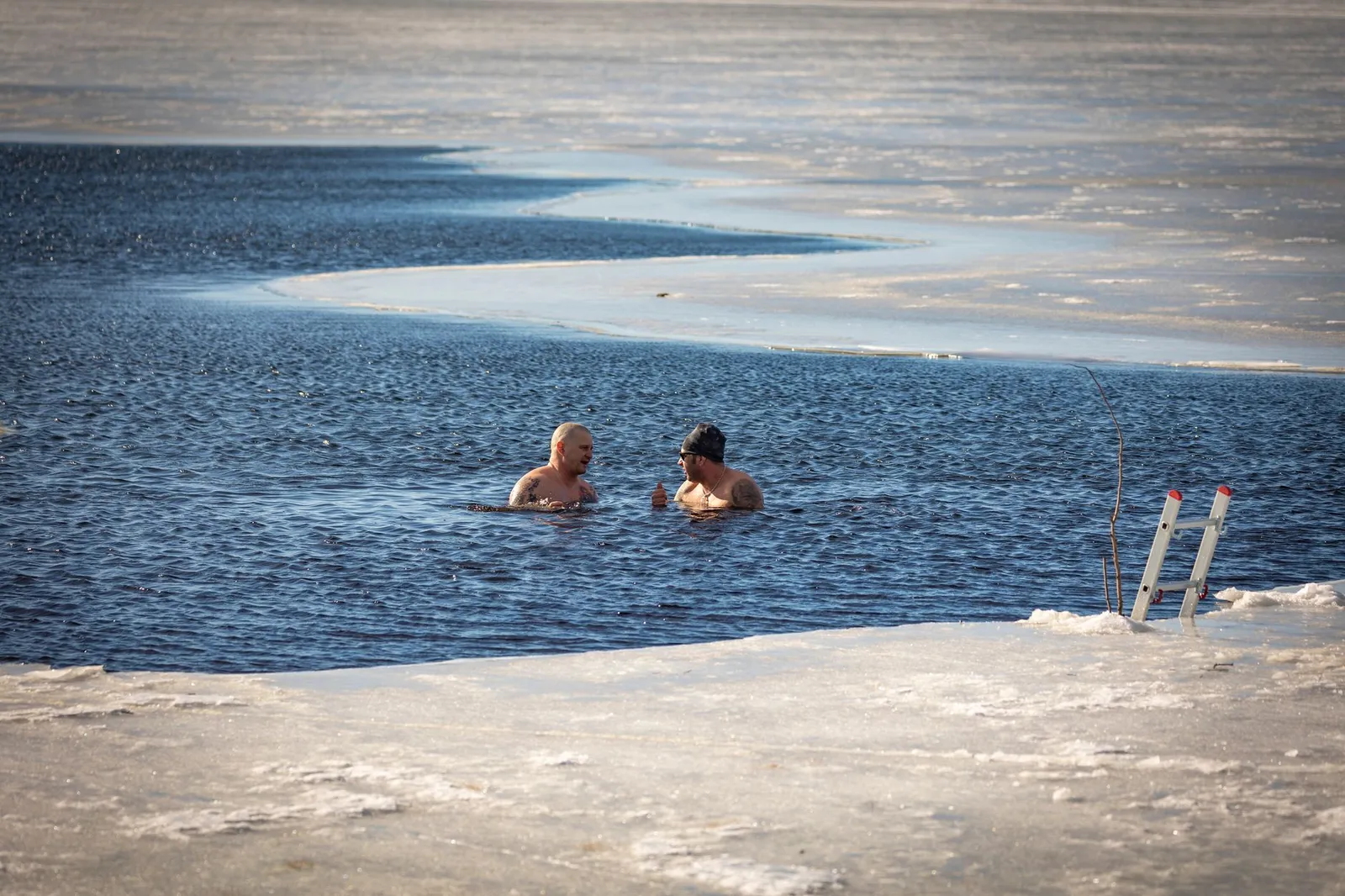
A typical 10-to-15-minute ice bath burns roughly 20 to 80 extra kcal (85 to 335 kJ) — less than the energy in a single banana, and an order of magnitude below the 250 to 500 kcal that plunge marketing claims. The physiology is real: measured studies show cold water can double or even quintuple your metabolic rate while you are in it. But you are multiplying a resting burn of only about 1.2 kcal per minute, and only for a few minutes [1][3][5].
Cold plunges are one of the defining wellness trends of 2025 and 2026 — backyard barrels, recovery rooms in gyms, and a wave of marketing that pairs the genuine discomfort of cold water with a very specific promise: hundreds of calories burned per session. The discomfort is real, and so is the extra heat your body produces to defend its core temperature. Researchers have measured that heat with indirect calorimetry, cooling suits, and PET scans for decades. The measurements are the problem for the marketing.
This post works through what the cold-exposure literature actually reports — in kcal and kilojoules — and what it means for your food log. It pairs with our reviews of fitness tracker calorie accuracy and finding your real TDEE from your own log, because the same principle runs through all three: measured numbers beat marketing numbers.
How many calories does an ice bath actually burn?
As of September 2026, the best-supported estimate for a typical 10-to-15-minute plunge at 5 to 15 °C is roughly 20 to 80 extra kcal (85 to 335 kJ) above sitting at room temperature — derived from measured immersion metabolic rates, not vendor calculators [1][3][5].
The arithmetic is short. A resting adult of around 70 kg burns close to 1.2 kcal (5 kJ) per minute. Cold water raises that multiple ways: a 2024 GeroScience review of cold-water therapy reports that a classic immersion experiment found 60 minutes of head-out immersion at 14 °C raised metabolic rate by about 350 percent, and that peak shivering can reach roughly fivefold the resting rate [5]. Take the full span — from a mild doubling in someone cold-adapted through to hard fivefold shivering — and you get 1.2 to 4.8 extra kcal per minute. Over 10 minutes that is 12 to 48 kcal; over 15 minutes, 18 to 72 kcal. Rounded generously at both ends: 20 to 80 kcal, or 85 to 335 kJ.
Real-world sessions tend toward the bottom of that range. Most people plunge for well under 15 minutes, submerge to the chest rather than the neck, and — as regular plungers acclimatise — shiver less over time, which lowers the multiplier. In a 2024 randomised crossover trial, 15 minutes of 10 °C immersion to the waist produced a measurable but modest rise in oxygen uptake, not a metabolic firestorm [6].
Where did the 250 to 500 calorie claims come from?
The 250-to-500-kcal figures on plunge-vendor sites extrapolate peak shivering rates across an entire session and stack speculative afterburn on top — a 500 kcal claim over 15 minutes works out to 33 kcal per minute, roughly nine times the highest shivering heat production measured [5].
Shivering is the most energetically expensive thing cold water makes you do, and its output has been quantified: about 10 to 15 kJ (2.4 to 3.6 kcal) per minute of heat generation [5]. A vendor claim of 500 kcal in a 15-minute session requires 33 kcal per minute — a rate of energy expenditure comparable to running at world-record marathon pace, sustained while sitting still in a tub. The claims survive because almost nobody runs the division.
| Number | kcal per minute | kJ per minute |
|---|---|---|
| Vendor claim: 500 kcal in 15 minutes | 33.3 | 139 |
| Peak shivering heat production [5] | 2.4–3.6 | 10–15 |
| Fivefold resting metabolic rate, 70 kg adult [5] | ~6.0 | ~25 |
| Measured extra burn, typical plunge [1][3] | 1.2–4.8 | 5–20 |
What do measured cold-exposure studies show?
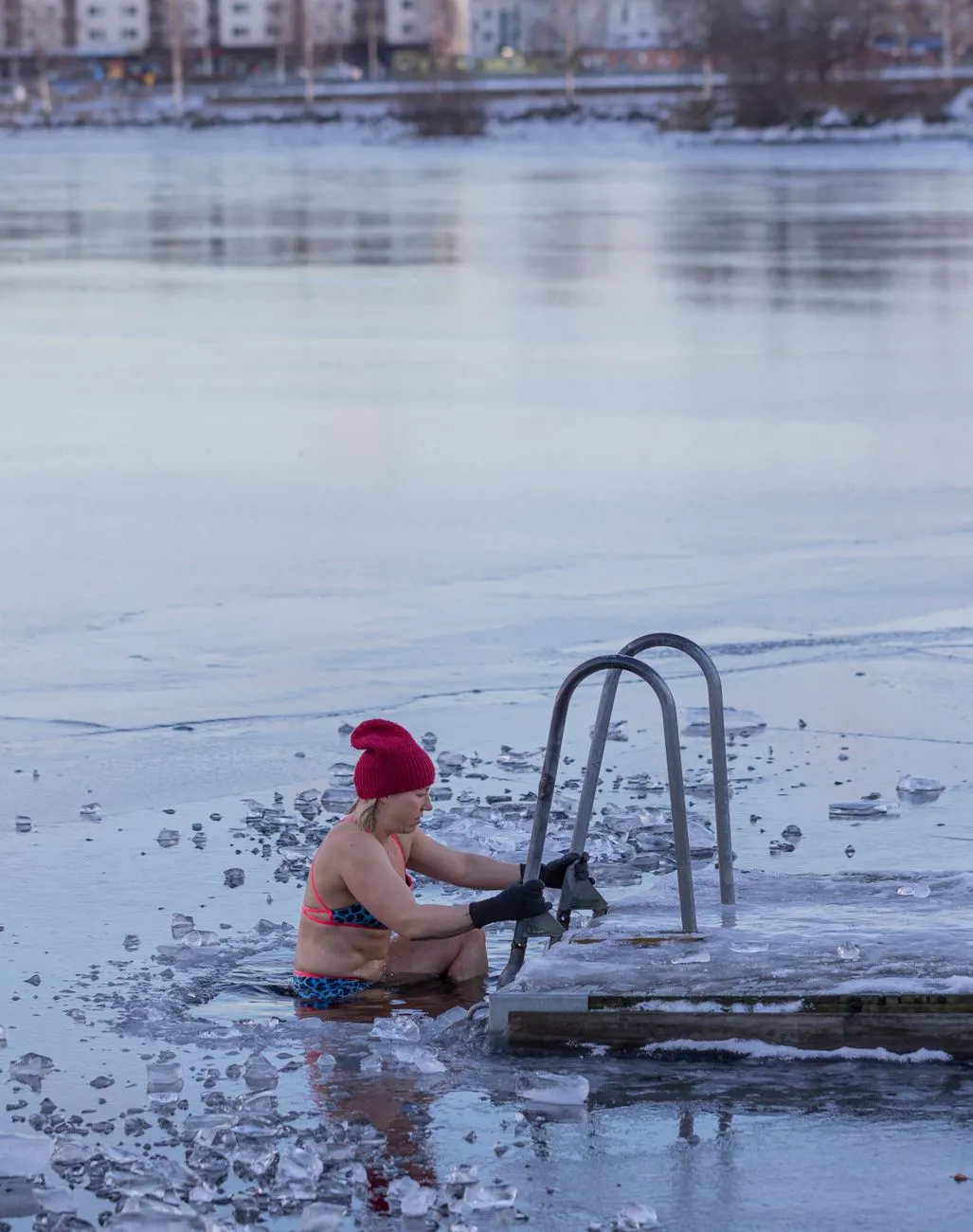
Across the strongest measurements, cold exposure adds tens to a few hundred kcal: 250 kcal over three full hours in an 18 °C cooling suit, 188 kcal per day in a 10-trial meta-analysis, and about 190 kcal above rest for the 88-minute world record in crushed ice [1][2][3].
Three measurements anchor the range. In a 2012 Journal of Clinical Investigation study, six men wore a liquid-conditioned suit circulating 18 °C water for 150 minutes while researchers tracked whole-body oxygen consumption. Metabolism rose about 1.8-fold, and the total extra cost came to 250 ± 45 kcal (about 1,045 kJ) — for three hours of continuous, carefully controlled cold [1].
A 2022 meta-analysis in Frontiers in Physiology pooled 10 randomised controlled trials covering 176 healthy adults exposed to 16–19 °C air for 30 minutes to 12 hours. Compared with 24 °C, energy expenditure rose by a mean of 188 kcal per day (95 percent confidence interval: 140 to 237 kcal) [2].
The most extreme datapoint is a 2019 case study of the world-record holder for full-body ice immersion: 88 minutes shoulder-deep in 0.1 °C crushed ice. His metabolic heat production climbed from 169 W at rest to 321 W — close to a doubling — which works out to roughly 190 extra kcal (795 kJ) across the entire 88 minutes. Remarkably, researchers observed no shivering, and his core temperature fell just 0.7 °C [3]. If the outer limit of human ice exposure costs about one large apple of energy, a ten-minute backyard plunge sits far below it.
| Study | Exposure | Extra energy above rest |
|---|---|---|
| Ouellet 2012 [1] | 18 °C cooling suit, 150 min | 250 kcal (1,045 kJ) total |
| Huo 2022 meta-analysis, 10 RCTs [2] | 16–19 °C air, 30 min to 12 h | 188 kcal (785 kJ) per day |
| Bongers 2019 world-record case [3] | 0.1 °C crushed ice, 88 min | ~190 kcal (795 kJ) total |
| Yoneshiro 2013, after 6 weeks of acclimation [4] | 17 °C air, 2 h daily | 289 kcal (1,210 kJ) per day of cold-induced thermogenesis |
| Typical plunge, derived [1][3][5] | 5–15 °C water, 10–15 min | 20–80 kcal (85–335 kJ) |
Does brown fat make cold plunges a fat-loss tool?
Brown adipose tissue is real, measurable, and trainable — but the measured effect required two hours of daily cold for six weeks, which raised cold-induced thermogenesis from 108 to 289 kcal per day and reduced body fat by 5.2 percent [4].
Brown fat is the tissue behind most "cold burns fat" headlines. Unlike white fat, it burns fuel to make heat, and PET imaging shows cold exposure switches it on. In the landmark 2013 acclimation trial, 12 volunteers sat in 17 °C air for two hours every day for six weeks. Their cold-induced thermogenesis nearly tripled — from 108 ± 23 to 289 ± 70 kcal per day — brown-fat activity rose significantly, and body fat fell by 5.2 percent while controls did not change [4]. Three participants with no detectable brown fat at baseline developed it during the trial [4].
Two caveats keep the result honest. First, the dose: two hours daily at 17 °C is a fundamentally different commitment from a three-minute plunge, and the elevated thermogenesis was measured during cold exposure, not around the clock. Second, the fuel: the 2012 PET study found active brown fat draws mainly on its own stored triglyceride rather than pulling fat off your waistline in real time [1]. The 2022 meta-analysis adds that people with obesity show diminished brown-fat activation, and that prolonged cold exposure tends to trigger compensatory increases in food intake — the body defends its energy stores from both directions [2].
Does the burn continue after you get out?
Rewarming keeps metabolism modestly elevated — oxygen uptake measured about 48 percent higher after a 15-minute 10 °C immersion than after ambient-air recovery — but the absolute cost stays small, and cold exposure also tends to increase how much people eat afterwards [2][6].
The afterburn argument has a real mechanism behind it. In the 2024 crossover trial with 21 endurance athletes, oxygen uptake late in recovery sat at 7.16 versus 4.83 ml per minute per kilogram after cold immersion versus ambient recovery, and the authors describe rewarming as non-linear and metabolically costly [6]. For a 75 kg adult, that gap is worth very roughly 0.8 kcal per minute while it lasts — and it fades as skin and muscle re-warm. Measured against a 188-kcal-per-day ceiling for sustained mild cold [2], post-plunge afterburn is a rounding entry, not a meal.
There is also a ledger on the intake side. The 2022 review notes that longer cold exposure prompts compensatory eating [2] — cold is a classic appetite trigger, as anyone who has finished a winter ocean swim ravenous can confirm. A plunge can also move the scale in confusing directions through fluid shifts and cold-induced urination; the mechanics are the same as in our guide to why the scale jumps overnight.
How do you log an ice bath in a calorie tracker?
The honest log entry for a 10-minute plunge is about 20 to 50 kcal — or nothing at all. An entry that small sits inside the noise of your daily intake estimate, so leaving it at zero keeps your log conservative [1][3].
If you want a workable protocol:
- Leave it unlogged by default. A 20-to-50-kcal entry is smaller than the legal tolerance on a single food label, and treating recovery tools as calorie-neutral avoids licensing extra snacks against them.
- If you do log it, cap the rate at about 3 kcal per minute. That matches measured shivering output in genuinely cold water [5] and still likely overstates a chest-deep, well-acclimatised session.
- Consider ignoring the watch number entirely. Optical heart-rate sensors struggle in cold water for the same reasons they struggle in a pool — sensor lift-off and cold-constricted skin vessels — which we detailed in the swimming calorie calculator.
- Expect scale noise, not fat change. Fluid shifts from immersion and cold-induced urination can move the next morning's weigh-in by a few hundred grams in either direction with zero fat involved.
- Judge the habit by your weight trend, not the session. If plunging genuinely changed your energy balance, a 2-to-4-week trend against logged intake would show it — the same arithmetic as calculating TDEE from your own log.
None of this argues against cold plunging. Recovery, mood, and the simple satisfaction of doing a hard thing are separate questions with their own evidence base — and none of them depend on the calorie claim being true.
Frequently Asked Questions
Do ice baths burn fat?
Not meaningfully at typical doses. A 10-to-15-minute plunge costs roughly 20 to 80 kcal (85 to 335 kJ) [1][3][5] — a deficit you could match by skipping half a biscuit. The one trial that did reduce body fat through cold used two hours of 17 °C exposure daily for six weeks [4].
How many calories does a 10-minute ice bath at 10 °C burn?
Roughly 15 to 50 kcal (60 to 210 kJ) above resting, depending on your size, immersion depth, and how much you shiver. Measured immersion studies put cold-water metabolic rates at about two to five times resting [5], and resting is only about 1.2 kcal per minute for a 70 kg adult.
Does shivering burn more calories than staying still in the cold?
Yes — shivering is the most expensive part of cold exposure, generating about 10 to 15 kJ (2.4 to 3.6 kcal) of heat per minute at its peak [5]. Regular plungers adapt and shiver less, which is more comfortable but lowers the already-small energy cost further.
Do regular cold plunges speed up your metabolism long term?
Cold acclimation can raise cold-induced thermogenesis — from 108 to 289 kcal per day in the six-week, two-hours-daily trial [4] — but that elevated burn shows up during cold exposure, not permanently. The 2022 meta-analysis found a 188 kcal per day increase during 16–19 °C exposure, alongside evidence that people with obesity activate brown fat less readily [2].
Does cold exposure make you hungrier?
Research suggests it can. The 2022 review of cold-exposure trials notes that prolonged cold triggers compensatory increases in food intake [2], which may cancel — or exceed — the modest extra burn. If you plunge regularly, it may be worth watching post-session snacking in your log.
Is an ice bath worth logging as exercise?
Consider skipping it. At 20 to 80 kcal per session, the entry is smaller than the day-to-day error in food labels and portion estimates. Logging it as zero keeps your numbers conservative; logging a vendor figure of 300-plus kcal builds a phantom deficit into your week.
Sources
- Ouellet V, Labbé SM, Blondin DP, et al. Brown adipose tissue oxidative metabolism contributes to energy expenditure during acute cold exposure in humans. Journal of Clinical Investigation. 2012;122(2):545–552. https://www.jci.org/articles/view/60433
- Huo C, Song Z, Yin J, et al. Effect of acute cold exposure on energy metabolism and activity of brown adipose tissue in humans: a systematic review and meta-analysis. Frontiers in Physiology. 2022;13:917084. https://pmc.ncbi.nlm.nih.gov/articles/PMC9273773/
- Bongers CCWG, Eijsvogels TMH, Thijssen DHJ, Hopman MTE. Thermoregulatory, metabolic, and cardiovascular responses during 88 min of full-body ice immersion — a case study. Physiological Reports. 2019;7:e14304. https://pmc.ncbi.nlm.nih.gov/articles/PMC6934874/
- Yoneshiro T, Aita S, Matsushita M, et al. Recruited brown adipose tissue as an antiobesity agent in humans. Journal of Clinical Investigation. 2013;123(8):3404–3408. https://www.jci.org/articles/view/67803
- Kunutsor SK, Lehoczki A, Laukkanen JA. The untapped potential of cold water therapy as part of a lifestyle intervention for promoting healthy aging. GeroScience. 2024;47(1):387–407. https://pmc.ncbi.nlm.nih.gov/articles/PMC11872954/
- Giraud D, Pomportes L, Nicol C, et al. Mechanism involved of post-exercise cold water immersion: blood redistribution and increase in energy expenditure during rewarming. Temperature (Austin). 2024;11(2):137–156. https://pmc.ncbi.nlm.nih.gov/articles/PMC11152100/
Ready to track smarter?
Join thousands who use kcalm for calorie tracking. AI-powered food recognition, scientifically-validated calculations, and zero anxiety.