How Do They Measure Calories in Food? Fire, Then Math
Labels usually calculate calories rather than burn the food: grams of protein, fat and carbohydrate times about 4, 9 and 4. Where the bomb calorimeter fits.
kcalm editorial team
Prepared with AI assistance
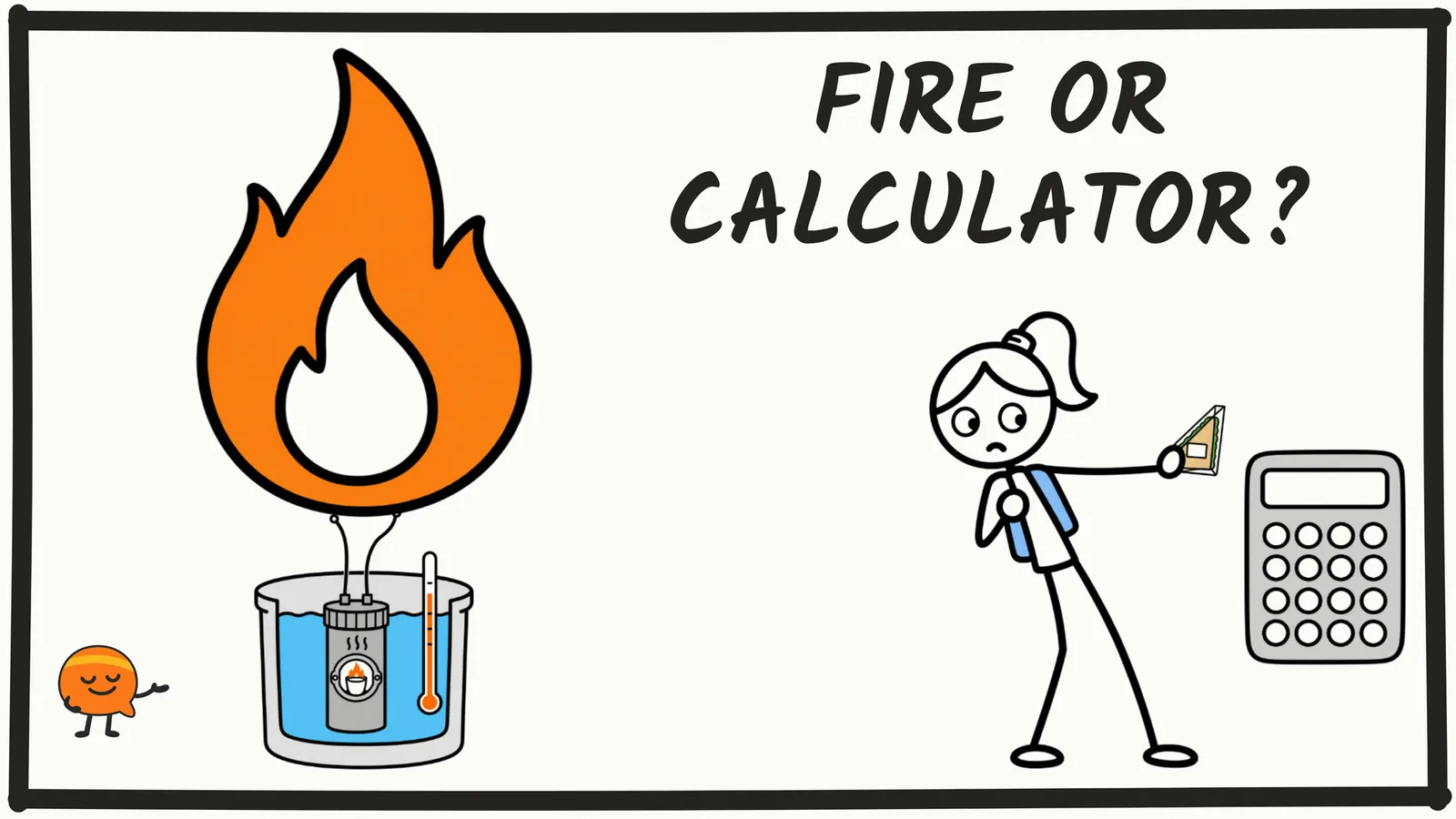
The 5-minute video goes live on 24 November.
How do they measure calories in food? Food labels usually calculate them rather than burn the food: grams of protein, fat and carbohydrate are multiplied by about 4, 9 and 4 calories per gram and added up. Those factors came from burning food in a bomb calorimeter and from digestion experiments with people.
kcalm makes a food-logging app, so we have a commercial interest in people logging food. This is general information, not medical or nutrition advice.
How do they measure calories in food?
Respected sources seem to disagree. The Merck Manual's consumer page says "The food is burned." The Tufts Health and Nutrition Letter says "Food manufacturers now calculate calories".
Each describes a real step, and neither is the whole story. Merck describes a lab method; Tufts, what usually happens for a label, though it also calls the instrument "rarely used anymore", while labs still publish methods for it.
How are calories on food labels calculated?
The sum starts with a list: grams of protein, fat and carbohydrate, from lab analysis or from tables of foods tested before. Each amount is multiplied by an energy factor. The general factors are about 4 calories per gram for protein, 9 for fat and 4 for carbohydrate. Carbohydrate is sometimes calculated "by difference": whatever remains once the other components are counted.
Those three numbers are averages. In 1955, USDA's Agriculture Handbook 74 set out more specific factors that depend on the food a nutrient is found in, because digestibility varies. US rules still permit those specific factors, citing the slightly revised 1973 edition, among several listed methods.
What does a bomb calorimeter measure?
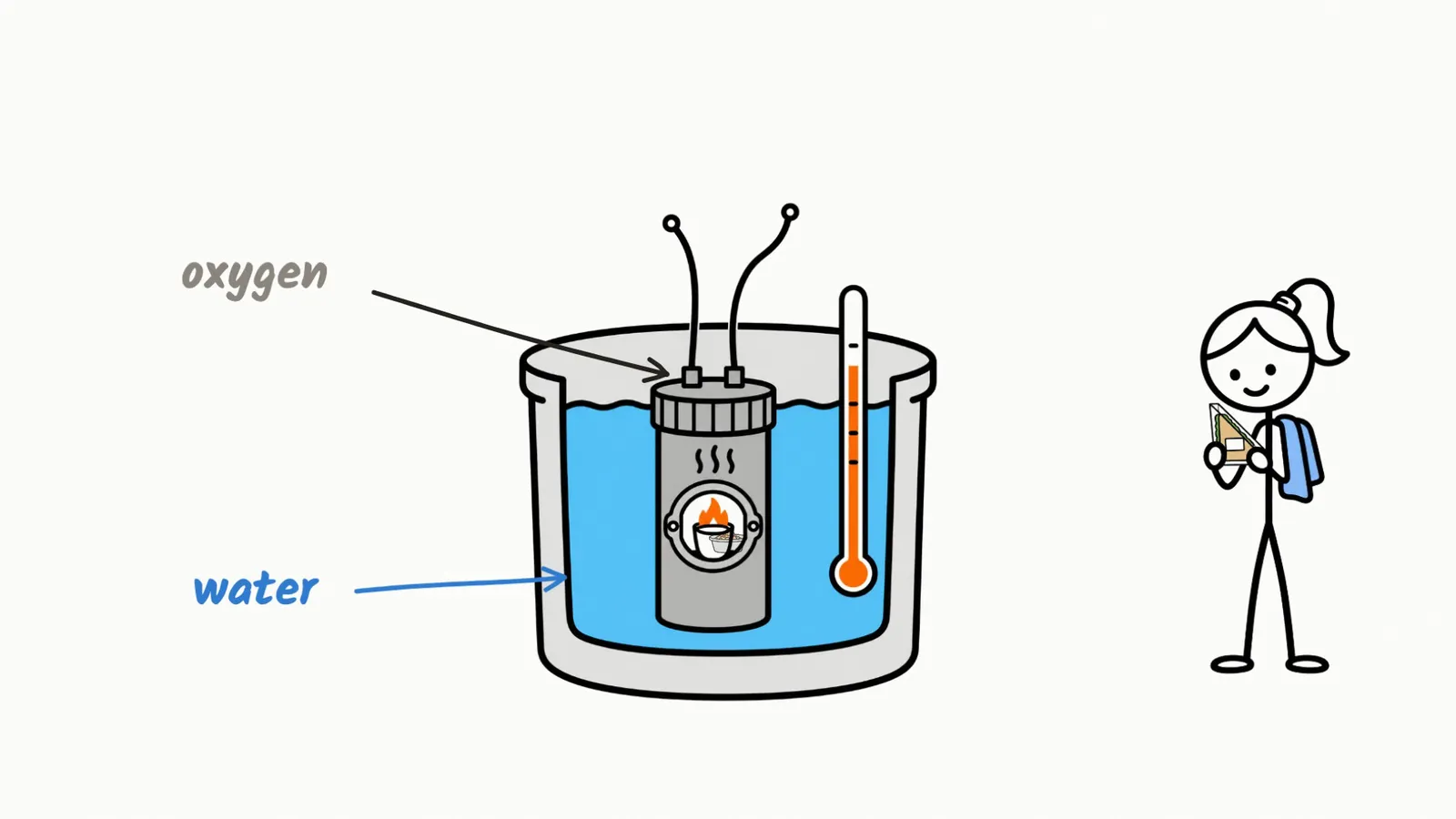
A bomb calorimeter is a sealed metal vessel filled with oxygen, sitting in water. A small sample, commonly mixed and dried first, burns completely inside it. The heat warms the water, and calibration turns that temperature change into a measure of energy.
The reading is called gross energy: Handbook 74 calls the heat of combustion "a measure of the gross energy value of the food". It is not too high. It answers its own question, how much heat comes out, while a label asks how much energy a body can use. Wilbur Atwater relied on this instrument in his food energy research.
Where do 4, 9 and 4 calories per gram come from?
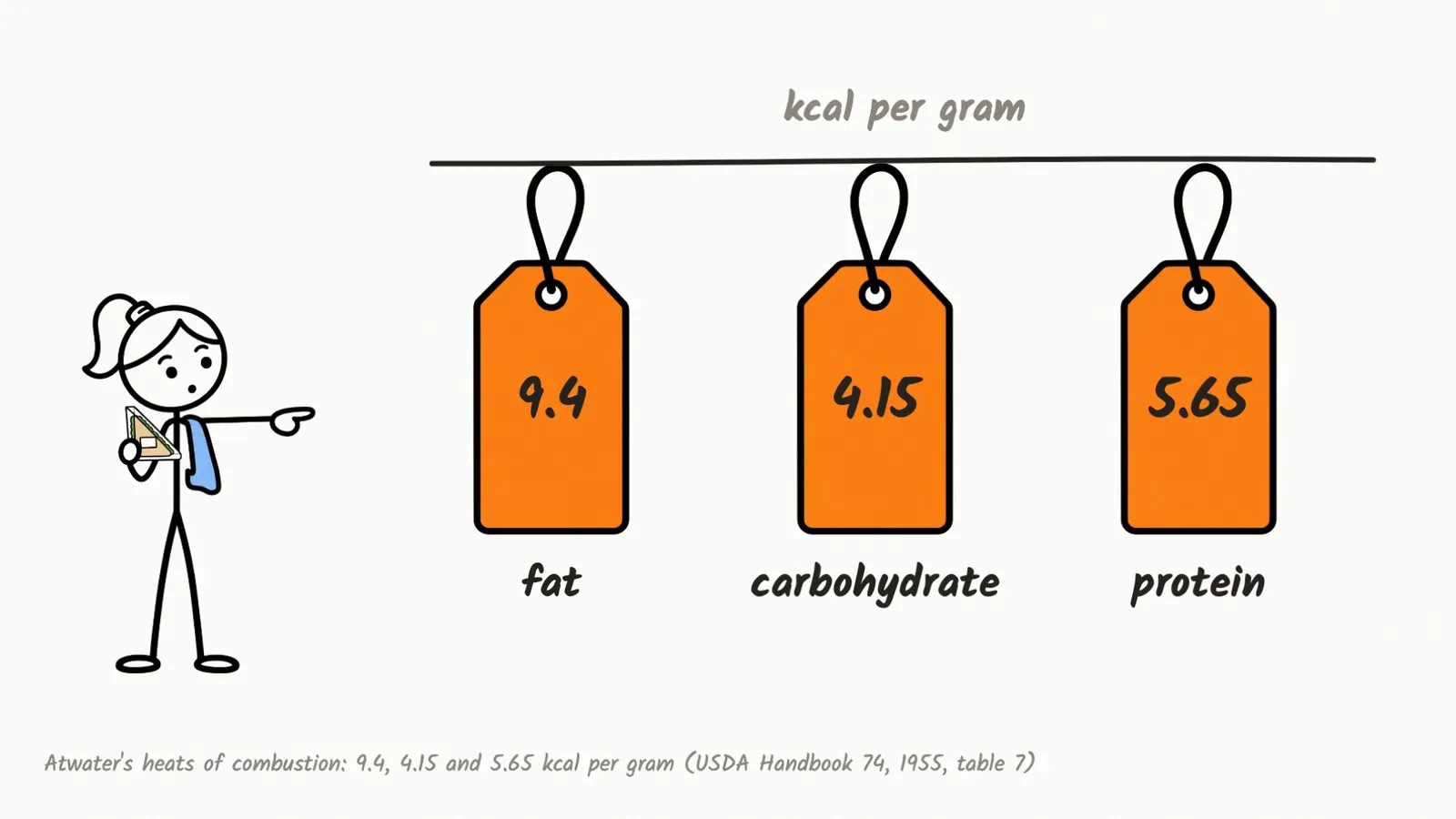
The second kind of evidence was digestion experiments with people: what went in was measured, and so was what came back out unused. Atwater and his colleagues combined the two in a report for 1899. Handbook 74's table 7 reproduces their figures for a typical mixed diet of the time:
| Nutrient | Heat of combustion, kcal per gram | Share absorbed | Original rounded fuel value, kcal per gram | Later rounded to |
|---|---|---|---|---|
| Protein | 5.65 | 92% | 4.0 | 4 |
| Fat | 9.4 | 95% | 8.9 | 9 |
| Carbohydrate | 4.15 | 97% | 4.0 | 4 |
So fire and digestion records built the factors, and the factors make the label. Merck and Tufts each describe one part of that chain.
Do they still burn food to count calories?
Yes. Labs still burn food samples, and US rules allow a company to use "bomb calorimetry data subtracting 1.25 calories per gram protein". The regulation says this corrects "for incomplete digestibility" and points to page 10 of Handbook 74, where the same 1.25 is explained as the heat of combustion of the unoxidized products in urine.
It is one method among several, so a label can skip the fire: the factors already carry its results.
Calories or kilojoules: how do Australian labels count energy?
Labels in Australia and New Zealand declare energy in kilojoules, or in kilojoules and calories. UK labels must show both. One food calorie, really a kilocalorie, is 4.184 kilojoules, or about 4.2 in everyday use.
Schedule 11 sets the Australian and New Zealand factors:
| Component | kJ per gram |
|---|---|
| Protein | 17 |
| Fat | 37 |
| Available carbohydrate | 17 |
| Unavailable carbohydrate, including fibre | 8 |
What does the calorie number on a label mean?
It is an estimate of the energy a food makes available to a body, on average, worked out from what is in it. It is not a reading taken from your sandwich, and it is not a score for your meal.
A sandwich made at home has no label. In kcalm, the app that made this article, you can type it into the chat, get calorie and nutrient estimates, and correct an ingredient when it guesses wrong. We are not claiming kcalm runs this exact sum.
What this does not mean
- Not "the label is fake". An average is a defined estimate.
- Not "the fire was wrong". Gross energy is a correct answer to a different question.
- Not a correction to apply yourself. The 1.25 belongs to one company lab method. It is not something to subtract from a label or a food log.
- Not "one experiment settled it". The factors came from a research programme, and they are averages.
- Not the same number everywhere. Countries use different factors and definitions, so converting units will not always make two labels match.
How we made this
Made by kcalm, an iPhone app for logging food by photo, text or voice. AI narration. Researched from the sources below and checked by a separate AI fact-check; not reviewed by a dietitian. The labs, rooms and experiments in the video are drawn, and no food was burned or measured for it. General information, not medical or nutrition advice. Written November 2026. Corrections are welcome at [email protected].
Sources
- USDA FoodData Central. Foundation Foods Documentation, energy section. https://fdc.nal.usda.gov/Foundation_Foods_Documentation/
- FAO (2003). Food energy: methods of analysis and conversion factors, Food and Nutrition Paper 77, chapter 3. https://www.fao.org/4/y5022e/y5022e04.htm
- FAO (2003). Food energy, chapter 4, analytical methods. https://www.fao.org/4/y5022e/y5022e05.htm
- FDA. 21 CFR 101.9(c)(1)(i), Nutrition labeling of food. https://www.ecfr.gov/current/title-21/chapter-I/subchapter-B/part-101/subpart-A/section-101.9
- FSANZ. Standard 1.2.8, Nutrition information requirements. https://www.legislation.gov.au/F2015L00395/latest/text
- FSANZ. Schedule 11, Calculation of values for nutrition information panel. https://www.legislation.gov.au/F2015L00481/latest/text
- Food Standards Scotland. Nutrition declarations (Retained EU Regulation 1169/2011: energy in kJ and kcal). https://www.foodstandards.gov.scot/business-guidance/running-a-food-business/packaging-and-labelling/nutrition-declarations
- Greenfield H, Southgate DAT (2003). Food Composition Data, chapter 7. FAO. https://www.fao.org/4/y4705e/y4705e12.htm
- Hopper Z et al. (2023). Preparation procedures of food and beverage samples for oxygen bomb calorimetry: a scoping review and reporting checklist. https://pmc.ncbi.nlm.nih.gov/articles/PMC10281735/
- Merrill AL, Watt BK (March 1955; slightly revised 1973). Energy Value of Foods: Basis and Derivation, USDA Agriculture Handbook 74 (1955 text, table 7 and pages 1, 8 to 11). https://www.ars.usda.gov/ARSUserFiles/80400535/Data/Classics/USDA%20Handbook%2074.pdf
- Maynard LA (1962). Early Days of Nutrition Research in the United States of America. https://www.ars.usda.gov/ARSUserFiles/80400530/pdf/hist/maynard1962_earlydays.pdf
- Marsh A (2020). How Counting Calories Became a Science. IEEE Spectrum. https://spectrum.ieee.org/how-counting-calories-became-a-science-2652903943
- Hargrove JL (2006). History of the calorie in nutrition. J Nutr. https://pubmed.ncbi.nlm.nih.gov/17116702/
- Merck Manual, Consumer Version. How Are Calories in Foods Measured? https://www.merckmanuals.com/home/multimedia/table/how-are-calories-in-foods-measured
- Tufts Health and Nutrition Letter (2018, updated 2019). How is the number of calories determined in a portion of food? https://www.nutritionletter.tufts.edu/ask-experts/q-how-is-the-number-of-calories-determined-in-a-portion-of-food/
- Australian Government. Eat for Health, Frequently Asked Questions. https://www.eatforhealth.gov.au/food-essentials/frequently-asked-questions
- Lemelson-MIT. Otto Rohwedder (first sliced bread sold July 7, 1928). https://lemelson.mit.edu/resources/otto-rohwedder
Video transcript
The full narration of the video, with its chapter times. Watch it on YouTube: How Do They Measure Calories in Food? Fire, Then Math
0:00 How do they measure calories in food?
Fire has never touched the cook's sandwich. Not one scorch mark. Yet its wrapper prints a calorie number, and the classic way to measure energy in food is to burn it. Who burned this one? Ask how they measure calories in food, and respected sources seem to disagree. A medical guide says the food is burned. A university nutrition letter says food makers calculate the calories. A fire, or a calculator? Let's play this number's life backwards, with the cook along, lunch in hand. Rewind: shelf, delivery van, the van reversing all the way to the factory, flawlessly, because in rewind, everyone is brilliant at reversing.
0:36 How are calories on food labels calculated?
At the factory, the cook gets a hairnet and a surprise: nobody here is holding a match. Somebody is holding a list: grams of protein, fat and carbohydrate, from lab tests or tables of foods tested before. Then, a sum. Calories on a food label are usually calculated, not burned: the grams of protein, fat and carbohydrate are multiplied by about 4, 9 and 4 calories per gram, and added up. Multiply, add, print. And carbohydrate is sometimes just whatever's left once everything else is counted. Better question: who decided a gram of fat is worth 9? Rewind to 1955: a handbook from America's Department of Agriculture lands on the table with more specific factors for different foods, because 4, 9 and 4 are averages, and one food's protein isn't digested quite like another's. American rules still allow them, which is how a book from 1955 can end up on a label printed this morning. It refined older work, so keep rewinding, past the invention of sliced bread, a tense moment for a sandwich, all the way to the 1890s and Wilbur Atwater and his colleagues. This is where the numbers were born, from two kinds of evidence. Call them two rooms.
1:43 What does a bomb calorimeter measure?
The first room has the fire. Not a bonfire: a sealed metal vessel filled with oxygen, sitting in water. A small sample, mixed and usually dried first, goes inside and burns completely. The heat warms the water, and because the instrument is calibrated, that warming becomes a measure of energy. It's called a bomb calorimeter, which is the most dramatic name anyone has ever given a kettle. The cook keeps her sandwich behind her back anyway. That reading is called gross energy: all the heat released when food burns completely. Nobody digests lunch by setting it on fire, but the bomb hasn't overcounted. It has answered the question printed on its own door: how much heat comes out? A label asks a different one: how much does a body actually get?
2:24 Where do 4, 9 and 4 calories per gram come from?
That's the second room's job, and it's much less glamorous. No flames, just digestion experiments with people: what went in, measured, and what came back out unused, measured too, in detail we will happily skip. The fire, it turned out, counts energy the body never collects. Watch the tags. Each starts at its fire number: fat a little over 9 calories a gram, carbohydrate just over 4, protein well over 5. Fat and carbohydrate are mostly absorbed, so their tags barely move. Protein's drops the most, because a fire burns protein all the way, while a body packs its nitrogen into urea, a waste product that still holds energy. Trim that, plus the little that's never absorbed, and protein lands on 4. By 1899, Atwater's team had pulled it all together. So each source had one room right, and neither showed you the whole building. The fire and the digestion records built the factors, and the factors make the label.
3:20 Do they still burn food to count calories?
So do they still burn food to count calories? Fast-forward and see. Yes: labs still burn food samples, and American labelling rules even let a company take its number straight from the bomb, as long as it subtracts one and a quarter calories for every gram of protein. The rule book still shows the working: that's the second room's urea lesson, applied with a pencil. It's one method among several, though. A label can skip the fire: the factors already carry it inside them.
3:50 Calories or kilojoules: how do Australian labels count energy?
Down here, the sum switches units. Labels in Australia and New Zealand count energy in kilojoules, with calories optional, and British labels show both. The food isn't bigger here; the ruler is just smaller. One food calorie, really a kilocalorie, is about 4.2 kilojoules, so flip the tags and check: protein's 4 times 4.2 is about 17, and Australia's table says 17 kilojoules a gram. Fat gets 37, available carbohydrate 17. But it's a table of its own, not just a conversion: fibre and other unavailable carbohydrate get their own tag of 8, because people get only part of fibre's energy, from gut microbes that ferment it. The unit tells you how the energy is expressed. The method tells you how the estimate was made.
4:33 What does the calorie number on a label mean?
So the calorie number on a label is an estimate: the energy that food makes available to a body, on average, worked out from what's in it. It isn't a reading from your sandwich, and it makes no comment on your lunch. A sandwich made at home has no wrapper. Anyone who logs with kcalm, the app this channel belongs to, can type it into the chat, get calorie and nutrient estimates, and fix the filling when it guesses wrong. The fire and the digestion records came first; the calculator has used their numbers for over a century. This number's handbooks, papers and rulebooks are all at kcalm.app. The counter reads today again, the sandwich still hasn't seen a flame, and the cook finally eats her lunch.
Ready to track smarter?
Join thousands who use kcalm for calorie tracking. AI-powered food recognition, scientifically-validated calculations, and zero anxiety.