Cooked vs Uncooked Rice Calories: Where Do They Go?
Uncooked white rice is about 365 calories per 100 g, cooked about 130. Cooking in plain water adds weight, not calories: here is the maths, with sources.
kcalm editorial team
Prepared with AI assistance
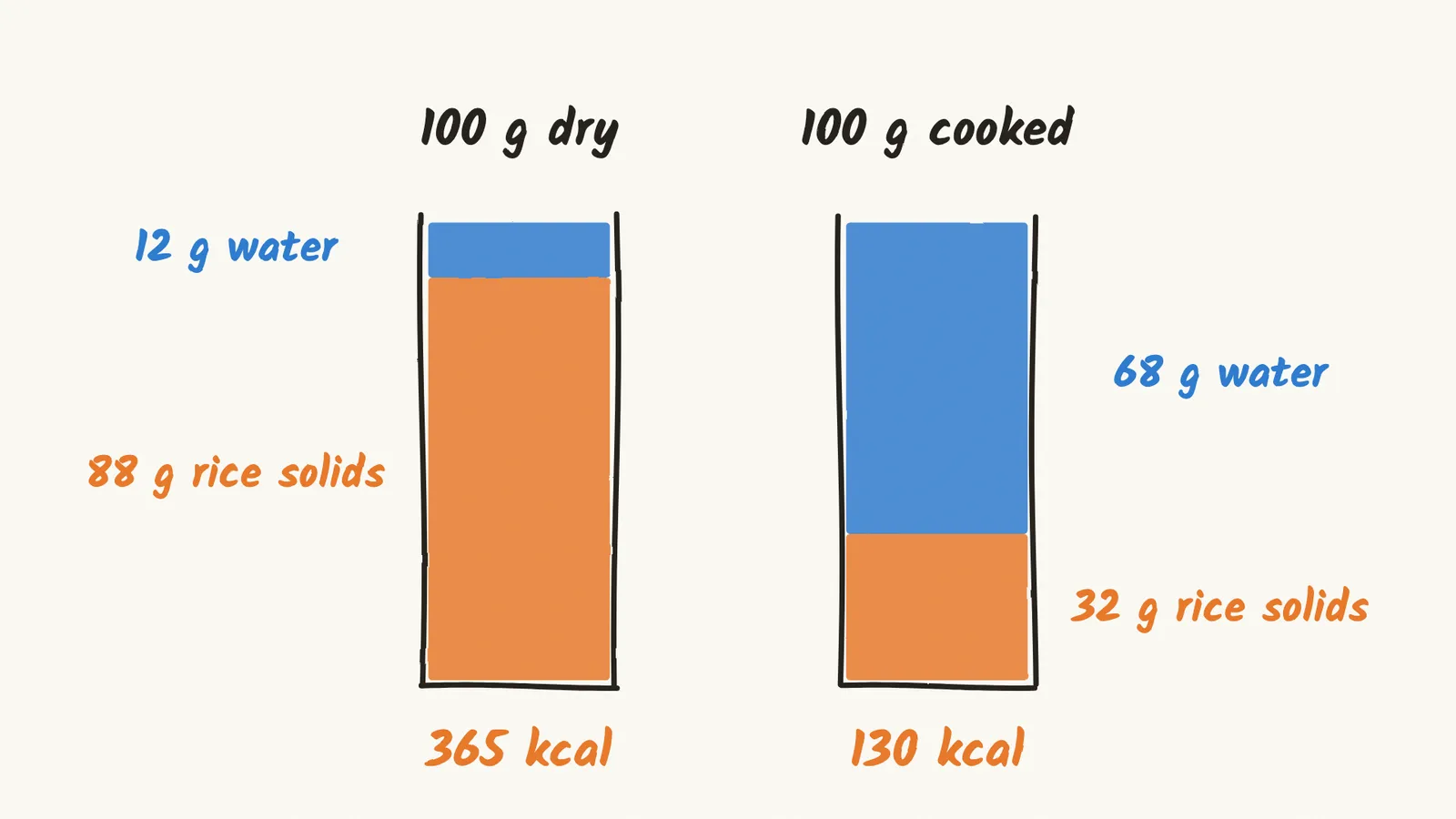
Cooked rice has fewer calories per 100 grams than uncooked rice because it soaks up water, which has no calories. In USDA FoodData Central's long-grain white rice entries, 100 grams is about 365 calories dry and about 130 cooked. For rice cooked in plain water, the calories in the pot stay about the same, diluted by water.
Why does the number change?
In USDA FoodData Central, raw, enriched long-grain white rice lists 365 calories per 100 grams. The cooked entry for the same kind of rice lists 130. These are separate reference entries, not one pot measured twice; the main difference between them is water. So did cooking destroy two thirds of the calories?
No. Both numbers are correct. They describe 100 grams of two different mixtures: one is mostly rice solids, the other is mostly water.
Where do the calories go?
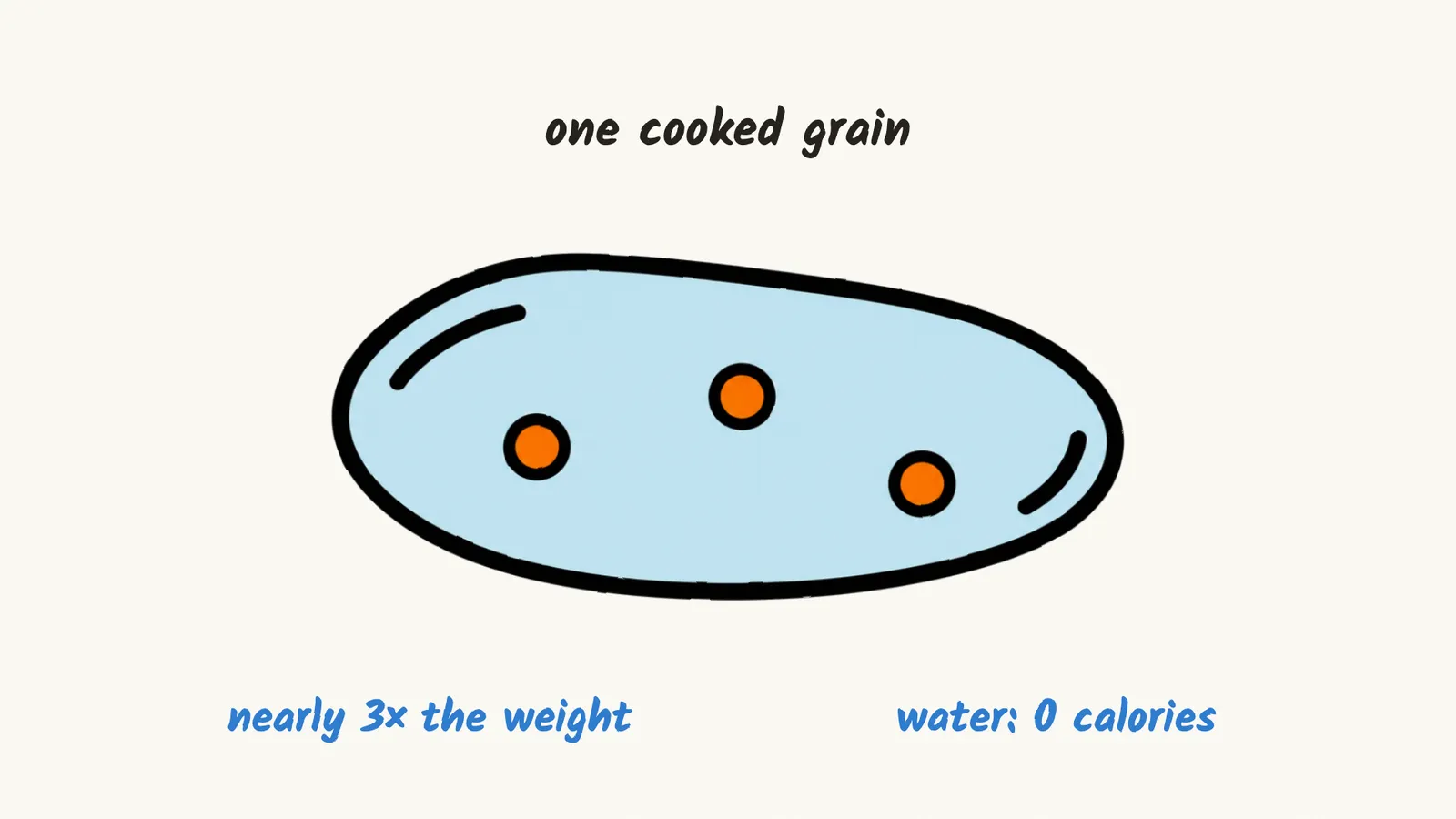
Mostly, they stay in the pot. A dry grain's energy comes mostly from starch. Cooking in plain water makes the grain soak up water and swell, and water adds no calories, so roughly the same energy sits in a bigger, wetter grain. Added ingredients, such as oil or butter, contribute their own energy.
The two USDA entries show it. Per 100 grams (rice solids means everything except water):
| Per 100 g | Water | Rice solids | Calories |
|---|---|---|---|
| White rice, raw (FDC 168877) | about 12 g | about 88 g | 365 |
| White rice, cooked (FDC 168878) | about 68 g | about 32 g | 130 |
How much heavier is cooked rice?
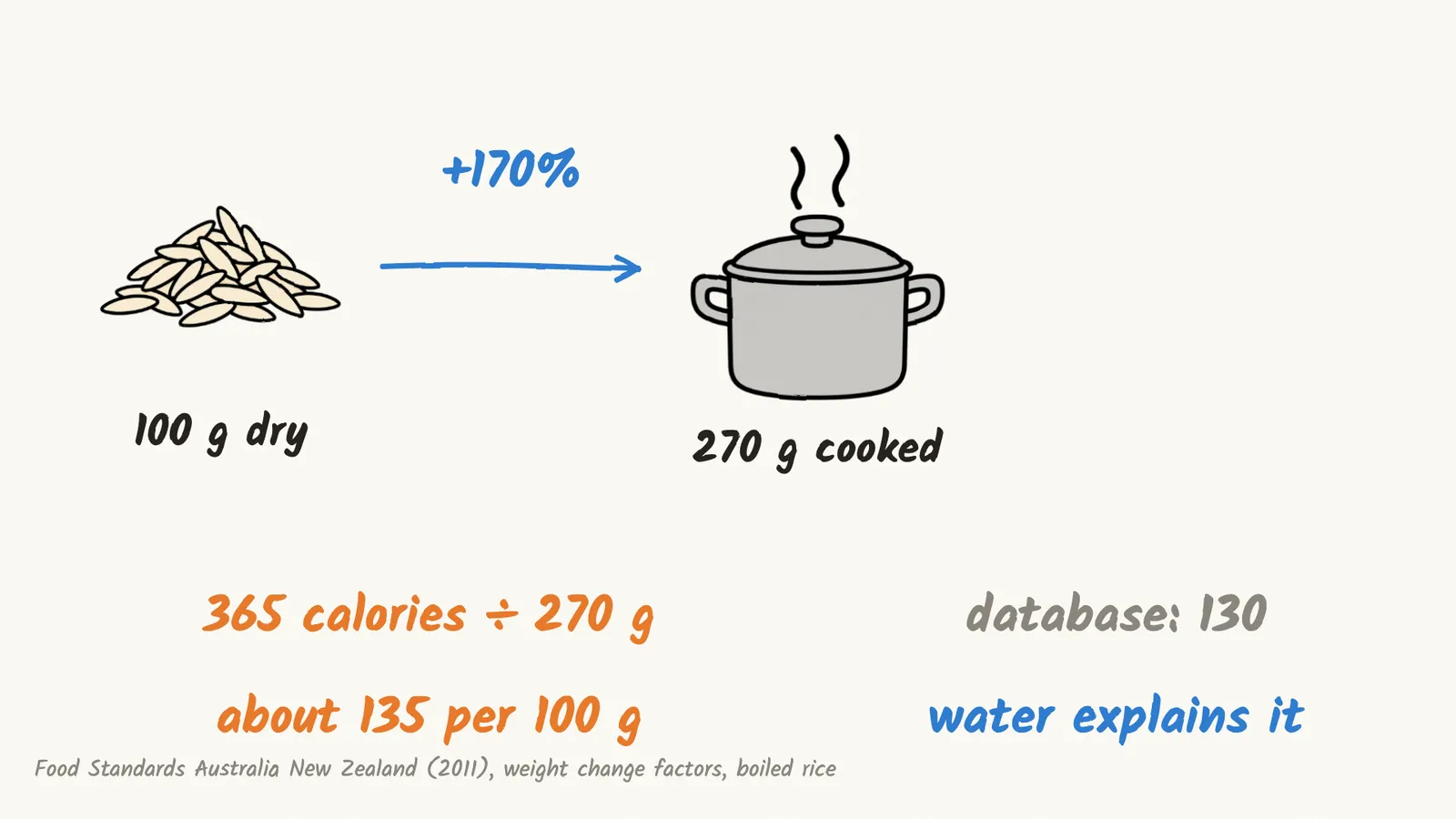
Food Standards Australia New Zealand lists an indicative weight change of plus 170 percent for boiled rice (Appendix 5 of its Nutrition Panel Calculator notes). So 100 grams of dry rice becomes roughly 270 grams cooked.
For an illustration, spread those 365 calories over 270 grams: about 1.35 calories per gram, or about 135 per 100 grams, close to USDA's cooked 130. It combines separate reference figures, so it shows the mechanism rather than measuring it.
Why does cooked rice weigh differently each time?
FSANZ calls its weight change factors “indicative only”. How much water stays in the rice depends on the rice type, the amount of water, the cooking time and whether the lid is on.
In a 1971 lab study, Bhattacharya and Sowbhagya found that 20 rice varieties took up between about 1.65 and 2.45 grams of water per gram of rice in 20 minutes of cooking. Draining matters too: rice boiled in plenty of water and drained loses some solids to the cooking water (Febina, John and Raman, 2023), and FSANZ notes that rinsing after cooking can change the energy content. No single conversion fits every pot.
Should you log rice cooked or dry?
Logging is optional. If you do log, choose the entry that matches the rice you are describing:
- Dry rice with a dry rice entry.
- Cooked rice with a cooked rice entry.
For these two entries, a mix-up can make the estimate nearly three times as large, or only about a third as large, because 365 is about 2.8 times 130.
kcalm, the app that made this article and the video, estimates meals from a photo, typing or voice, and you can correct the portion or the ingredients in chat, for example to say the rice was cooked. It is always an estimate, so the details you give it matter.
Does cooling rice lower its calories?
Chilling cooked rice can increase resistant starch, which resists digestion in the small intestine but can still provide some energy (Behall and Howe, 1996, a cornstarch study, so its numbers do not apply to leftover rice). In one small 2015 study, Sonia, Witjaksono and Ridwan found freshly cooked rice had about 0.64 grams of resistant starch per 100 grams, and rice refrigerated for 24 hours at 4 degrees Celsius and then reheated had about 1.65 grams: roughly one extra gram. Their human trial measured blood sugar response, not how many calories people absorbed.
In a 2021 randomized crossover trial in healthy adults, Wolever and colleagues found estimated starch digestibility was similar for hot and cold rice: about 94 percent and 93 percent, estimated from breath hydrogen. These studies do not tell us a dependable amount of calories to subtract from leftover rice.
For leftovers, the NSW Food Authority advises refrigerating within two hours, storing below 5 degrees Celsius and eating refrigerated rice within two days. If you reheat it, do so no more than once, until steaming hot all the way through. The UK Food Standards Agency is stricter: ideally chill rice within one hour and eat it within 24 hours.
What does this mean for your next meal?
Nothing about the rice changes. You do not need to eat more or less because you now know how this number works. “Per 100 grams” on a label is a reference amount for comparing foods, not a portion recommendation, and it always depends on how much water is in those 100 grams.
What this does not mean
- The lower number mainly reflects absorbed water, not lost energy. Draining can remove some solids, and oil or butter add their own energy.
- 2.7 is not an exact conversion. It is an indicative figure, and your pot may differ.
- The USDA numbers are reference values for one kind of white rice, not a measurement of yours.
- These studies do not tell us a dependable amount of calories to subtract from leftover rice.
- You do not need to weigh your food. If you choose to log, matching the entry is the part that matters.
Frequently Asked Questions
Does cooking rice remove calories?
No. The lower number per 100 grams comes from absorbed water. For rice cooked in plain water, the calories in the pot stay about the same; draining can pour away a little starch, and oil or butter add their own calories.
Should you weigh rice cooked or uncooked?
Either, as long as the entry matches the rice: dry rice with a dry entry, cooked rice with a cooked entry. For these USDA entries, mixing them up makes the estimate nearly three times as large, or about a third as large. Logging and weighing are optional.
How much heavier is rice after cooking?
Food Standards Australia New Zealand gives a typical gain of about 170 percent for boiled rice, so 100 grams dry becomes about 270 grams cooked. Rice type, water, cooking time, the lid and draining all change it.
How we made this
Made by kcalm, an iPhone food-logging app, so we are not neutral about food logging. The video uses an AI voice. We researched the script from the sources below and had it fact-checked by an AI model with live web search; no dietitian has reviewed it. General information, not medical or nutrition advice: for your own health, talk to your doctor or an accredited dietitian. Written 20 October 2026. Corrections welcome at [email protected].
If food or eating feels hard right now, you are not alone. In Australia, the Butterfly Foundation helpline is 1800 33 4673.
Sources
- USDA FoodData Central (2019). Rice, white, long-grain, regular, raw, enriched. FDC 168877. https://fdc.nal.usda.gov/food-details/168877/nutrients
- USDA FoodData Central (2019). Rice, white, long-grain, regular, enriched, cooked. FDC 168878. https://fdc.nal.usda.gov/food-details/168878/nutrients
- Food Standards Australia New Zealand (2011). Nutrition Panel Calculator: Explanatory Notes, Appendix 5. https://www.foodstandards.gov.au/sites/default/files/2023-12/npc-explanatory-notes-2011.pdf
- Bhattacharya KR, Sowbhagya CM (1971). Water uptake by rice during cooking. https://ir.cftri.res.in/7243/
- Febina M, John D, Raman M (2023). Physicochemical properties, eating and cooking quality and genetic variability: a comparative analysis in selected rice varieties of South India. https://link.springer.com/article/10.1186/s43014-023-00164-x
- Sonia S, Witjaksono F, Ridwan R (2015). Effect of cooling of cooked white rice on resistant starch content and glycemic response. PubMed abstract: https://pubmed.ncbi.nlm.nih.gov/26693746/
- Wolever TMS et al. (2021). Neither low salivary amylase activity, cooling cooked white rice, nor single nucleotide polymorphisms in starch-digesting enzymes reduce glycemic index or starch digestibility: a randomized, crossover trial in healthy adults. https://pubmed.ncbi.nlm.nih.gov/34293081/
- Behall KM, Howe JC (1996). Resistant starch as energy. https://pubmed.ncbi.nlm.nih.gov/8935440/
- NSW Food Authority. Leftovers. https://www.foodauthority.nsw.gov.au/consumer/food-extra-care/leftovers
- UK Food Standards Agency (2026). Home food fact checker. https://www.gov.uk/government/publications/home-food-fact-checker/home-food-fact-checker
Video transcript
The full narration of the video, with its chapter times. Watch it on YouTube: Cooked vs Uncooked Rice Calories: Where Do They Go?
0:00 Where do the calories go when you cook rice?
Here's a magic trick. Take 100 grams of dry white rice. Look it up, and you'll find about 365 calories. Now boil it, scoop out 100 grams of the cooked rice, and look that up: about 130. Two thirds of the calories, gone. So where did they go? Let's line up the suspects. The steam? Steam is just water, and water has no calories. The heat? Heat changes how starch behaves, but it doesn't make it disappear. And the pot? Cook rice the usual way, until it soaks up all the water, and there's nothing left to pour away. So the calories that went in are, give or take a crumb stuck to the bottom, still in that pot.
0:38 Why does cooked rice have fewer calories?
So the trick isn't in the rice. It's in two little words: 100 grams. Follow one grain. Dry, it's a tight little package, and most of its energy comes from starch, drawn here as orange dots. Drop it in hot water, and it drinks. And drinks. It ends up nearly three times as heavy, but water brings no calories, so no new dots appear. So here's the whole answer. Cooked rice has fewer calories per 100 grams because most of those 100 grams are now water. The calories didn't vanish. They got diluted.
1:11 Is 100 g of raw rice the same as 100 g cooked?
You can see it if you wring the water out of 100 grams of each, and stack it on top. Dry rice is almost all solid rice. Only about 12 grams is water. Cooked rice is about 68 grams of water, and only about 32 grams of rice solids. Same weight, about a third of the solids, so about a third of the calories. And the arithmetic checks out. Australia and New Zealand's food standards agency puts the weight gain from boiling at about 170 percent, so 100 grams of dry rice becomes about 270 grams cooked. Spread 365 calories over 270 grams, and you get about 135 per 100 grams. The database says 130. Not bad for a back-of-the-envelope sum: the water explains almost all of it.
1:56 Should you track rice cooked or uncooked?
Which sets up a classic food-logging mix-up. Log cooked rice with the entry for dry rice, and your number comes out nearly three times too high. Do it the other way round, and you get about a third of what it should be. The rice didn't change. Only the label did. So the rule is boring, but bulletproof: dry with dry, cooked with cooked. If you use kcalm, the app that makes this channel, you just snap or describe the rice the way it is on your plate, and fix the amount in the chat if it guessed wrong. It's an estimate, like every number in this video.
2:26 Does all rice soak up the same water?
Now, 170 percent is a typical figure, not a law. The kind of rice, how much water you use, how long it cooks, and whether the lid is on all change how much water ends up inside. Boil it in lots of water and drain it, and a little starch goes down the sink too. Butter or oil bring their own calories, of course. Water's the ingredient that adds weight without adding any.
2:49 Water adds weight, not calories
So, the magic trick? There was no magic. The calories never vanished. The water just changed what 100 grams means. This is Food, Explained, from kcalm.app. Next time: when you snap a photo of your dinner, can the photo see the oil?
Ready to track smarter?
Join thousands who use kcalm for calorie tracking. AI-powered food recognition, scientifically-validated calculations, and zero anxiety.