
kcalm vs SnapCalorie
SnapCalorie comes from a Google Lens engineer and uses your iPhone depth sensor for portion size, with published research behind it. kcalm trades some of that for chat logging and GLP-1 tracking.
- kcalm
- USD 14.99/mo or 69.99/yr · 15 AI analyses free · iOS, Telegram, WhatsApp
- SnapCalorie
- USD 19.99/mo or 149/yr · iOS, Android
kcalm Team
Nutrition & Wellness
Choose kcalm if
You want to fire a photo into a WhatsApp thread on the way out of a restaurant, you track GLP-1 medication, or you want an annual price under USD 50.
Choose SnapCalorie if
The camera estimate is the product for you, you carry an iPhone Pro and want depth-sensor portion maths, you want 100-plus micronutrients, or you want a native Android app.
Both apps point a camera at a plate. kcalm treats that as one of five ways in, alongside plain-language text, voice notes, Siri and chat logging from Telegram and WhatsApp, and it returns 42 nutrients, tracks GLP-1 shots, and costs USD 69.99 a year.
SnapCalorie treats the camera estimate as the entire product, and it has the strongest technical pedigree in the category. It comes from Perception Labs, Inc., co-founded by Wade Norris, who worked on Google Lens and co-authored the Nutrition5k paper at CVPR 2021 with Google Research. The app measures food volume with your iPhone's depth sensor, pulls nutrition from what its listing calls 500k+ foods verified against USDA data, and tracks calories, macros and 100+ micronutrients. It has an Android app, a barcode scanner and a nutrition label scanner, and its annual price on the US App Store is USD 149.00.
If precision from a photograph is what you are buying, SnapCalorie has done work nobody else in this category has. If your logging dies because you never opened the app, keep reading.
Quick comparison
| Feature | kcalm | SnapCalorie |
|---|---|---|
| Primary logging methods | Photo, text, voice, Siri, chat | Photo, voice, barcode, search, label scan |
| AI photo analysis | Yes | Yes, plus LiDAR depth on iPhone Pro |
| Plain-language input | Yes, describe a meal in words | Yes, voice notes and text hints |
| Chat logging (Telegram, WhatsApp) | Yes, both | No |
| Voice input | Yes, via the chat bots and Siri | Yes, in the app |
| Barcode or label scanning | No barcode scanner | Barcode scanner and nutrition label scanner, both free |
| Food database approach | AI estimate, no search-first flow | 500k+ foods verified against USDA data |
| Micronutrients | 42 nutrients, tap any meal for the breakdown | 100+ claimed on the App Store listing |
| GLP-1 medication tracking | Yes, shots, sites, side effects | Not listed |
| Exercise and wearables | Describe a workout, AI estimates the burn; Apple Health read only | Apple HealthKit sync for active calories |
| Ads | None | No third-party ads; some upgrade prompts |
| Platforms | iPhone, Telegram, WhatsApp. Android app in development | iPhone and Android |
| Free tier | 15 AI analyses, 3-day bot trial | 3 AI photo logs per day; text search and barcode logging uncapped |
| Paid price (USD) | 14.99 monthly, 69.99 yearly | 19.99 monthly, 149.00 yearly on the US App Store |
| Published accuracy research | None | Founder co-authored Nutrition5k (Google Research, CVPR 2021) |
| Feel | No streaks, no social feed | Photo-first visual timeline |
How logging actually works
kcalm: five ways in, one timeline
Photograph a plate, type "two flat whites and a banana", send a voice note, or message the Telegram or WhatsApp bot. Everything logged in chat syncs back to the iPhone app, so the record stays one timeline. For the mechanics, see how kcalm's food recognition works.
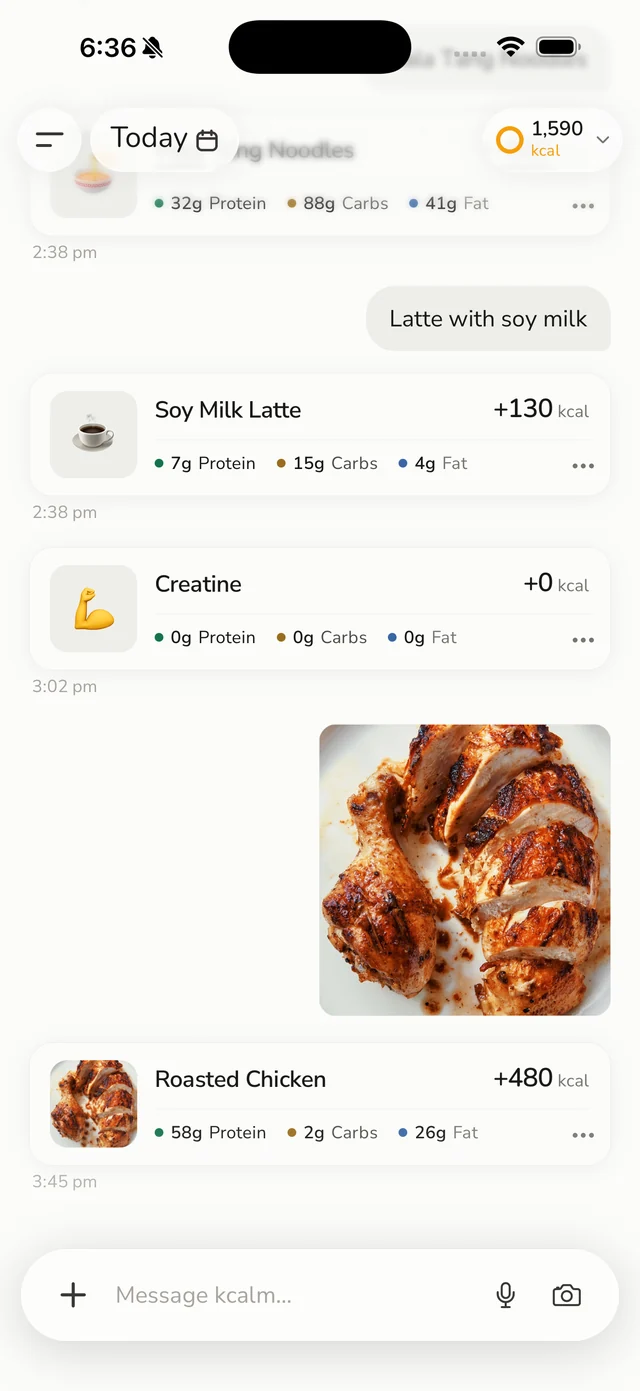
Targets come from Mifflin-St Jeor with standard activity multipliers, and macros use Atwater. A Base plus Exercise goal mode lets the target move with your training week, and typing "30 minute run" puts the estimated burn into the day's budget. Around that sit the daily surfaces: a lock-screen Live Activity, six home-screen widgets, one-tap water tracking, weigh-ins with progress photos, and a weekly AI briefing.
SnapCalorie: the camera, measured properly
SnapCalorie attacks the biggest source of error in photo logging, portion size, by measuring it: on an iPhone Pro it uses the LiDAR depth sensor to estimate food volume. Its FAQ is blunt about the limits: "perfectly measuring non-visible ingredients like oils, cooking fats, and sugar content would be impossible regardless of the approach or app used", so the model guesses from average values for that dish type plus visual cues. You can feed it hints, such as the menu description, and it folds them into the prediction.
The rest follows: voice dictation while you cook, a barcode scanner and a nutrition label scanner for packaged food, editable predictions, and Apple HealthKit sync. It has an in-app AI chat assistant, but no external messaging channel: nothing you send to Telegram or WhatsApp reaches it.
What one photo gives you back
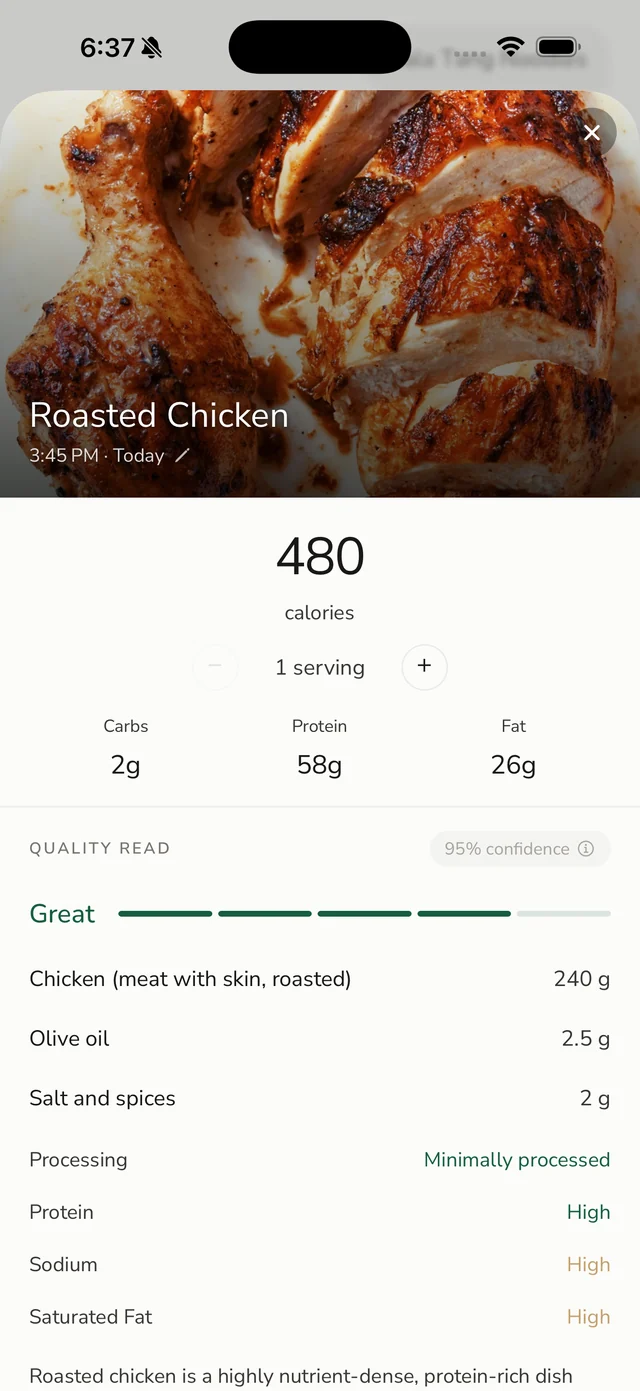
kcalm's estimate arrives itemised, with a confidence figure and the ingredient weights it inferred, which is what makes it correctable.
And the nutrient side, where SnapCalorie's advertised 100-plus beats kcalm's 42 on breadth.
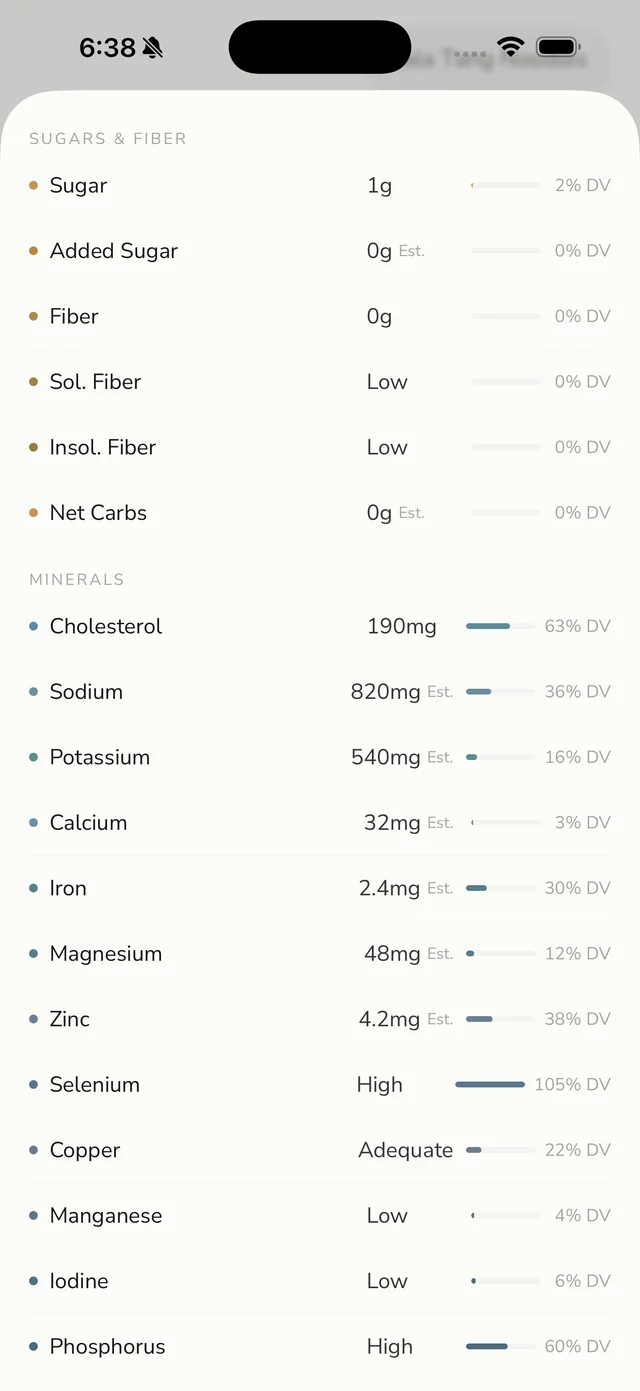
Neither app's micronutrients come from lab-analysed source data, so both are modelled figures. SnapCalorie lists more of them, and kcalm marks its own as estimates.
Logging without opening an app
This is the clearest structural difference between the two. kcalm runs a Telegram bot and a WhatsApp bot. You message a photo, a sentence or a voice note in whatever chat app you already have open, and it logs.
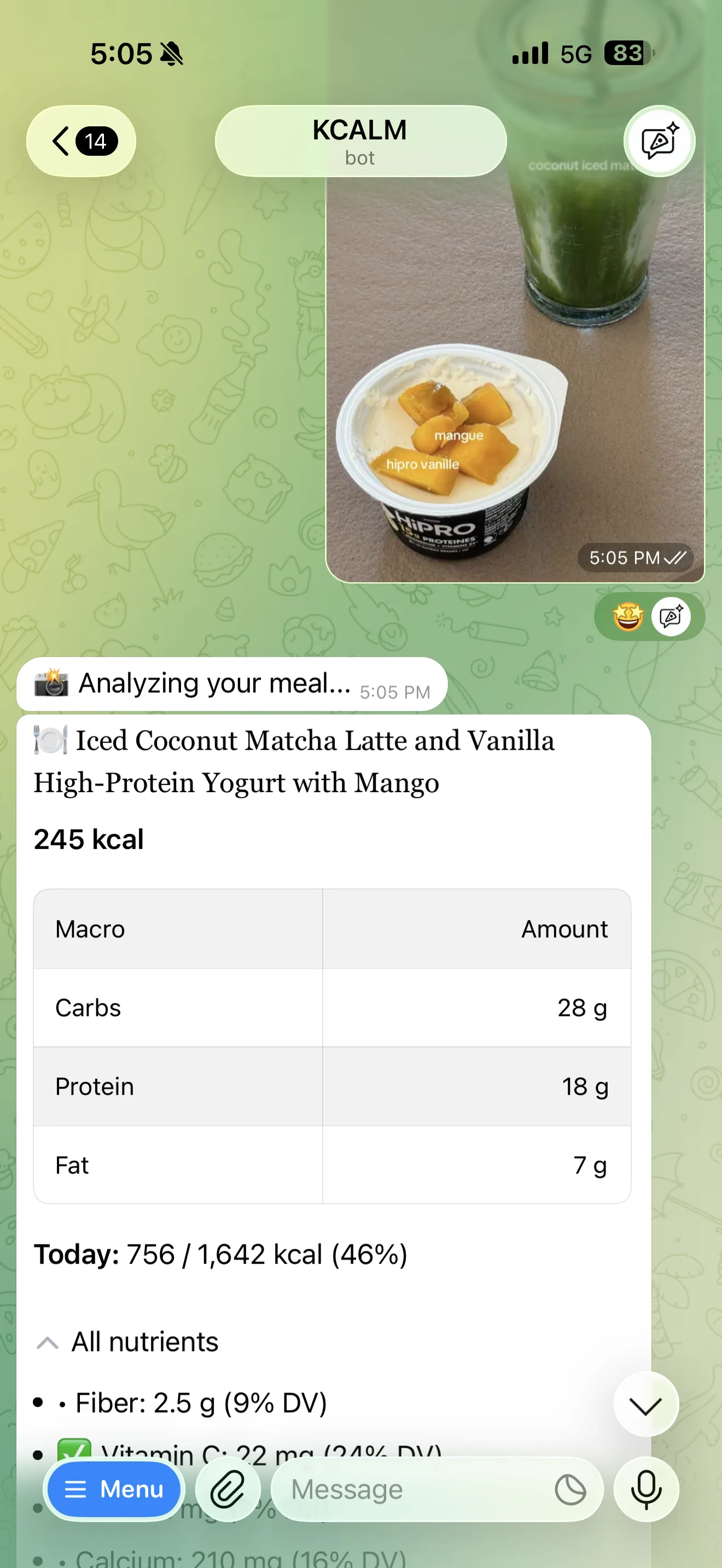
No app to launch, and it works wherever Telegram or WhatsApp runs, including an Android phone or a desktop chat client. Siri is the third route on iPhone. SnapCalorie has no equivalent to any of that: its logging methods all live inside the app, as does its AI chat assistant, so every entry starts with a launch. Perception Labs publishes a developer API, but that is for other companies to build on. If your failure mode is forgetting to open the tracker, that gap matters more than a few points of portion accuracy.
Accuracy, depth sensing, and what the research actually shows
The published research is real, and it is about a research model
Nutrition5k is a genuine peer-reviewed contribution. The paper released a dataset of 5,000 real dishes with video, depth images, per-ingredient weights and nutritional annotations, and reported a model that outperforms professional nutritionists on visual estimation. The dataset was released by Google Research, where Norris worked at the time, and SnapCalorie's FAQ describes the paper as "co-authored by Perception Labs, Inc (the parent company of SnapCalorie) and Google Research". A founder with a CVPR paper behind the method is more than almost any consumer tracker can show.
The honest caveat is scope: the paper evaluates a research model on a curated laboratory dataset, not the shipping app on your dinner. It is strong evidence the technique works, not a warranty on tonight's estimate.
What SnapCalorie itself claims
SnapCalorie's FAQ states it is "on average around 15% mean caloric error (that's +/- 150 calories on a 1000 calorie dish)". For context it offers three comparisons: nutrition labels are legally allowed 20 percent error, dietitians estimating from a photo run around 40 percent, and average users of other tracking apps run 53 percent. Those framing numbers are SnapCalorie's own, not an independent audit.
That first comparison applies to every tracker: nutrition labels are legally allowed to be 20 percent off. If the printed number on a packet can be off by a fifth, a photo estimate inside 15 to 20 percent is not the weak link people assume it is.
kcalm claims 10 to 20 percent for most foods and nothing more precise, with no published benchmark, dataset or paper. On single-photo portion precision, SnapCalorie has done the work and kcalm has not. Where kcalm argues back is capture rate: a 15 percent error on a meal you logged beats a 5 percent error on a meal you skipped. For the wider picture, see how accurate AI food recognition is.
GLP-1 medication support
kcalm has a dedicated GLP-1 section: shot logging with estimated medication levels between doses, injection-site rotation, and side-effect tracking for Wegovy, Ozempic, Mounjaro and Zepbound. See GLP-1 calorie and protein targets for the numbers side.
SnapCalorie lists no GLP-1 features on its App Store listing, its website or its FAQ. Its wider nutrient list helps if reduced intake has you worried about vitamin and mineral shortfalls, a real risk on a GLP-1, but medication tracking is not part of the product. This is not a category-wide gap any more: MyFitnessPal shipped free GLP-1 support in April 2026, so kcalm is early rather than alone.
Privacy and data
kcalm processes meal photos for analysis, does not store them permanently, and states that your images are never used for AI training. Data is encrypted in transit and at rest, isolated with Row Level Security, and deletable in full at any time. No advertising, and guest mode lets you start without registering, as set out in the privacy policy.
SnapCalorie states on its homepage that "Your data is encrypted and private. We never sell your information." Its FAQ names Apple Health as the only fitness integration. Neither app runs third-party advertising.
Pricing
| Plan | kcalm | SnapCalorie |
|---|---|---|
| Free tier | 15 AI food analyses, no card required | 3 AI photo logs per day; text search and barcode logging uncapped |
| Trial | 3-day free trial on the chat bots | Not stated on the official free-trial page; third-party reviews report 7 days |
| Monthly | USD 14.99 | USD 19.99 |
| Yearly | USD 69.99 (about USD 5.83 a month) | USD 149.00 |
| Billing | Apple in-app purchase, cancel in iPhone Settings | Apple and Google in-app purchase |
SnapCalorie's pricing is the least transparent thing about it. The homepage says "Free forever. Core features are completely free." The FAQ says "SnapCalorie is FREE for up to 3 AI logs per day" with a premium subscription on top. Its free-trial page states something different again, that free users get every logging method but are "capped at one photo log per day". The US App Store lists Premium at USD 19.99 monthly and USD 149.00 annually plus eight unnamed price points from USD 9.99 to USD 99.99, and Google Play lists in-app purchases from USD 15.99 to USD 149.99.
Where SnapCalorie is the better buy
- Its co-founder co-authored Nutrition5k at CVPR 2021 with Google Research, an open dataset of 5,000 weighed dishes, a pedigree almost no consumer tracker can match, and LiDAR volume measurement on iPhone Pro attacks portion size instead of guessing at it.
- It has a native Android app, with 500,000 or more downloads and a 4.6 star average across roughly 22,400 Google Play reviews. The kcalm Android app is in development, with WhatsApp and Telegram logging available now.
- Its listing advertises 100 or more micronutrients including vitamins, minerals and amino acids, against the 42 on kcalm's listing.
- A 500,000-plus food database verified against USDA data gives you a manual fallback when the camera reads a dish wrong, plus a barcode scanner and a nutrition label scanner, both uncapped on the free tier, where kcalm has no barcode scanning at all.
- The free tier is genuinely usable rather than a demo: 3 AI photo logs a day plus uncapped barcode and text logging, and a July 2026 reviewer wrote that "the free version gives you everything you need already".
Where kcalm is the better buy
- You can log from Telegram or WhatsApp without opening any app, which SnapCalorie has no equivalent for, and five ways in means a bad photo is not the end of the log.
- GLP-1 shot tracking with estimated medication levels, injection-site rotation and side-effect logging, which SnapCalorie does not offer. On a low-appetite day one message to the bot still leaves a record rather than a gap.
- A year costs USD 69.99 against USD 149.00, so kcalm lands a little under half the price, and a month is USD 5 cheaper.
- Estimates arrive itemised with a confidence figure, so a wrong number can be traced to the ingredient that caused it.
- No streaks to break, no social feed and no advertising, on the free tier as well as the paid one.
- Guest mode lets you start tracking without creating an account.
Switching takes about two minutes
Nothing to export, and SnapCalorie's free tier is worth keeping for its barcode scanner.
Install kcalm, use guest mode, and log the next meal in both. If you have an iPhone Pro, SnapCalorie's depth measurement should give it the edge on portion size, so run the test on a day you eat something the camera cannot see into: a stew, a curry, a bowl. Then send one to the Telegram bot on your way out of a restaurant and see which app you would actually have used. Fifteen free analyses is about three days.
The bottom line
SnapCalorie is the better buy if precision from a photograph is what you are paying for, if you carry an iPhone Pro and want the depth sensor doing the portion maths, if you want the wider nutrient list, or if you want a native Android app. Android users can use kcalm through its WhatsApp or Telegram bots. Its free tier is also the more generous of the two if you only log a few meals a day.
kcalm is the better buy if what breaks your tracking is friction rather than accuracy: firing a photo into a WhatsApp thread on the way out of a restaurant, keeping Wegovy or Mounjaro shots and side effects beside your food log, and an annual price under half SnapCalorie's. The Android app is in development. Current limits include no web tracker, no barcode scanner and a narrower nutrient list. Install it and log one meal from a chat thread, which is the thing SnapCalorie cannot do at any price.
Frequently Asked Questions
Is there a free alternative to SnapCalorie?
Yes, including kcalm. Its free tier gives you 15 AI food analyses with no credit card, plus tracking across 42 nutrients, personalised goals, progress charts and guest mode, and the chat bots have a 3-day trial. SnapCalorie's own FAQ describes its free tier as up to 3 AI logs per day, with barcode and text logging uncapped, though its homepage calls core features free forever.
Is kcalm cheaper than SnapCalorie?
Yes, on both plans. kcalm Premium is USD 14.99 a month or USD 69.99 a year, about USD 5.83 a month. SnapCalorie's US App Store listing shows Premium at USD 19.99 monthly and USD 149.00 annually, so the annual gap is the wide one. SnapCalorie's free tier is the more generous of the two if you only log a few meals a day.
Does kcalm work on Android?
Yes. You can already use the kcalm bots on WhatsApp or Telegram on Android for the same AI chat experience, including photo, text and voice logging. The native Android app is in development. Charts, home-screen widgets and offline meal viewing are currently available in the iOS app.
Can I track calories without opening an app?
With kcalm, yes. Message the Telegram or WhatsApp bot a photo, a sentence or a voice note and it logs, then syncs to the iPhone app, or say "Hey Siri, log my lunch" on iPhone. SnapCalorie has an in-app AI assistant but no Telegram, WhatsApp or Siri route, so every log still starts by opening the app.
How accurate is SnapCalorie really?
SnapCalorie's FAQ states around 15 percent mean caloric error, which it describes as plus or minus 150 calories on a 1,000 calorie dish, and its method traces back to the Nutrition5k paper its co-founder worked on at CVPR 2021. That paper evaluates a research model on a curated dataset rather than the shipping app on your meal, so treat 15 percent as the company's own figure. kcalm claims 10 to 20 percent for most foods and has published no benchmark, so neither number is independently audited.
Does SnapCalorie track GLP-1 medications like Ozempic or Mounjaro?
Not as a listed feature. Nothing on SnapCalorie's website, FAQ or App Store listing mentions GLP-1 tracking. kcalm has a dedicated GLP-1 section with shot logging, estimated medication levels, injection-site rotation and side-effect tracking for Wegovy, Ozempic, Mounjaro and Zepbound.
What do SnapCalorie users complain about in 2026?
Recent App Store reviews cluster on the May 2026 interface redesign. A one-star review titled "Ruined by Recent User Interface Update" says the update "turned out to be a big downgrade", singling out a home-page calendar that shows day and date but not month, and a diary view that lost its chronological breakfast, lunch, dinner and snack breakdown. Other 2026 reviews are positive, and a July 2026 five-star review notes there are "pop ups, but no ads(!!)". Updates have shipped since, most recently version 140.2.0 on 3 August 2026, and the overall rating is 4.7 stars across roughly 6,200 US ratings.
Sources
- SnapCalorie official FAQ, pricing and accuracy claims: https://www.snapcalorie.com/faq.html
- SnapCalorie homepage, free tier and marketing claims: https://www.snapcalorie.com/
- SnapCalorie on the US App Store, rating, version and in-app purchase prices: https://apps.apple.com/us/app/snapcalorie-ai-calorie-counter/id1574239307
- SnapCalorie on Google Play, Android rating, downloads and in-app purchase range: https://play.google.com/store/apps/details?id=com.snapcalorie.alpha002
- SnapCalorie free-trial page, free-tier logging methods and photo cap: https://www.snapcalorie.com/free-trial.html
- Nutrition5k: Towards Automatic Nutritional Understanding of Generic Food, CVPR 2021: https://arxiv.org/abs/2103.03375
- Nutrition5k dataset release by Google Research: https://github.com/google-research-datasets/Nutrition5k
- kcalm pricing and features: https://kcalm.app
Keep SnapCalorie. Add kcalm for a week.
Nothing to export, nothing to cancel, no account to create. Log the next meal both ways and keep whichever one you actually opened.
15 AI analyses free, no card and no account needed.
Other comparisons

kcalm vs Cal AI
The viral photo-first tracker two US high schoolers built, past 15 million downloads and acquired by MyFitnessPal in March 2026. Still on the App Store, still does not publish a price.

kcalm vs MyFitnessPal
The category default since 2005, now with 20 million-plus food entries, a barcode scanner, free GLP-1 support in the US, and ads on the free tier.

kcalm vs Cronometer
The precision tracker: lab-analysed data from NCCDB, USDA and NUTTAB, up to 92 nutrients a day, a barcode scanner on the free tier, and a data-dense interface.