

kcalm vs Cal AI
Cal AI is on the App Store despite pages claiming otherwise, and MyFitnessPal now owns it. How its photo-first logging and unpublished pricing compare with kcalm at USD 69.99 a year.
- kcalm
- USD 14.99/mo or 69.99/yr · 15 AI analyses free · iOS, Telegram, WhatsApp
- Cal AI
- Unpublished, IAPs to USD 29.99 · iOS, Android
kcalm Team
Nutrition & Wellness
Choose kcalm if
You want a published price before you install, you want to log from a Telegram or WhatsApp message, or you track GLP-1 shots and would rather not be sold a streak repair.
Choose Cal AI if
You want a native Android app, you want barcode scanning against MyFitnessPal-scale food data, or you land on its cheapest annual offer and price decides it.
Both apps read a plate from a photograph. The difference is everything that happens around it. kcalm gives you five ways in: photograph the meal, type a sentence, ask Siri, send a voice note, or message a Telegram or WhatsApp bot from any phone. Every entry comes back with 42 nutrients rather than a macro count, GLP-1 shots sit next to the food log, and there is no streak to break and nothing to buy back when you miss a day.
Cal AI is the photo-first tracker two American high schoolers built and launched in 2024. It passed 15 million downloads, and MyFitnessPal bought it in a deal announced on 2 March 2026. It has a native Android app, a barcode scanner, MyFitnessPal's database behind it, and it is very likely the cheaper of the two.
One thing to clear up first, because several competitor sites still run pages headlined "Cal AI removed from the App Store". Cal AI is on the App Store right now: version 26.31.0 shipped on 7 August 2026 and the listing carries 4.8 stars from 350,786 ratings. The removal was real, it happened in mid-April 2026, and the app was back about a day later.
Quick comparison
| Feature | kcalm | Cal AI |
|---|---|---|
| Logging methods | Photo, text, voice, chat | Photo, barcode, typed description |
| Design and feel | Calm, no scoring or shaming | Gamified: streaks, badges, groups |
| Plain-language text input | Yes | Yes |
| Voice and Siri logging | Voice notes via the chat bots, Siri hands-free on iPhone | Not listed |
| Chat logging (Telegram, WhatsApp) | Yes, both | No |
| Barcode scanning | No | Yes |
| Food database | AI estimation, no manual database search | MyFitnessPal, 20M+ foods, 380+ chains |
| Micronutrients | 42 nutrients, including iron, vitamin D, omega-3, B vitamins | Calories, macros, fiber; sodium and sugar as secondary metrics |
| GLP-1 medication tracking | Yes, shots, sites, side effects | Not listed |
| Exercise and steps | Exercise logged in plain language, AI estimates the burn; no step sync | Steps via Apple Health and Google Fit |
| Streaks and gamification | None | Streaks, milestone badges, USD 0.99 streak restore |
| Social feed | None | Public Groups |
| Ads | None | None listed |
| Platforms | iOS, Telegram, WhatsApp. Android app in development | iOS 18+, Apple Watch, Android 10+ |
| Free tier | 15 AI analyses, no card required | Free app; AI photo analysis paywalled |
| Price | USD 14.99/month, USD 69.99/year | Not published; App Store IAPs USD 2.99 to 29.99 |
How logging actually works
kcalm: five ways in, one timeline
Photograph the plate. Type "large flat white and a ham and cheese croissant". Send a voice note. Say "Hey Siri, log my lunch" without touching the screen. Or message the Telegram or WhatsApp bot from whatever device is in your hand. It all lands in the same timeline.
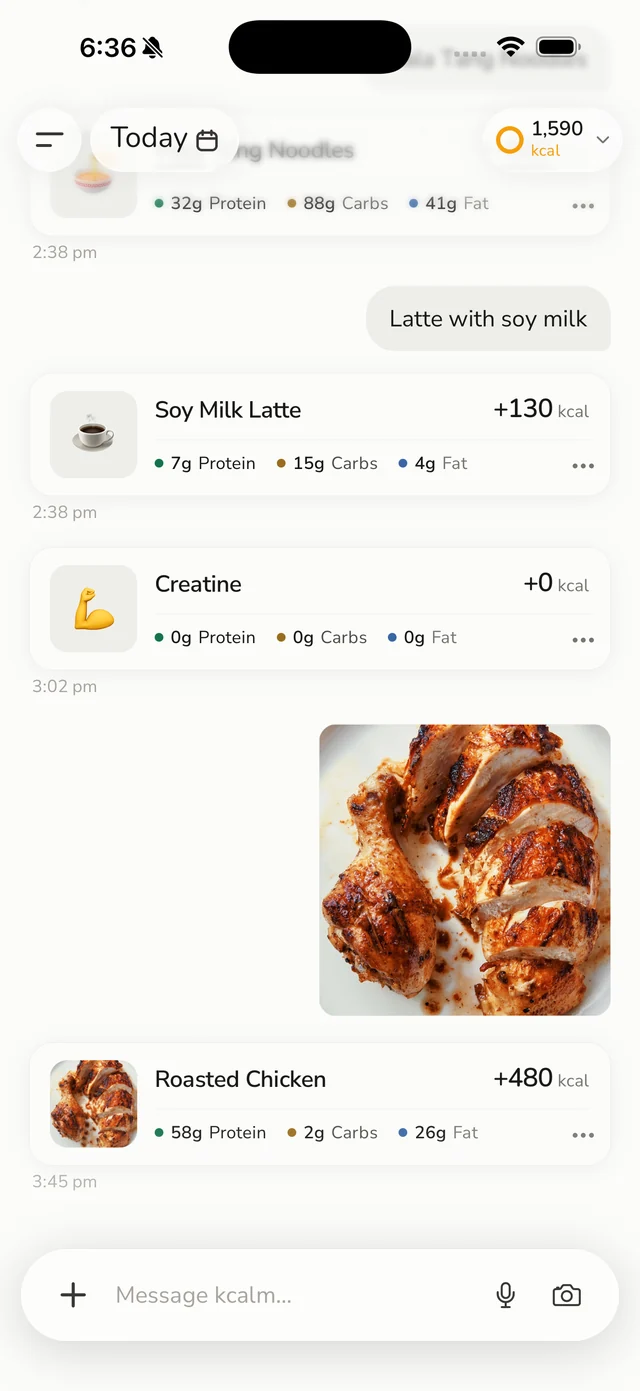
kcalm's accuracy claim is deliberately modest: within 10 to 20 percent of actual for most foods, roughly the tolerance the law already allows on a packaged nutrition label. Background in how accurate AI food recognition really is. What kcalm lacks is a barcode scanner or a searchable database, a real gap if you eat a lot of packaged food.
Cal AI: photo scan, barcode, and typed descriptions
Cal AI's pitch is three steps: answer onboarding questions, photograph the meal, read the breakdown. It also scans barcodes, accepts typed descriptions, and syncs steps from Apple Health or Google Fit. Since the acquisition it queries MyFitnessPal's database of 20 million-plus foods, 68,500 brands and meals from over 380 restaurant chains, a genuinely large advantage over any small AI tracker.
The catch is where the paywall sits. Cal AI's App Store description carries the line "FOOD SCANNING ANALYSIS RESULTS REQUIRE A SUBSCRIPTION". Barcode scanning and manual search stay available without paying, but the AI photo analysis most people install for does not: that sits behind a 3-day trial which requires payment details up front.
What one photo gives you back
Cal AI returns calories, macros and fiber, with sodium and sugar as secondary metrics. kcalm returns the same photo broken into ingredients with a confidence score attached.
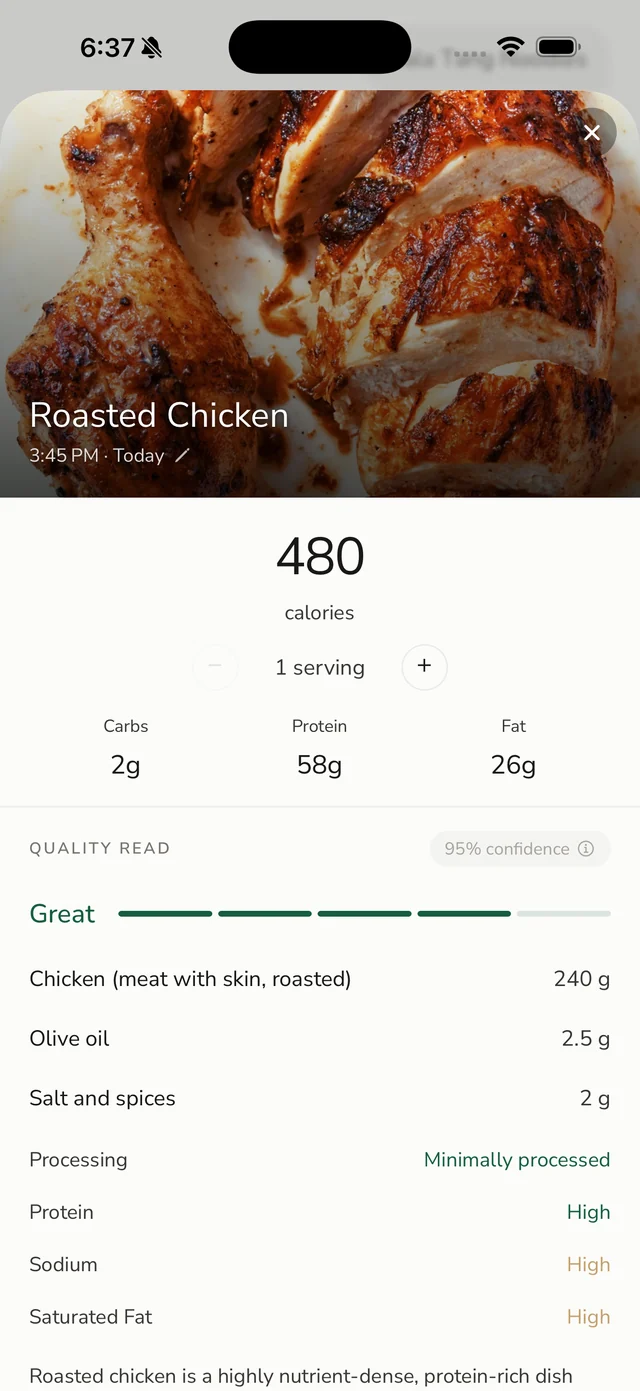
Then it keeps going, into the 42 nutrients that are the actual difference between these two products. Iron at 30 percent of the daily value, zinc at 38, selenium at 105, each marked "Est." so it is clear which numbers are inferred.
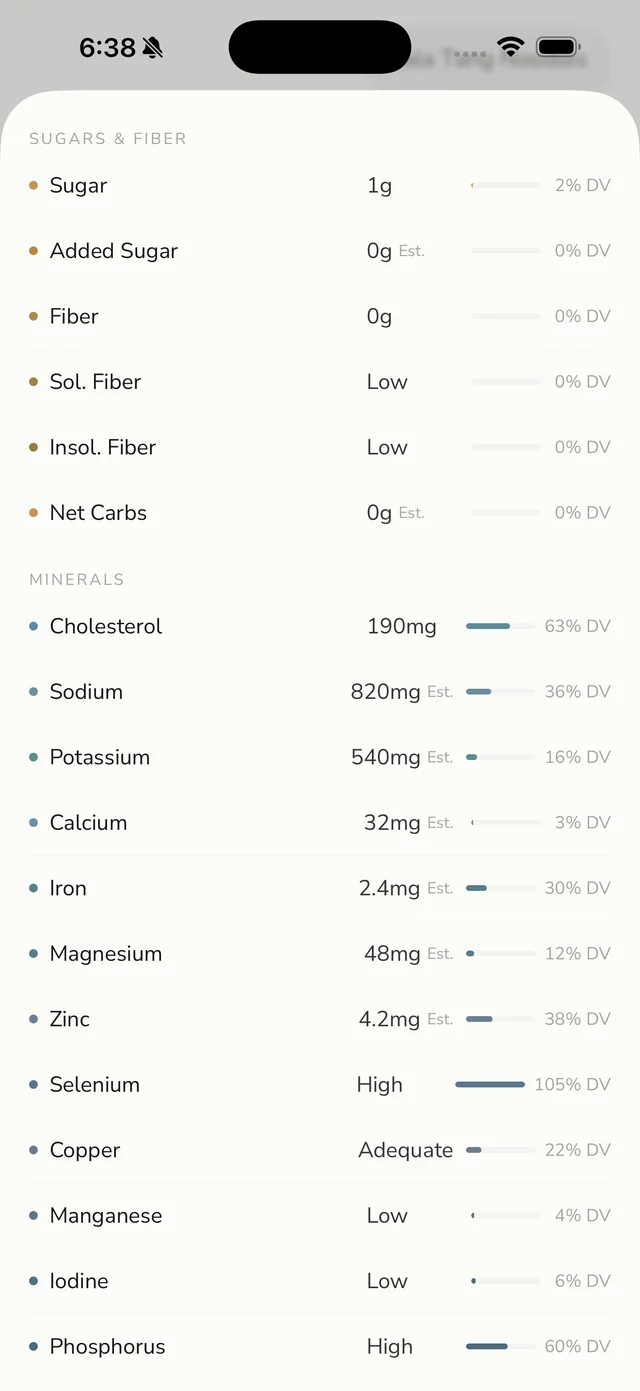
If you are eating less than you used to, whether by diet or by medication, the calorie number is the easy part and the micronutrient shortfall is the one that catches people out. That is the gap Cal AI's macro count leaves open.
Logging without opening an app
This is the clearest structural difference between the two. Cal AI is an app: to log lunch you wake the phone, find the icon, wait for the camera, and shoot.
kcalm takes the app out of the loop. Send a photo, a sentence, or a voice note to the Telegram bot or the WhatsApp bot, in the conversation list you already have open, and it is logged, then mirrored into the iOS app.
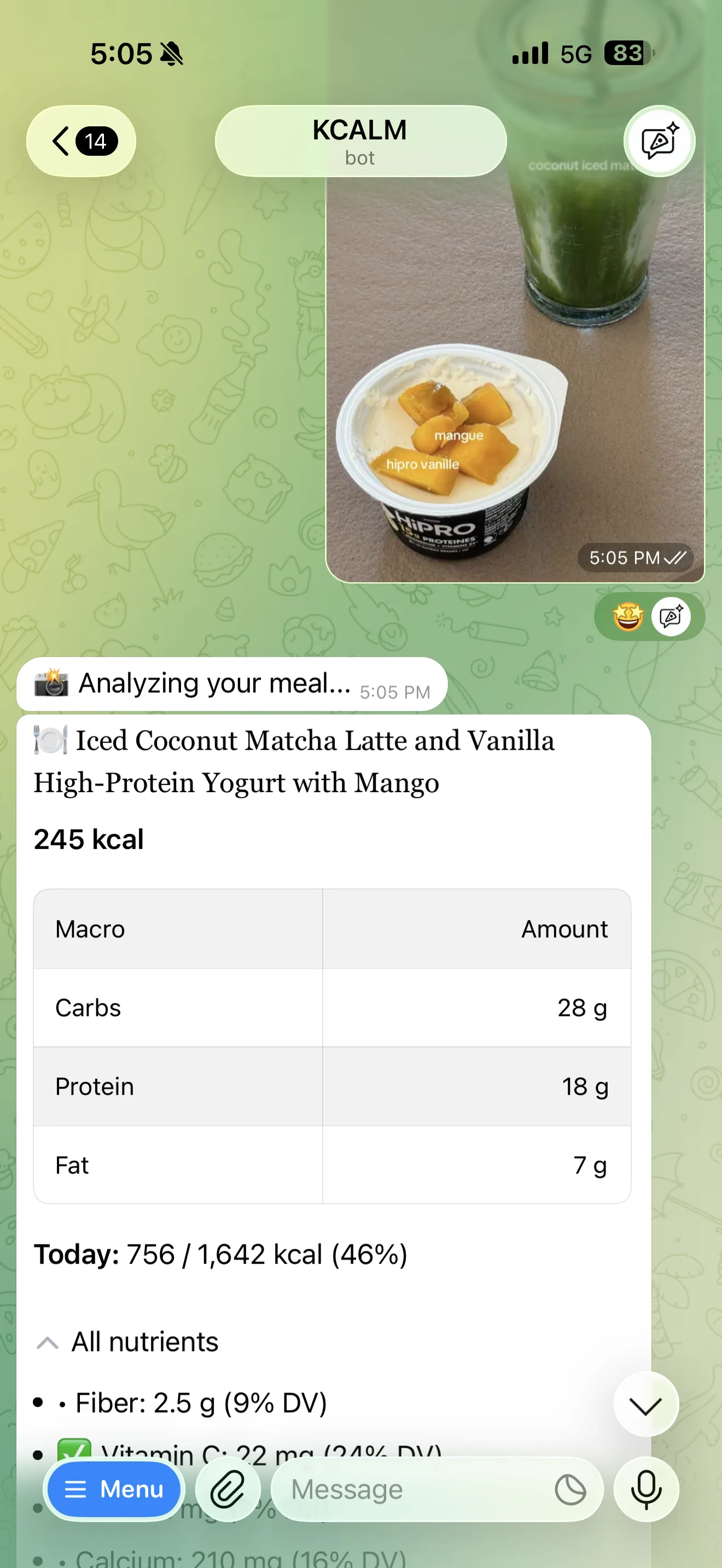
On an iPhone there is a third route that skips the screen entirely: "Hey Siri, log my lunch" records the meal hands-free. Reading the numbers back is similarly hands-off, with calorie progress live on the lock screen and six home-screen widgets. Cal AI has no equivalent for any of that: no Telegram bot, no WhatsApp integration, no Siri logging. Its answer to glanceability is the Apple Watch app, which kcalm has no version of. Android users can already use the same chat experience through the bots while the native Android app is in development.
What actually happened to Cal AI in 2026
It was pulled in April, then reinstated a day later
Apple pulled Cal AI in mid-April 2026 and it was back on 17 April. Apple cited App Review Guidelines 3.1.1 and 3.1.2c plus Developer Code of Conduct section 5.6. The specifics, per TechCrunch and PiunikaWeb: an embedded Superwall-powered Stripe checkout that bypassed Apple's in-app purchase flow, a weekly calculated price displayed more prominently than the amount actually billed, automatic renewal obscured in the free-trial toggle, and a second, different subscription offer pushed at users who declined the first.
Cal AI addressed what Apple flagged and the app returned. A day offline is not an existential event, and pages still describing it as delisted are four months out of date. But the design decisions Apple objected to are the same ones that recur in its one-star reviews, and those did not all vanish with the fix.
It is now a MyFitnessPal subsidiary
The deal closed in December 2025 and was announced on 2 March 2026. MyFitnessPal's press release put Cal AI at over USD 40 million in sales in the last 12 months; TechCrunch reported more than 15 million downloads in under two years and a team of seven, including co-founder and CEO Zach Yadegari, retained after the sale. The database got much better and the company is not going to disappear. It also means Cal AI is now one product inside a portfolio serving 280 million-plus members.
About that accuracy number
Third-party pages claim Cal AI is 95, 99, even 99.8 percent accurate. We could not trace any of those figures to Cal AI or MyFitnessPal, so discount them. Cal AI's own FAQ states: "CalAI is about 80% accurate. No food tracking app is perfect, and calories and nutrition values can vary." Yadegari has separately described it publicly as a little over 90 percent on average. Neither figure rests on a peer-reviewed benchmark, and neither does kcalm's 10 to 20 percent range. Nobody here has third-party validation, ours included. See what researchers found testing LLMs on meal photos.
GLP-1 medication support
kcalm has GLP-1 tracking built into the iOS app: log each injection, see estimated medication levels between shots, rotate injection sites, and record side effects, for Wegovy, Ozempic, Mounjaro and Zepbound. The chat bots matter more here than anywhere else. On a low-appetite day, when opening a calorie app is the last thing you want, one line sent to WhatsApp still leaves a record instead of a gap. See GLP-1 calorie and protein targets.
Cal AI lists no GLP-1 or medication tracking. Its parent does: MyFitnessPal launched free GLP-1 Support on 28 April 2026 for US users. That announcement concerns the MyFitnessPal app and says nothing about Cal AI. So if GLP-1 tracking is why you are here, MyFitnessPal gives it free, kcalm gives it with chat logging attached, and Cal AI does not give it at all.
Privacy and data
kcalm processes meal photos for analysis and does not store them permanently. Data is encrypted in transit and at rest, isolated per user with Row Level Security, and deletable in full at any time. There is no advertising, and guest mode lets you use the app without registering. Details are in the privacy policy.
Cal AI's onboarding runs the other way. It collects height, weight, age, birth date, activity level and goals, and asks to connect Apple Health, before disclosing that scanning requires payment. Billing and paywall complaints are the dominant negative theme in its reviews, and Apple's own finding in April 2026 was that the paywall "misled customers by displaying the weekly calculated pricing more prominently than the amount the user would be billed".
Pricing
| Plan | kcalm | Cal AI |
|---|---|---|
| Free tier | 15 AI food analyses, no card | Free app, but AI photo analysis requires a subscription |
| Free trial | 3 days on the chat bots | 3 days, payment details required |
| Monthly | USD 14.99 | Not published |
| Yearly | USD 69.99 (about USD 5.83 a month) | Not published |
| Billing | Apple in-app purchase | Apple or Google in-app purchase |
What kcalm offers instead is a number you can read before you install. Neither calai.app nor its FAQ lists a subscription price, so you find out what you owe when the paywall renders, and which paywall you land in varies. kcalm publishes USD 14.99 and USD 69.99, and its free tier runs 15 AI analyses with no card, where Cal AI puts the photo analysis you came for behind a trial that takes your payment details first.
Where Cal AI is the better buy
- The fastest, simplest photo-first flow in the category: onboarding to a logged meal in about three seconds, with nothing to learn. That is why it reached 15 million downloads.
- A native Android app and an Apple Watch app. The kcalm Android app is in development, and Android users can already use WhatsApp or Telegram for the same AI chat experience.
- Barcode scanning plus MyFitnessPal's database behind it: 20 million-plus foods, 68,500 brands and 380-plus restaurant chains, so a branded or chain-restaurant item resolves to a real catalogue entry rather than an estimate.
- Its commonly reported annual price, around USD 29.99, undercuts kcalm's USD 69.99 by a wide margin, and it syncs steps from Apple Health and Google Fit where kcalm reads Apple Health on device only.
- A far larger evidence base and a stable owner: 350,786 iOS ratings at 4.8 stars, 272,000 Google Play reviews at 4.6, and Public Groups for social accountability that kcalm has no version of.
Where kcalm is the better buy
- Logging happens in Telegram or WhatsApp, so it survives the days you never open an app, and it works from an Android phone.
- Every meal comes back with 42 nutrients, not calories, macros and fiber, which is what you want if you are eating less than you used to.
- GLP-1 injection tracking, site rotation and side-effect logging are built in. Cal AI has none of it.
- No streaks, no milestone badges, and nothing to buy back when you miss a day. Cal AI sells a USD 0.99 Streak Restore.
- Voice notes are a first-class logging method, and Siri logs hands-free.
- The free tier needs no credit card: 15 AI analyses, guest mode, full manual tracking. Cal AI's trial takes your payment details first.
- Prices are published in plain USD before you install, and billing runs through Apple's standard in-app purchase, cancellable in iPhone Settings.
Switching takes about two minutes
Nothing to export and nothing to cancel. Keep Cal AI installed if you like it, and let the two run side by side for a few meals.
Install kcalm, use guest mode so there is no account and no card, and photograph the next thing you eat. Then compare: same plate, two estimates, and one of them itemises the ingredients and fills in the iron and zinc. Fifteen free analyses covers about three days. If you are on a GLP-1, log one shot too, since that is the feature Cal AI has no answer for.
The bottom line
Cal AI is the right pick if you want a native Android app, want the simplest possible photo-and-go loop, eat a lot of packaged or restaurant food and want barcode scanning against a serious database, or if price decides it and you land on the USD 29.99 annual paywall. It passed 15 million downloads for defensible reasons, and MyFitnessPal ownership makes it more solid, not less.
kcalm is the right pick if what breaks your tracking is friction and guilt rather than database coverage. Logging by message means the days you least want to open an app still get logged, GLP-1 shots sit next to your food, every meal returns 42 nutrients, and there is no streak and no 99 cent penance for a missed day. The Android app is in development. For now, kcalm has no barcode scanner and includes 15 free analyses. Install it, photograph one meal, and see which breakdown you would rather have.
Frequently Asked Questions
Was Cal AI removed from the App Store?
Briefly. Apple pulled it in mid-April 2026 over in-app purchase and billing violations, including a Superwall-powered Stripe checkout that bypassed Apple's payment flow, and it was reinstated on 17 April 2026 after the developer addressed the issues. As of 10 August 2026 it is live at version 26.31.0 with 350,786 ratings. Pages claiming it is still delisted are out of date.
Is there a free alternative to Cal AI?
Cal AI's App Store description states that food scanning results require a subscription, so its free tier excludes the feature most people install it for, though barcode scanning and manual search remain available. kcalm gives you 15 AI food analyses with no credit card, plus manual tracking, personalised goals, progress charts and guest mode. Neither app is free forever, but kcalm lets you test the AI before paying.
Does kcalm work on Android?
Yes. You can already use the kcalm bots on WhatsApp or Telegram on Android for the same AI chat experience, including photo, text and voice logging. The native Android app is in development. Charts, home-screen widgets and offline meal viewing are currently available in the iOS app.
Is kcalm cheaper than Cal AI?
No. kcalm is USD 14.99 a month or USD 69.99 a year. Cal AI does not publish prices, but its App Store in-app purchases run from USD 2.99 to USD 29.99 and reviewers commonly report USD 29.99 a year, which undercuts kcalm. kcalm's argument is transparency, 42 nutrients, GLP-1 tracking and chat logging, not the lowest price.
Can I track calories without opening an app?
With kcalm, yes. Message the Telegram or WhatsApp bot with a photo, a sentence like "two eggs on sourdough", or a voice note, and it logs and syncs to the iOS app. Cal AI has no chat, WhatsApp or Telegram logging, so every entry starts by opening the app.
How accurate is Cal AI?
Cal AI's own FAQ says the app "is about 80% accurate", and its CEO has publicly described it as a little over 90 percent on average. Third-party pages quoting 95, 99 or 99.8 percent trace back to no source we could find. No photo calorie tracker, kcalm included, has published a peer-reviewed accuracy benchmark.
Does Cal AI track GLP-1 medication like Ozempic?
Cal AI lists no medication tracking. Its parent added free GLP-1 Support to the MyFitnessPal app on 28 April 2026 for US users, but that is a different app. kcalm tracks injections, estimated medication levels, injection-site rotation and side effects for Wegovy, Ozempic, Mounjaro and Zepbound inside its iOS app, and lets you log a dose from a chat thread.
Sources
- https://apps.apple.com/us/app/cal-ai-calorie-tracker/id6480417616 (Cal AI App Store listing, version, ratings and in-app purchase prices, checked 10 August 2026)
- https://www.calai.app/faq (Cal AI official FAQ: the "about 80% accurate" statement, cancellation and refund policy, platform requirements)
- https://play.google.com/store/apps/details?id=com.viraldevelopment.calai (Cal AI on Google Play: 4.6 stars, 272K reviews, 1M+ downloads, July 2024 release)
- https://techcrunch.com/2026/03/02/myfitnesspal-has-acquired-cal-ai-the-viral-calorie-app-built-by-teens/ (TechCrunch on the acquisition, downloads, team and database integration)
- https://www.globenewswire.com/news-release/2026/03/02/3247439/0/en/myfitnesspal-acquires-cal-ai-expanding-on-its-position-as-the-leading-player-in-digital-nutrition-tracking.html (MyFitnessPal acquisition press release, over USD 40 million in sales in the last 12 months)
- https://techcrunch.com/2026/04/21/apples-cal-ai-crackdown-signals-its-still-policing-the-app-store/ (TechCrunch on the App Store removal, guidelines cited and the Stripe checkout)
- https://piunikaweb.com/2026/04/16/cal-ai-removed-from-app-store-viral-payment-sheet-post/ (removal and 17 April reinstatement, Superwall confirmation)
- https://www.globenewswire.com/news-release/2026/04/28/3282728/0/en/MyFitnessPal-Launches-Comprehensive-GLP-1-Support-Helping-Users-Stay-Consistent-and-Build-Habits-Alongside-Medication-to-Maximize-Their-Experience.html (MyFitnessPal GLP-1 Support launch)
Keep Cal AI. Add kcalm for a week.
Nothing to export, nothing to cancel, no account to create. Log the next meal both ways and keep whichever one you actually opened.
15 AI analyses free, no card and no account needed.
Other comparisons
kcalm vs SnapCalorie
The most technically serious photo-first tracker, from a Google Lens engineer who co-authored the Nutrition5k paper. Uses the iPhone depth sensor for portion volume and tracks micronutrients.

kcalm vs MyFitnessPal
The category default since 2005, now with 20 million-plus food entries, a barcode scanner, free GLP-1 support in the US, and ads on the free tier.

kcalm vs Cronometer
The precision tracker: lab-analysed data from NCCDB, USDA and NUTTAB, up to 92 nutrients a day, a barcode scanner on the free tier, and a data-dense interface.