

kcalm vs MyFitnessPal
MyFitnessPal has the largest food database and a barcode scanner; kcalm logs from a photo or a Telegram message for USD 69.99 a year against MyFitnessPal Premium at USD 79.99. Where each one actually wins.
- kcalm
- USD 14.99/mo or 69.99/yr · 15 AI analyses free · iOS, Telegram, WhatsApp
- MyFitnessPal
- USD 19.99/mo or 79.99/yr · iOS, Android, web
kcalm Team
Nutrition & Wellness
Choose kcalm if
You cook food that has no database entry, you want to log by messaging a bot or asking Siri instead of opening an app, or you want a tracker with no ads at any tier.
Choose MyFitnessPal if
You eat mostly packaged food and want a barcode scanner, you want a native Android app or a web app, or you want a workout library and Fitbit, Garmin and Whoop data flowing in automatically.
Photograph your plate. That is the whole logging step in kcalm: the model reads the food, estimates the portions, and hands back calories, macros and 42 nutrients without a search box, a serving-size dropdown or a decision about which of eleven "chicken breast" entries is the right one. Type "two eggs on sourdough and a flat white" and you get the same thing. Send either to a Telegram or WhatsApp bot and you get it without opening an app at all.
MyFitnessPal is the incumbent and has been since 2005. It is owned by Francisco Partners, runs on iPhone, Android and the web, advertises "20.5M+ foods, including restaurant dishes", and holds 2.3 million iOS ratings at 4.7 stars. In March 2026 it bought Cal AI, so it has a second AI photo logger in the family. Its core loop is still the search box, and in 2026 the fast tools sit behind a USD 19.99 per month subscription while the free tier carries ads.
If you eat mostly labelled, packaged food and want the biggest catalogue in the category, MyFitnessPal is the safer buy. If what actually stops you tracking is the act of tracking, keep reading.
Quick comparison
| Feature | kcalm | MyFitnessPal |
|---|---|---|
| Primary logging method | AI estimation from photo or text | Database search |
| Photo logging | Yes, core feature | Meal Scan, paid tiers only |
| Plain-language text input | Yes | Not for logging in-app |
| Chat logging (Telegram / WhatsApp) | Yes, both | No |
| Voice input | Yes, chat bots and Siri | Voice Log, Premium, US English |
| Barcode scanning | No | Yes, Premium only |
| Food data approach | AI estimate, 10 to 20 percent range | 20.5M+ entry database |
| Micronutrients | Yes, 42 nutrients | Yes |
| GLP-1 tracking | Shots, sites, side effects, levels | Free, launched US only |
| Exercise tracking | Yes, AI estimates the burn | Yes, plus a workout library |
| Wearable integrations | None, reads Apple Health on device | Fitbit, Garmin, Whoop, Health Connect |
| Ads | None, any tier | Yes, on the free tier |
| Platforms | iOS, Telegram, WhatsApp. Android app in development | iOS, Android, web, watches |
| Free tier | 15 AI analyses, no card | Unlimited manual logging with ads |
| Price (USD) | 14.99/mo or 69.99/yr | 19.99/mo or 79.99/yr |
| Design and feel | No streaks, no social feed | Card-based Today screen, community |
How logging actually works
kcalm: describe the meal, in any form
There is no lookup step. You photograph the plate or type a sentence, and the estimate comes back complete. Voice notes work in the chat bots, and on an iPhone "Hey Siri, log my lunch" records a meal without the screen ever waking properly.
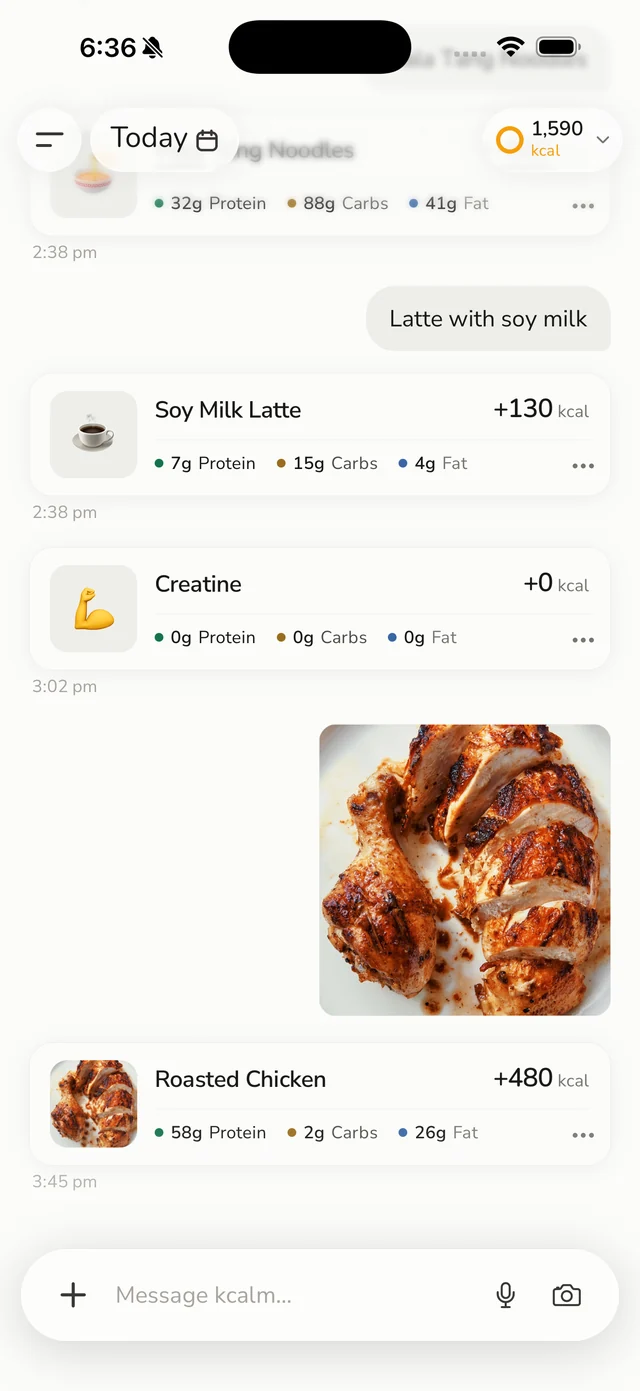
Exercise goes in the same way: type "30 minute run" and the estimated burn lands in that day's budget. Underneath, the arithmetic is standard and published: Mifflin-St Jeor for your baseline, the usual activity multipliers, Atwater 4/4/9 for macros, with a Base plus Exercise mode that reads activity from Apple Health if you prefer to eat back what you burn.
The honest limit: kcalm estimates within 10 to 20 percent for most foods, wider on mixed dishes where portion size is hidden, and it publishes no third-party benchmark. For the reasoning behind that number, see how accurate AI food recognition is.
MyFitnessPal: search first, AI second
You type a food name, pick from a ranked list, choose a serving, and save. The database is the product, and at 20.5 million entries it covers packaged and restaurant food better than anything else. Results mix entries MyFitnessPal has reviewed with entries members added themselves, which is why some foods carry a check and others do not, and why two entries for the same product often disagree. Our write-up on MyFitnessPal versus Cronometer accuracy research covers what the studies found.
The AI layer is not new, but it is paid. Meal Scan arrived in July 2024 and Voice Log in December 2024, both Premium. The February 2026 Winter Release added Photo Upload to Meal Scan, the Cal AI acquisition closed on 2 March 2026, and an AI Coach launched on 10 June 2026 for Premium and Premium+ subscribers in five countries. On the free tier you get no barcode scanner, no Meal Scan, no Voice Log and no custom macro goals, and you do get ads. Voice Log is also limited to US members using English.
What one photo gives you back
This is the part a feature table cannot convey. One photo of a roast chicken dinner returns the calorie number, the macro split, a confidence score, and the itemised ingredients the model believes it is looking at.
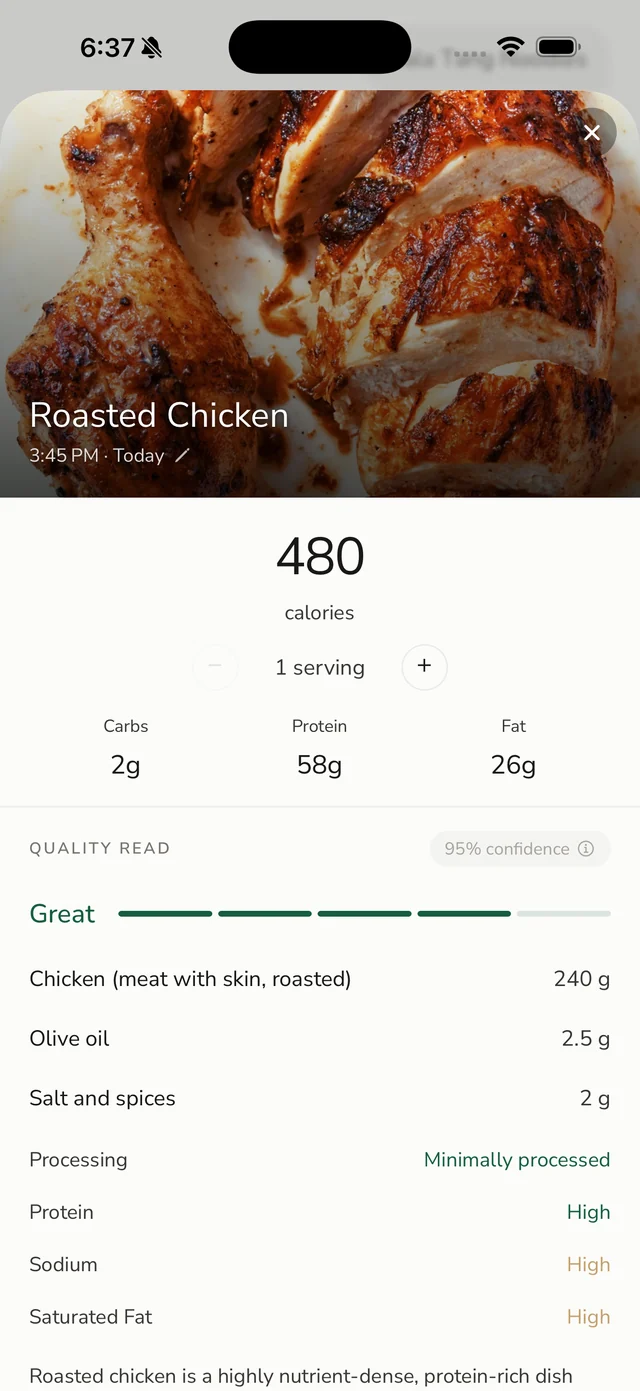
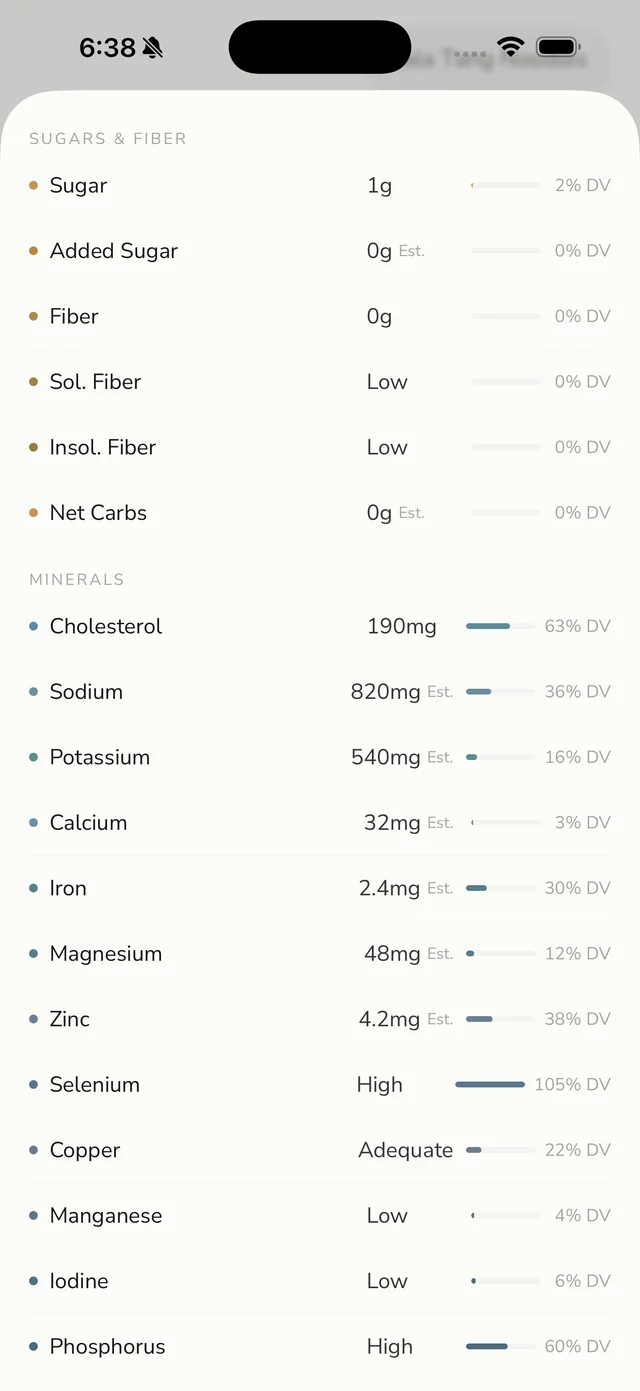
The same photo also fills in the micronutrients, which is the part most photo trackers skip entirely. Iron at 30 percent of the daily value, zinc at 38, selenium at 105, sodium at 36, each marked "Est." so you can see which figures are inferred rather than read off a label.
In MyFitnessPal, a barcoded product returns the label's own values, which is more exact. Getting there means the product has a barcode, you have the packet, and you are willing to scan it, which is a Premium feature. For a home-cooked plate, neither app is reading a label: MyFitnessPal is matching you to a stranger's entry and kcalm is estimating the food in front of you.
Logging without opening an app
This is the clearest structural difference. kcalm has a Telegram bot and a WhatsApp bot. Send a photo, a sentence or a voice note to a chat you already have open and it syncs to the iOS app.
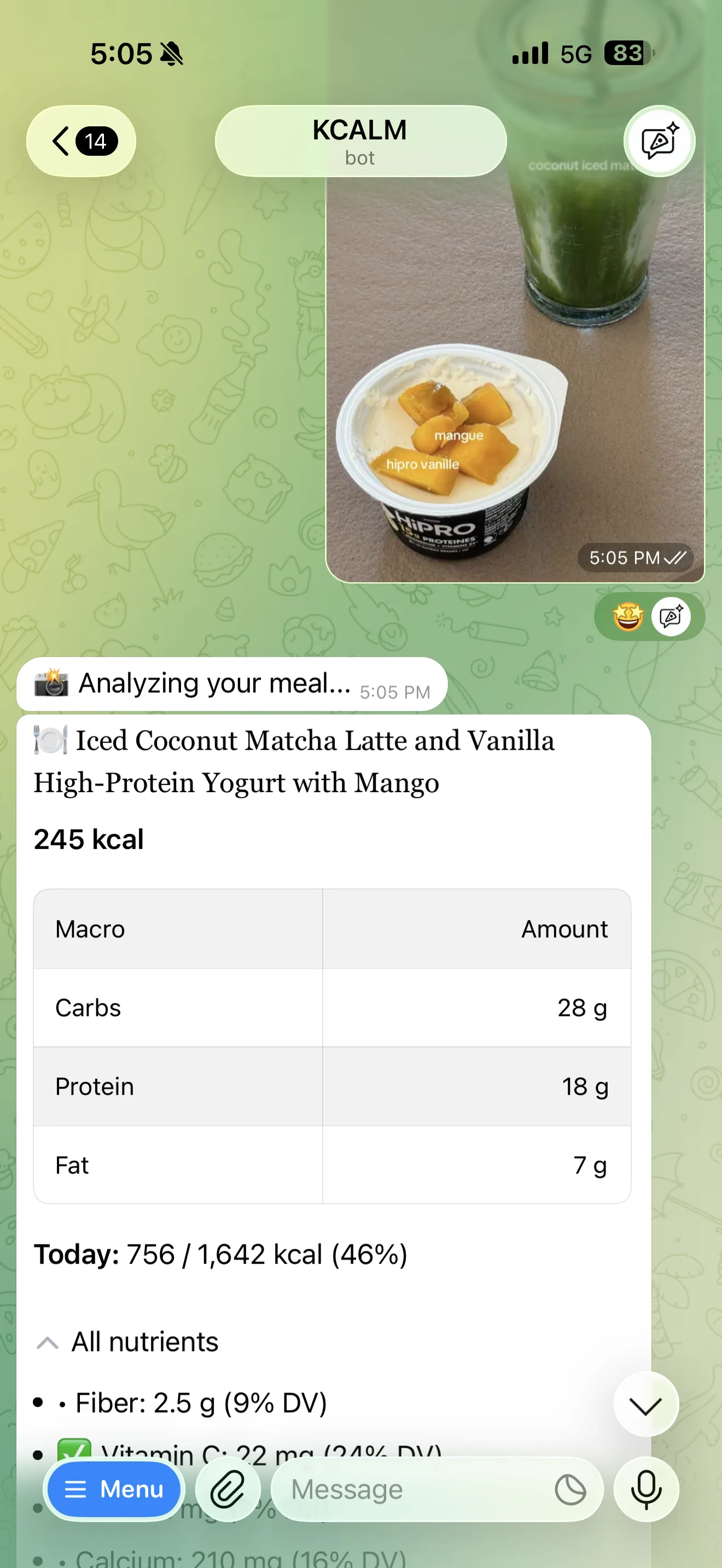
MyFitnessPal has no chat equivalent, though its Apple Watch and Wear OS apps let you quick add calories and frequent foods from the wrist. It launched an app inside ChatGPT's Health experience on 7 January 2026, which answers nutrition questions and returns targets and recipes from its database. That is a question-answering surface, not a logging surface, and MyFitnessPal has described natural-language meal logging through it as planned rather than shipped.
The consequence shows up on the days you are least likely to track: travelling, eating out, feeling unwell. Sending a message takes seconds. Opening an app, searching a database and picking a serving does not.
What the 2026 redesign did to the free experience
MyFitnessPal's April 2026 v26.16.0 update replaced the long-standing Diary tab with a card-based Today screen, and the response was harsh. App-review analytics from MWM recorded reviews on that version averaging 1.54 stars against 3.24 on the version before it. Users reported that logging a full day took more taps, that the diary was buried behind a "View All" button, and that copying a single food item between meals was gone. MyFitnessPal's help article calls the new Today tab the path forward and offers no way to revert. Some subscribers said they cancelled over it.
kcalm's day-to-day surface is smaller and much of it sits outside the app. A Live Activity keeps calorie progress on the lock screen, and six home-screen widgets cover quick input, daily summary, water, health score, routines and macros. Water is one tap, weigh-ins can carry a progress photo, and a weekly AI briefing summarises the eating timeline, macro trends and nutrient gaps.
GLP-1 medication support
MyFitnessPal is no longer absent here. On 28 April 2026 it launched GLP-1 Support free to every US user: medication type, dose, injection site, date and time logged next to your food, dose reminders and side-effect tracking. Two limits: US only, and side-effect tracking was iOS only at launch.
kcalm's GLP-1 tab covers shot tracking with estimated medication levels between doses, injection-site rotation, and side-effect logging for Wegovy, Ozempic, Mounjaro and Zepbound. The estimated-level view is the piece MyFitnessPal does not list, and it is what gives context to how you feel at different points in the dosing week. The chat bots matter here more than anywhere else: on the day after a shot, when appetite is gone and opening a food app is the last thing you want, one message still leaves a record instead of a gap. For the targets, see our guide to GLP-1 calorie and protein goals.
Privacy and data
kcalm processes meal photos for analysis and does not store them permanently. Data is encrypted in transit and at rest, isolated per user with Row Level Security, and you can delete everything at any time. There is no advertising anywhere in the product, and guest mode lets you start without creating an account.
MyFitnessPal's free tier is ad-supported, which puts an advertising stack inside a product that knows what you eat and what you weigh. Paying removes the ads. That is disclosed and defensible, and it is a different deal from a product with no ad tier at all.
Pricing
| Plan | kcalm | MyFitnessPal |
|---|---|---|
| Free | 15 AI food analyses, no card required | Manual logging with ads |
| Monthly | USD 14.99 | Premium USD 19.99, Premium+ USD 24.99 |
| Yearly | USD 69.99 (about USD 5.83/mo) | Premium USD 79.99, Premium+ USD 99.99 |
| Trial | 3-day free trial on the chat bots | 7-day free trial |
The free tiers are different bargains rather than different sizes. MyFitnessPal's is unlimited in volume, ad-supported, and stripped of the fast logging tools. kcalm's is 15 AI analyses with no card and no account, which is enough to find out whether photo logging handles the food you actually eat. kcalm bills through Apple in-app purchase, so you cancel in iPhone Settings.
Where MyFitnessPal is the better buy
- The database is the largest in the category at 20.5 million-plus entries, with a barcode scanner kcalm does not have in any form. If most of what you eat comes with a label, that is decisive.
- It runs on Android, the web, Apple Watch and Wear OS, and syncs with Fitbit, Garmin, Whoop, Apple Health and Health Connect. kcalm has an iPhone app and two chat bots.
- Its free tier is unlimited in volume and usable indefinitely, where kcalm's is 15 analyses and then a decision.
- Micronutrients on a barcoded product come off the label rather than from an estimate, and exercise goes deeper: a structured workout library plus burn data arriving from wearables.
- Two decades of community, recipes and friend features, and Premium+ adds a meal planner with 1,500-plus recipes and grocery syncing, none of which kcalm attempts.
Where kcalm is the better buy
- Logging survives your worst days, because it happens in Telegram or WhatsApp rather than in an app you have to decide to open.
- Photo and plain-language logging are the default, not a USD 19.99 upgrade.
- The full 42-nutrient breakdown comes out of the same photo you already sent, with no separate lookup and no nutrient-entry step.
- No ads at any tier, including the free one, so nothing in the product is being sold to you while you log what you eat.
- GLP-1 tracking adds estimated medication levels between doses and injection-site rotation, and stays usable on a low-appetite day.
- No streaks, no social feed, no leaderboard. Miss four days and nothing greets you when you come back.
- Guest mode means you can test it without an account, an email address or a card, and USD 69.99 a year undercuts Premium.
Switching takes about two minutes
You do not have to migrate anything. Nothing needs exporting, your MyFitnessPal history stays where it is, and you can keep the subscription running while you test.
The whole switch is: install kcalm, skip the account with guest mode, and photograph whatever you eat next. That entry gives you the calorie number, the macro split and the 42 nutrients in one action, and you will know inside one meal whether estimation reads your food well enough. Fifteen analyses is roughly three days of normal eating, which is long enough to answer the only question that matters here: which app did you actually open.
The bottom line
MyFitnessPal is the incumbent for good reasons. Meal Scan, Voice Log, the AI Coach and free GLP-1 Support leave little of the AI gap open, the database has no rival, and it offers a native Android app and a web app. Android users can use kcalm through its WhatsApp or Telegram bots for the same AI chat experience. Go in knowing the free tier carries ads and the fast tools cost USD 19.99 a month.
kcalm is for the reader whose tracking keeps dying at the logging step. An iPhone user who eats home-cooked or unlabelled food, wants to log from the table by sending a message, or is on a GLP-1 and wants medication levels beside their meals. It is USD 69.99 a year against USD 79.99, no ads at any tier, and the first fifteen analyses cost nothing and need no card. Install it and log tonight's dinner from a photo. That single entry tells you more than the rest of this page.
Frequently Asked Questions
Is there a free alternative to MyFitnessPal?
kcalm has a free tier with 15 AI food analyses and no credit card required, including nutrition tracking, personalised calorie and macro goals, progress charts and guest mode. It is a trial-sized allowance, not an unlimited free plan. MyFitnessPal's free tier is unlimited in volume but ad-supported, with the barcode scanner, Meal Scan and Voice Log on the paid tiers.
Does kcalm work on Android?
Yes. You can already use the kcalm bots on WhatsApp or Telegram on Android for the same AI chat experience, including photo, text and voice logging. The native Android app is in development. Charts, home-screen widgets and offline meal viewing are currently available in the iOS app.
Is kcalm cheaper than MyFitnessPal?
Yes. kcalm Premium is USD 14.99 a month or USD 69.99 a year. MyFitnessPal Premium is USD 19.99 a month or USD 79.99 a year, and Premium+ is USD 24.99 or USD 99.99. kcalm also has a free tier that needs no card, where MyFitnessPal's free tier carries ads.
Can I track calories without opening an app?
With kcalm, yes. Send a photo, a sentence or a voice note to the Telegram or WhatsApp bot and it logs to your account, then syncs to the iOS app. MyFitnessPal has no chat-based logging. Its ChatGPT integration answers nutrition questions and suggests targets, but meal logging through it is described as planned, not shipped.
Does MyFitnessPal have GLP-1 tracking?
Yes. MyFitnessPal launched free GLP-1 Support on 28 April 2026 covering medication type, dose, injection site, date and time, dose reminders and side-effect tracking. It launched for US users only, and side-effect tracking was iOS only at launch. kcalm's version adds estimated medication levels between doses and injection-site rotation, and lets you log a dose from a chat thread.
Did MyFitnessPal buy Cal AI?
Yes, announced on 2 March 2026. MyFitnessPal said Cal AI had generated over USD 40 million in sales in the prior twelve months and would keep operating as a standalone product. MyFitnessPal's own photo logging, Meal Scan, sits on its paid tiers.
How accurate is kcalm compared with MyFitnessPal's database?
kcalm estimates within 10 to 20 percent for most foods and publishes no third-party benchmark. MyFitnessPal's database can be exact for a barcoded product and badly wrong for a member-submitted entry nobody checked. For unlabelled and home-cooked food the two approaches are closer than the database's precision suggests.
Sources
- MyFitnessPal App Store listing, version 26.31.0, 4.7 stars, 2.3M ratings, "20.5M+ foods": https://apps.apple.com/us/app/myfitnesspal-calorie-counter/id341232718
- MyFitnessPal official pricing page (Premium and Premium+ tiers, 7-day trial): https://www.myfitnesspal.com/premium
- MyFitnessPal launches app in ChatGPT Health experience, 7 January 2026: https://www.globenewswire.com/news-release/2026/01/07/3214864/0/en/myfitnesspal-launches-app-in-new-chatgpt-health-experience.html
- MyFitnessPal 2026 Winter Release, 24 February 2026: https://www.globenewswire.com/news-release/2026/02/24/3243668/0/en/myfitnesspal-debuts-its-2026-winter-release.html
- MyFitnessPal GLP-1 Support launch, 28 April 2026: https://finance.yahoo.com/sectors/healthcare/articles/myfitnesspal-launches-comprehensive-glp-1-130000875.html
- MyFitnessPal acquires Cal AI, 2 March 2026: https://www.globenewswire.com/news-release/2026/03/02/3247439/0/en/myfitnesspal-acquires-cal-ai-expanding-on-its-position-as-the-leading-player-in-digital-nutrition-tracking.html
- MyFitnessPal AI Coach launch, June 2026: https://9to5mac.com/2026/06/16/myfitnesspal-adds-ai-powered-coach-for-personalized-nutrition-guidance/
- User complaints about the April 2026 Today tab redesign: https://piunikaweb.com/2026/04/24/myfitnesspal-new-update-complaints/
- Version 26.16.0 rating drop and complaint breakdown: https://mwm.ai/articles/myfitnesspal-v26-16-0-replaces-diary-with-new-ui-sparking-rating-drop-in-april-2026
Keep MyFitnessPal. Add kcalm for a week.
Nothing to export, nothing to cancel, no account to create. Log the next meal both ways and keep whichever one you actually opened.
15 AI analyses free, no card and no account needed.
Other comparisons

kcalm vs Cronometer
The precision tracker: lab-analysed data from NCCDB, USDA and NUTTAB, up to 92 nutrients a day, a barcode scanner on the free tier, and a data-dense interface.

kcalm vs Lose It!
Shipping since 2008 and owned by Ziff Davis, with a 56 million-food database, Snap It photo logging, support groups, device syncs and a Premium tier that keeps absorbing features.

kcalm vs MacroFactor
The Stronger By Science tracker built around maths: it back-calculates your real energy expenditure weekly from intake and weight trend, then moves your targets to match.