
kcalm vs MacroFactor
MacroFactor recalculates your real energy expenditure every week and the maths is genuinely better. kcalm has no adaptive engine but logs from a photo or a chat message. Which matters more for you.
- kcalm
- USD 14.99/mo or 69.99/yr · 15 AI analyses free · iOS, Telegram, WhatsApp
- MacroFactor
- USD 11.99/mo or 71.99/yr · iOS, Android
kcalm Team
Nutrition & Wellness
Choose kcalm if
The step that breaks your tracking is logging rather than target-setting, you want to log from a chat window, or you are on a GLP-1 and want medication tracking built in.
Choose MacroFactor if
You train seriously, you want your calorie target derived from your own data rather than a 1990 equation, you want a curated food database, or you want a native Android app.
kcalm's primary path is not a database search. You photograph the plate, type "two eggs on sourdough and a flat white", or send a voice note to a Telegram or WhatsApp bot, and the AI returns an estimate you can adjust. The same entry produces 42 nutrients, and GLP-1 medication tracking sits beside the food log.
MacroFactor exists for the maths. It is a subscription macro tracker from Stronger By Science Technologies that back-calculates your energy expenditure every week from your logged intake and your weight trend, rather than handing you a target from a textbook equation. It calls itself the fastest food logger in the world and the claim is not empty: quick search, a barcode scanner covering nine countries, around 1.36 million verified entries, a URL recipe importer, and its own AI photo modes.
Worth saying plainly up front: kcalm has no adaptive expenditure engine. It sets your baseline with Mifflin-St Jeor and standard activity multipliers, so MacroFactor's target is the more precise of the two. The question this page is actually about is whether a more precise target helps you if the log has holes in it.
Quick comparison
| Feature | kcalm | MacroFactor |
|---|---|---|
| Primary logging method | AI photo and plain language | Fast search, barcode, plus AI photo |
| Photo logging | Yes, core method | Yes, Snap and Describe modes |
| Plain-language text input | Yes | Yes, via Describe |
| Chat logging (Telegram, WhatsApp) | Yes, both | No |
| Voice input | Yes, voice notes in chat plus Siri | Speech to text in app and on Apple Watch |
| Barcode scanning | No | Yes, plus a label scanner |
| Food database approach | AI estimation first, not search first | 1.36 million verified entries |
| Calorie target method | Mifflin-St Jeor plus activity factors | Adaptive expenditure, recalculated weekly |
| Micronutrients | Yes, 42 nutrients from AI estimates | Yes, from curated database entries |
| GLP-1 medication tracking | Yes, shots, levels, side effects | No |
| Exercise tracking | Yes, AI estimates burn from a description | Yes, plus a separate Workouts app |
| Design and feel | Conversational, low-pressure, no streaks | Data-dense, dashboard and check-in driven |
| Ads | None | None |
| Platforms | iOS, Telegram, WhatsApp. Android app in development | iOS, Android, Apple Watch |
| Free tier | 15 AI analyses, no card needed | None, 7-day trial only |
| Price (USD) | 14.99/mo or 69.99/yr | 11.99/mo or 71.99/yr |
How logging actually works
kcalm: estimation is the whole workflow
One action, complete entry. Exercise works the same way: log "30 minute run" and the estimated burn goes into the day's budget.
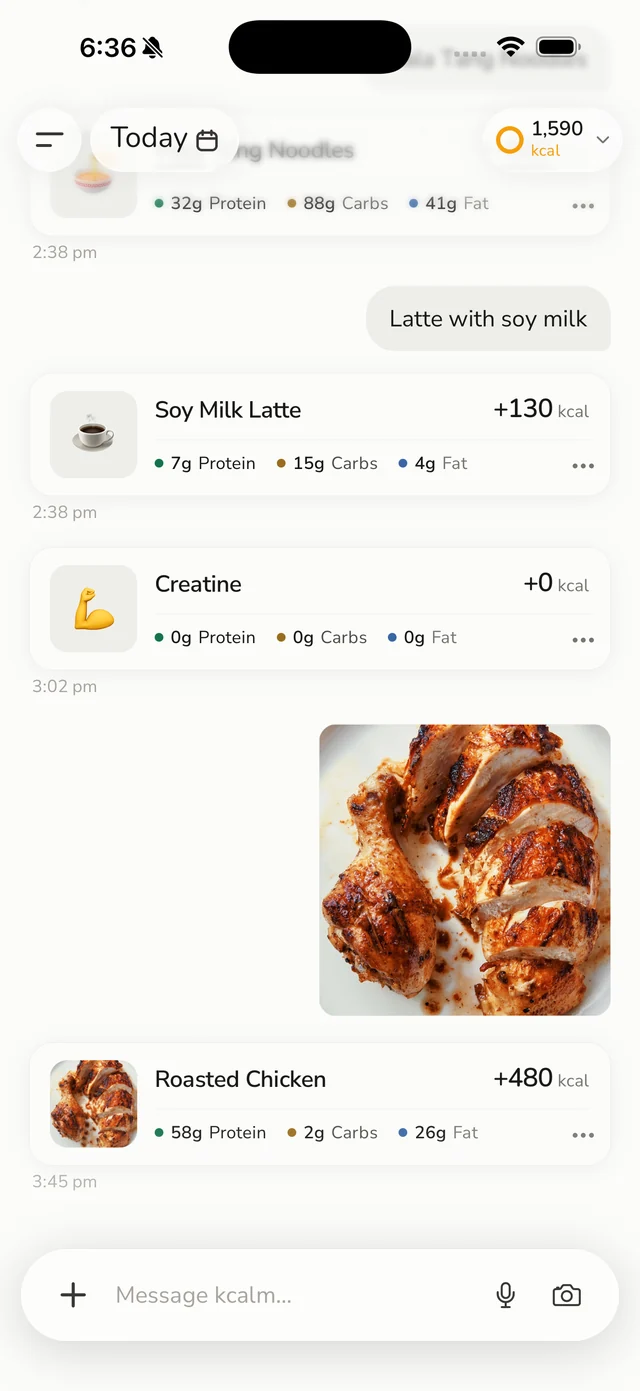
kcalm's stated accuracy is estimates within 10 to 20 percent for most foods, and it claims no benchmark-verified figure because there is not one. Twenty percent sounds loose until you notice that packaged nutrition labels are legally allowed to be 20 percent off in the first place. kcalm has no barcode scanner at all, a real gap if most of what you eat comes out of a packet.
Day to day the app stays out of the way: calorie progress on the lock screen as a Live Activity, six home-screen widgets, water in one tap. No streaks, no shaming notification when you miss a day, and no feed of other people's meals.
MacroFactor: fast search first, AI second
The search is quick, the barcode scanner covers nine countries including the US, UK and Australia, and the database holds around 1.36 million verified entries rather than the far larger crowd-sourced databases whose entry quality varies widely, a difference our MyFitnessPal vs Cronometer accuracy research digs into. There is also a nutrition label scanner upgraded in July 2026 to read multiple languages and formats.
MacroFactor also has AI photo logging, which a lot of 2026 comparison content still gets wrong. It launched in beta in 2025 and was rebuilt in May 2026 into two modes: Snap for quick in-the-moment photos, and Describe, which takes photos and text together so you can specify portions or exclusions. The AI breaks a meal into ingredients and matches them against real database entries rather than inventing numbers. It accelerates a manual workflow rather than replacing it: the app is still built around opening it and working a food log.
What one photo gives you back
Both apps now read a photo. The architectural difference shows on food no database entry exists for, because MacroFactor's AI resolves ingredients to catalogue entries and kcalm's estimates the plate directly.
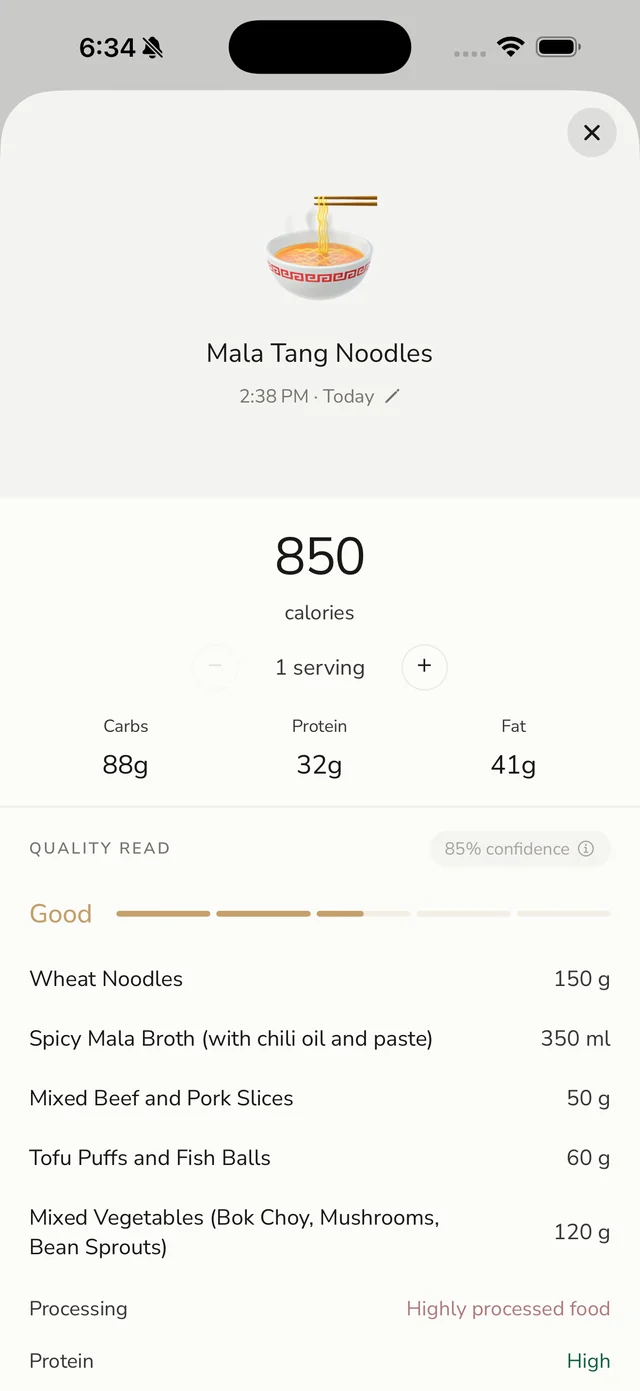
Micronutrients arrive from the same action, with the estimated ones marked.
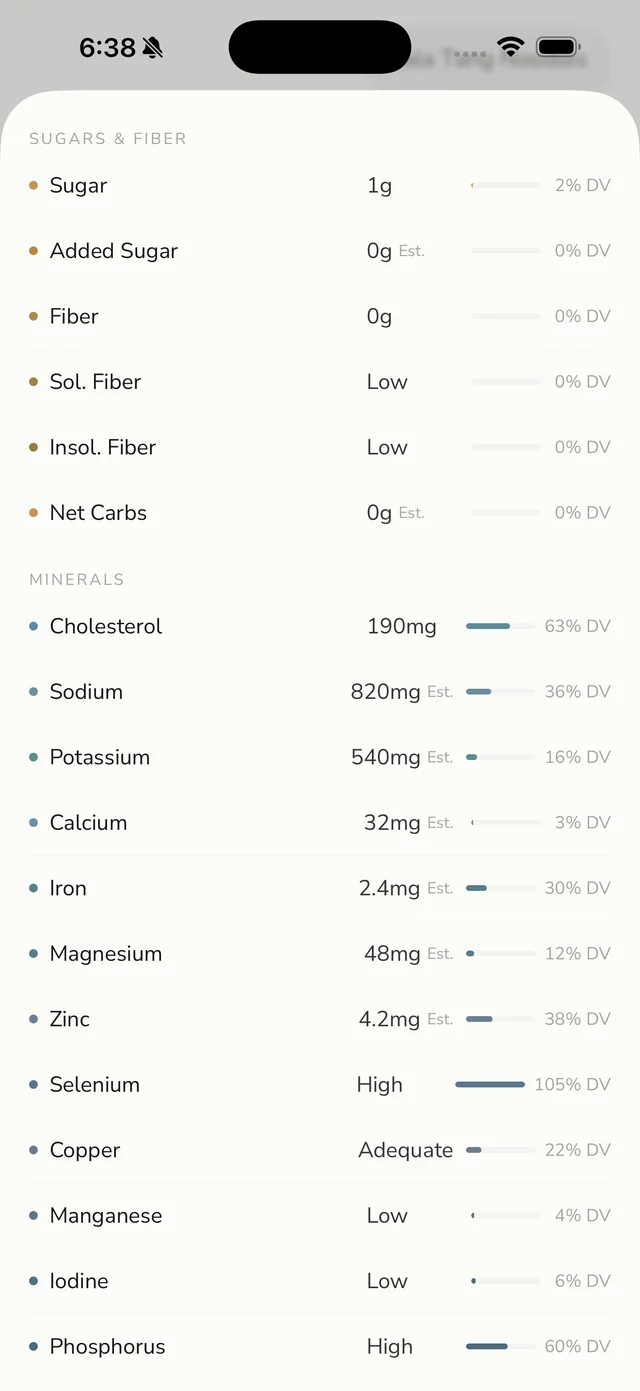
MacroFactor's nutrient figures come from curated database entries with known provenance, which is the better data. kcalm's arrive without a lookup step, which is the better workflow. That sentence is most of this comparison.
Logging without opening an app
This is the clearest structural difference. MacroFactor has no chat interface: no Telegram bot, no WhatsApp bot, no web app for logging. Everything happens inside the iOS or Android app, or on the Apple Watch app that shipped in September 2025.
kcalm lets you log by message. Send a photo or a sentence to the Telegram bot or the WhatsApp bot and it syncs to the iOS app.
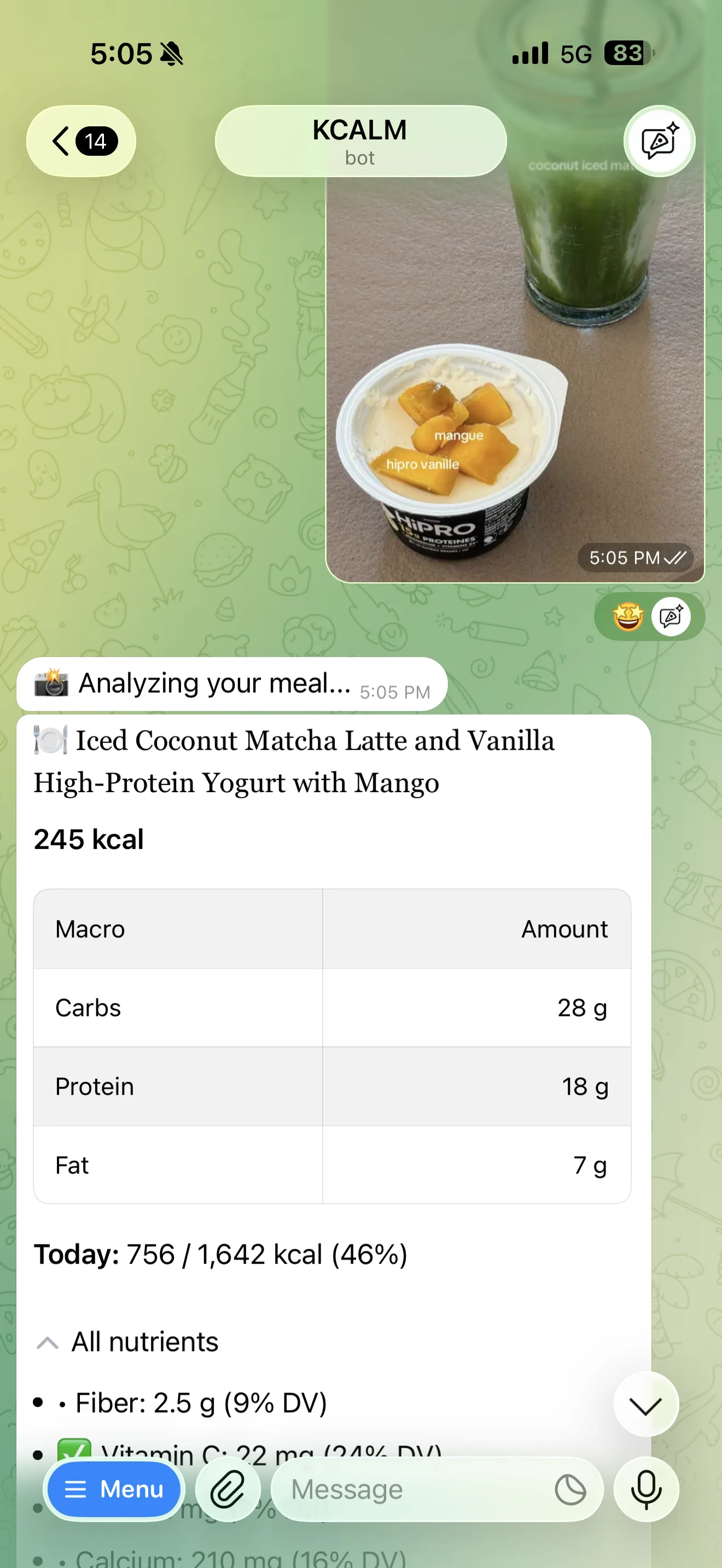
That matters when you are at a restaurant and pulling out a tracking app feels conspicuous, when you are on a phone that is not your iPhone, or when you cannot face opening another app tonight. Siri is the second route past the app icon. MacroFactor has speech to text of its own, but it runs inside the app or on the Watch, so something still has to be opened first.
Algorithmic precision versus capture speed
What MacroFactor's expenditure algorithm actually does
MacroFactor treats energy balance as an equation it can solve: calories in, minus the change in your stored energy, gives calories out. It smooths your weigh-ins into a trend weight, updates its expenditure estimate progressively rather than lurching day to day, and offers optional modifiers that feed in step trends and a predictive adjustment for goal changes.
MacroFactor also publishes numbers on this, which almost nobody in the category does. Its documentation reports that the modifiers cut monthly absolute weight-change prediction error by around 6 percent overall and around 8 percent after the adaptation period, with median error over 100 days falling from roughly 3 lb to 2.5 lb. Claims that specific are rare here, and they earn MacroFactor its price if you feed it a complete log.
What kcalm does instead
kcalm calculates BMR with Mifflin-St Jeor, applies standard Harris-Benedict activity multipliers, and derives macros using the Atwater system. A Base plus Exercise mode lets you set a resting target and add exercise on top, and custom goals override everything. This is a static estimate that does not learn your metabolism, and against MacroFactor's engine it is the weaker system.
What kcalm offers on the review side is a weekly AI briefing: eating timeline, macro and calorie trends, weight charts with progress photos, and nutrient analysis across weeks, months and years. It tells you what happened. It does not reset your target on the strength of it.
GLP-1 medication support
MacroFactor has no GLP-1 medication features, which is less a criticism than a statement of what it is for: lifters, athletes and dieters managing energy balance by hand.
kcalm has a dedicated GLP-1 section on iOS: shot tracking with estimated medication levels, injection-site rotation, and side-effect logging for Wegovy, Ozempic, Mounjaro and Zepbound. Chat logging matters more here than anywhere else: on a bad medication day when appetite is gone and nausea is winning, the realistic outcome in a manual tracker is a blank day, while one line to a bot still produces a record. Our guide to calorie and protein targets on Mounjaro and Ozempic covers why protein floors matter more than the calorie number.
One caveat in MacroFactor's favour: rapid GLP-1 weight loss is exactly where a static Mifflin-St Jeor estimate drifts fastest, and an adaptive expenditure model handles that well.
Privacy and data
Neither app runs advertising or monetises your food log, which puts both ahead of most of the category.
kcalm processes meal photos for analysis and does not store them permanently, encrypts data in transit and at rest, uses Row Level Security for isolation between accounts, and lets you delete everything at any time. Guest mode means you can start tracking without creating an account, and full detail is in the privacy policy.
MacroFactor's App Store privacy label discloses health and fitness data, purchase and contact information, identifiers, product interaction data and diagnostics, plus photos and videos under user content, all linked to your identity, and lists marketing among the stated uses. It is a paid, bootstrapped product with no ad business, so the practical risk is low, but the label is broader.
Pricing
| Plan | kcalm | MacroFactor |
|---|---|---|
| Free tier | 15 AI food analyses, no card | None |
| Free trial | 3 days on the chat bots | 7 days |
| Monthly | USD 14.99 | USD 11.99 |
| Annual | USD 69.99 (about USD 5.83/mo) | USD 71.99 (about USD 6.00/mo) |
| Other plans | None | USD 47.99 half-year, USD 89.99/yr bundled with Workouts |
The difference that does matter is the entry point. MacroFactor has no free tier at all: when the 7-day trial ends you subscribe or you lose access, and the trial takes payment details. kcalm's 15 free analyses need no card and no account, so you can test AI photo logging on your own food before deciding anything.
Where MacroFactor is the better buy
- The adaptive expenditure algorithm is the best implementation of dynamic TDEE in a consumer app, and MacroFactor publishes error figures rather than asserting it works. For a structured cut, bulk or contest prep, trend weight smoothing and weekly target adjustment are the right tools.
- It has native Android and Apple Watch apps. The kcalm Android app is in development, and Android users can already log through WhatsApp or Telegram.
- Its curated 1.36 million entry database, barcode scanning and multilingual label scanner cover packaged food far better than photo estimation ever will, and its micronutrients come from those entries rather than from an estimate.
- Exercise goes deeper: a separate Workouts app with cardio, strength progression and Live Activities, against kcalm's single AI burn estimate and no workout library.
- At 4.84 stars from over 20,500 iOS ratings it is among the highest-rated apps in the category, and the company is bootstrapped with 500,000 users rather than sitting on a runway.
Where kcalm is the better buy
- You can log from Telegram or WhatsApp without opening a tracking app, which MacroFactor cannot do at all, and Siri logs hands-free.
- Photo and plain-language logging is the primary path, not an add-on to a search box, so a home-cooked or regional dish is no harder than a packet.
- GLP-1 shot tracking, estimated medication levels, injection-site rotation and side-effect logging have no MacroFactor equivalent.
- All 42 nutrients come out of the photo or sentence you already sent, with the ones running short flagged, so nutrient detail costs no extra searching.
- There is a free tier needing no credit card and a guest mode needing no account, where MacroFactor has neither.
- No streaks and no guilt mechanics. MacroFactor is equally free of ads and social feeds, but it is built around weekly check-ins you are expected to keep.
- There is far less to learn. MacroFactor's own App Store reviews include a three-star user in July 2026 wishing it were "easier to use like My Fitness Pal" and a one-star reviewer in August 2026 calling it "way more complicated than it needs to be".
Switching takes about two minutes
There is nothing to migrate and no reason to cancel anything mid-trial. If MacroFactor's expenditure engine is working for you, that is the one thing here worth paying for and kcalm does not replicate it.
Install kcalm, use guest mode so there is no account and no card, and log the next two meals by photo. The comparison you are running is not accuracy, it is effort: how many taps each app took, and whether you would have bothered at 11pm. Fifteen free analyses is about three days.
The bottom line
MacroFactor is the better purchase if you are training seriously, want your calorie target derived from your own data rather than a 1990 equation, want nutrient numbers traceable to a curated entry, or need a native Android app today. It is unusually transparent about its own methods, and its one-star reviews are about friction rather than concept: Apple Health sync dropping out, and entries like "cooked rice" returning raw rice calories.
kcalm is the better purchase if your problem is not the target, it is the logging. If you have abandoned trackers because searching for every ingredient became a chore, if you want to log by messaging a bot from a phone that is not an iPhone, or if you are on a GLP-1 and want medication tracking beside your food. It costs about the same, so the choice is about the workflow, not the bill. The Android app is in development. Current limits include no barcode scanner and a target that will not adapt on its own. Install it, photograph two meals, and count the taps.
Frequently Asked Questions
Is there a free alternative to MacroFactor?
MacroFactor has no free tier at all, only a 7-day trial. kcalm gives you 15 AI food analyses free with no credit card and no account, plus a 3-day trial on the Telegram and WhatsApp bots. Fifteen is small, but enough to test whether AI photo logging handles your usual meals.
Does kcalm have adaptive TDEE like MacroFactor?
No. kcalm calculates your baseline using Mifflin-St Jeor with standard activity multipliers, plus a Base plus Exercise goal mode and custom goals. It does not recalculate expenditure from your intake and weight trend the way MacroFactor does. If a self-adjusting calorie target is what you want, MacroFactor does it better.
Does kcalm work on Android?
Yes. You can already use the kcalm bots on WhatsApp or Telegram on Android for the same AI chat experience, including photo, text and voice logging. The native Android app is in development. Charts, home-screen widgets and offline meal viewing are currently available in the iOS app.
Is kcalm cheaper than MacroFactor?
Not in any way worth deciding on. kcalm is USD 14.99 a month or USD 69.99 a year; MacroFactor is USD 11.99 a month or USD 71.99 a year. MacroFactor is USD 3 cheaper monthly, kcalm is USD 2 cheaper annually. The only real money difference is that kcalm has a free tier of 15 analyses and MacroFactor has none.
Can I track calories without opening an app?
With kcalm, yes. Send a photo, a sentence or a voice note to the Telegram or WhatsApp bot and it syncs to the iOS app. MacroFactor has no chat interface, so every entry happens inside the app or on Apple Watch.
Does MacroFactor have AI photo logging?
Yes, and a lot of 2026 comparison articles get this wrong. It launched in beta in 2025 and was rebuilt in May 2026 into Snap and Describe modes. The difference is architectural: MacroFactor's AI sits alongside a search-first workflow, while kcalm's AI estimation is the whole workflow.
Is kcalm or MacroFactor more accurate?
For calorie targets, MacroFactor, because it uses your own data rather than a population equation. For individual entries it depends what you eat: a verified database and barcode scanner beat photo estimation on packaged food every time, while kcalm's stated 10 to 20 percent range covers most foods and is most useful on home-cooked plates that are tedious to itemise.
Sources
- MacroFactor official pricing page: https://macrofactor.com/price/
- MacroFactor on the App Store, rating, version and privacy label: https://apps.apple.com/us/app/macrofactor-macro-tracker/id1553503471
- Recent MacroFactor App Store customer reviews feed: https://itunes.apple.com/us/rss/customerreviews/id=1553503471/sortBy=mostRecent/json
- MacroFactor expenditure algorithm documentation and error figures: https://macrofactor.com/expenditure/
- MacroFactor on Apple Watch, updated 9 September 2025: https://macrofactor.com/apple-watch/
- MacroFactor Monthly, May 2026, Snap and Describe modes: https://macrofactor.com/mm-may-2026/
- MacroFactor Monthly, July 2026, label scanner and AI workflow updates: https://macrofactor.com/mm-july-2026/
- MacroFactor product page, database size, platforms and user count: https://macrofactor.com/macrofactor/
Keep MacroFactor. Add kcalm for a week.
Nothing to export, nothing to cancel, no account to create. Log the next meal both ways and keep whichever one you actually opened.
15 AI analyses free, no card and no account needed.
Other comparisons

kcalm vs MyFitnessPal
The category default since 2005, now with 20 million-plus food entries, a barcode scanner, free GLP-1 support in the US, and ads on the free tier.

kcalm vs Cronometer
The precision tracker: lab-analysed data from NCCDB, USDA and NUTTAB, up to 92 nutrients a day, a barcode scanner on the free tier, and a data-dense interface.

kcalm vs Lose It!
Shipping since 2008 and owned by Ziff Davis, with a 56 million-food database, Snap It photo logging, support groups, device syncs and a Premium tier that keeps absorbing features.