Do Fibre Calories Count? The 2 kcal/g Food Label Maths
Learn how fibre calories count on food labels, why energy factors differ across countries and how to log high-fibre foods without subtracting calories twice.
kcalm editorial team
Prepared with AI assistance

Fibre calories count towards food energy, but fibre does not have one universal calorie value. A common label factor is 2 kcal per gram; Australian calculations use 8 kJ per gram for unavailable carbohydrate, including dietary fibre, with specific exceptions. For everyday tracking, use the energy printed on your food package rather than subtracting fibre calories again. The label calculation already accounts for its energy contribution under the relevant system [1][2][3].
How many calories does fibre provide per gram?
Fibre commonly receives a label value of 2 kcal per gram, roughly half the general factor for digestible carbohydrate. That is an accounting convention, not a measurement of what your own digestive system extracts from every gram. The factor depends on the fibre and the labelling system [1][3].
The practical question has two parts: what belongs in your food log, and what happens during digestion. Mixing those questions can make an otherwise straightforward breakfast entry confusing. You can use a consistent label value without pretending it describes your metabolism perfectly.
According to FDA consumer guidance, bacteria in the large intestine break down soluble fibre and provide some energy, while insoluble fibre can pass through relatively intact [4]. This explains why “not digested in the small intestine” does not automatically mean “zero calories”.
However, soluble versus insoluble is an imperfect guide to energy yield. The FAO technical workshop favoured fermentability for energy evaluation. Its general factor for fibre in traditional foods used an assumed fermentability of 70%, rather than assuming every gram behaves identically [5]. Research-informed label factors simplify a much more varied process.
Why do fibre calories differ between countries?
Fibre calories differ between countries because their calculation rules use different categories and exceptions. The US general-factor method distinguishes soluble from insoluble non-digestible carbohydrate; Australia uses a general unavailable-carbohydrate factor; Canada applies a default factor unless an accepted specific value is available [1][2][3].
| Label system or component | Energy factor | Meaning for your food log |
|---|---|---|
| US soluble non-digestible carbohydrate, general-factor method [1] | 2 kcal/g, about 8.4 kJ/g | Contributes to the calculated total |
| US insoluble non-digestible carbohydrate, same method [1] | 0 kcal/g, 0 kJ/g | Excluded from that energy calculation |
| Australia and New Zealand, general unavailable carbohydrate including fibre [2] | 8 kJ/g, about 1.9 kcal/g | Separate from available carbohydrate |
| Canada, default unavailable-carbohydrate factor [3] | 2 kcal/g, 8 kJ/g as listed | Applies unless an accepted specific value exists |
| Canadian polydextrose exception [3] | 1 kcal/g, 4 kJ/g as listed | An example of a fibre-specific factor |
Australia lists polydextrose separately at 5 kJ/g. Its general factor of 8 kJ/g converts to about 1.91 kcal/g using 4.184 kJ per kcal [2]. This is why “2 kcal equals 8 kJ” is useful shorthand but not an exact unit conversion. The table preserves each regulator's stated factors; approximate conversions are marked.
For an imported product, consider matching the local package rather than selecting a similarly named overseas entry. A country difference is one possible explanation for a mismatch, not proof that either entry is wrong. You still need to check the product and quantity.
Do net carbs mean you can subtract fibre calories?
Net-carbohydrate arithmetic does not establish a new calorie total. Removing fibre grams from a carbohydrate figure and removing energy from the printed calorie figure are different operations. A label can exclude fibre from available carbohydrate while still assigning fibre an energy contribution [1][2].
Here is an illustrative calculation, not a measured snack or a branded product. Suppose a serving contains 20 g of total carbohydrate, made up of 12 g digestible carbohydrate, 5 g soluble non-digestible carbohydrate and 3 g insoluble non-digestible carbohydrate. Assume no sugar alcohols or other special ingredients.
Under the US general-factor method described above, its carbohydrate-related energy would be:
- Calculate digestible carbohydrate: 12 g × 4 kcal = 48 kcal.
- Calculate soluble non-digestible carbohydrate: 5 g × 2 kcal = 10 kcal.
- Calculate insoluble non-digestible carbohydrate: 3 g × 0 kcal = 0 kcal.
- Add these contributions: 58 kcal, approximately 243 kJ, before protein and fat.
Calling the remaining 12 g “net carbs” and multiplying only that number by 4 gives 48 kcal. In this constructed example, that misses the 10 kcal from the soluble fraction. Conversely, multiplying all 20 g by 4 gives 80 kcal. Neither shortcut reproduces the selected calculation.
This is a demonstration of the factors, not a formula for reverse-engineering every package. You may not know the soluble and insoluble split, and special ingredients introduce further differences. If your goal is ordinary calorie logging, entering the stated energy is simpler than reconstructing an incomplete equation.
Our sugar alcohol calorie table explains another source of differences between carbohydrate grams and energy. Fibre and sugar alcohols are separate categories, so one blanket subtraction can obscure both.
How much difference can fibre accounting make in a day?
Fibre accounting can change an illustrative daily total by tens of calories, but there is no universal daily correction. The difference depends on how many grams receive a different factor and what the original entry already includes. A label-method comparison does not measure a change in your body's energy use.
The following is a sensitivity calculation: hold every other component constant and compare assigning selected grams 0 kcal/g versus 2 kcal/g. It is not an estimate of typical tracking error or a comparison of complete national labelling systems.
| Grams assigned a different factor | Calculated energy difference | Kilojoule equivalent |
|---|---|---|
| 5 g | 10 kcal | 42 kJ |
| 10 g | 20 kcal | 84 kJ |
| 15 g | 30 kcal | 126 kJ |
| 20 g | 40 kcal | 167 kJ |
A useful distinction is “different calculation” versus “additional energy”. If an entry already includes the relevant fibre factor, adding the table's amount would count it twice. Subtracting it would also move away from the selected label value. The right question is what the existing entry represents.
For more context on uncertainty in packaged foods, see our guide to nutrition label accuracy. Treat these worked examples as tools for understanding a mismatch, rather than a daily accounting task.
How can you log a high-fibre food consistently?
You can log a high-fibre food consistently by matching the product, the quantity eaten and the package's energy value. Keeping those three details together gives you a reproducible entry without an extra fibre deduction. This is a practical workflow, not a claim that a food label measures personal absorption.
Start with the nutrition panel. FSANZ explains that Australian panels show average quantities per serving and per 100 g or 100 mL, while serving sizes are chosen by the food business [7]. The comparison column and the portion column answer different questions.
Consider an invented cereal labelled 1,500 kJ per 100 g. If you serve 40 g, the calculation is 1,500 × 0.40 = 600 kJ, approximately 143 kcal. If the same panel lists 10 g fibre per 100 g, your portion has 4 g fibre. Log the 600 kJ and the 4 g as two facts about that portion. There is no separate 4 g deduction in this workflow.
When comparing that cereal with another entry, check the 100 g figures first. Then apply your portion. This avoids comparing a 40 g serving in one place with a 50 g serving elsewhere. A saved note such as “local package, 40 g portion” can make your next entry easier to repeat.
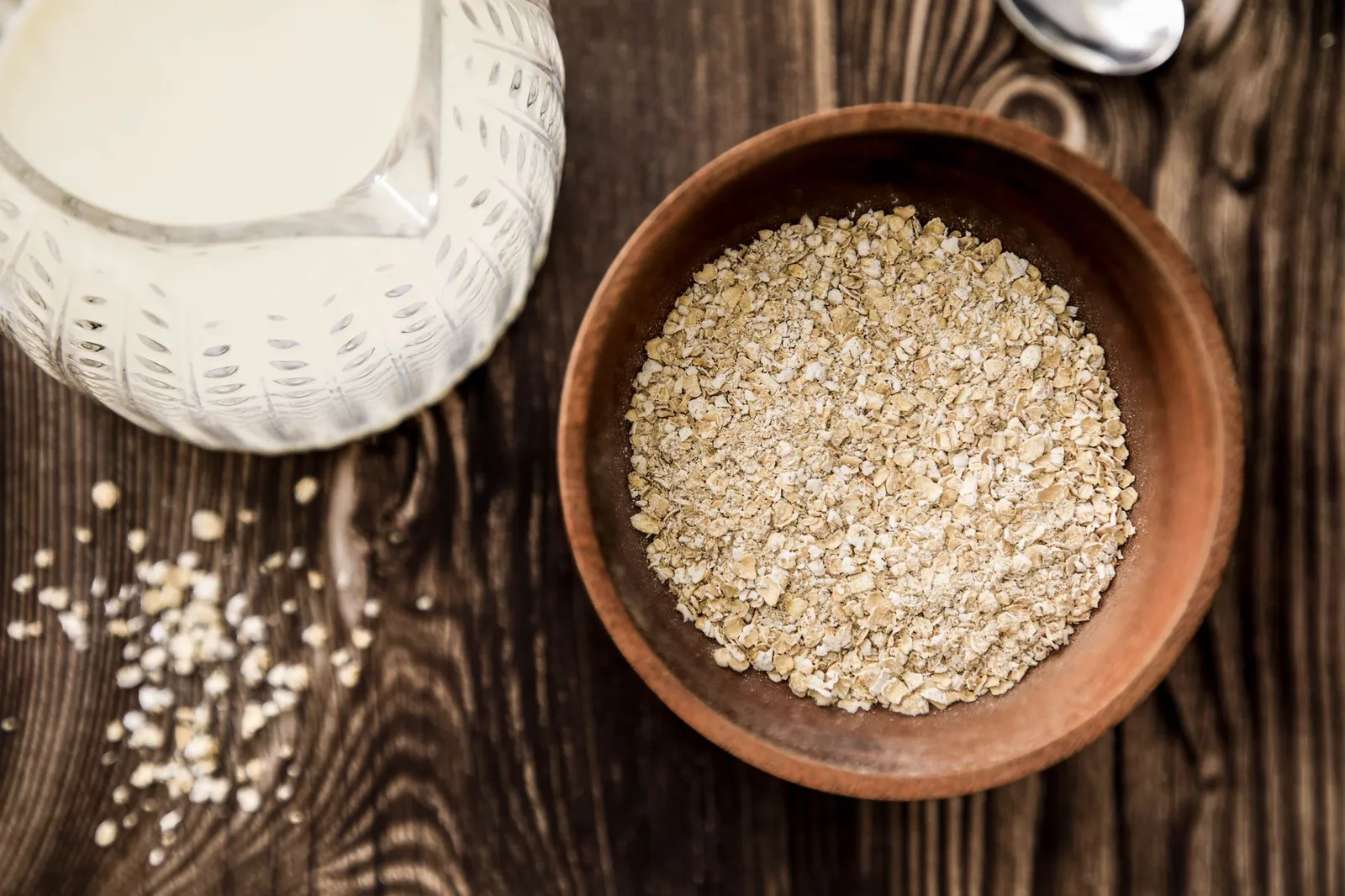
For a homemade breakfast, consider keeping oats, yoghurt, fruit and toppings as recognisable ingredients in your recipe record. If you revise an entry later, change the source information deliberately rather than adding an unexplained calorie adjustment. Our food scale and measuring cup guide can help you choose a comfortable way to estimate quantities.
You can use the same approach while tracking with kcalm: check the food and portion you are logging, and use the package as your reference when you have it. There is no need to turn a bowl of breakfast into a personal digestion experiment.
Does counting fibre energy make fibre less useful?
Counting fibre energy does not make fibre less useful. Energy contribution and nutritional function are different properties. Australian reference values list adequate intakes of 25 g/day for adult women and 30 g/day for adult men; these are population reference values, not a calorie allowance or a personalised prescription [8].
Those reference values also provide perspective on the maths. At a hypothetical flat 2 kcal/g, 25 g corresponds to 50 kcal and 30 g to 60 kcal. These are calculated illustrations, not extra calories to append to your day. The energy contribution belongs inside the food's existing total.
The FDA describes roles for fibre in bowel function and notes that soluble fibre can slow nutrient absorption and help with blood glucose control [4]. Health Canada explains that fermentation produces short-chain fatty acids, which can be absorbed and used by the body [3]. Providing some energy is compatible with those functions.
A useful tracking question is therefore “does this entry reflect the food I ate?” rather than “can I make this nutrient calorie-free?” Choose the level of detail that helps you understand your meals. If reviewing individual grams is becoming burdensome, you can keep the package total and move on.
Frequently Asked Questions
These frequently asked questions distinguish fibre energy from carbohydrate counts and practical food logging. The answers use the same principle throughout: keep the label's energy total separate from any discussion of how its carbohydrate grams are classified.
Does fibre have zero calories?
Fibre is not universally calorie-free. The US general-factor calculation assigns zero to insoluble non-digestible carbohydrate and 2 kcal/g to the soluble fraction [1]. That is a label method, not a personal absorption test.
Is 8 kJ exactly the same as 2 kcal?
No. Using 4.184 kJ per kcal, 8 kJ is about 1.91 kcal. Australia's schedule specifies a kilojoule calculation and conversion to kilocalories [2]. Keep the package's displayed units consistent when logging.
Can I deduct fibre from an Australian carbohydrate figure?
Australian available-carbohydrate calculations already exclude dietary fibre [2]. Applying a further fibre subtraction to that figure would repeat the exclusion. Check what the field represents before using an overseas net-carbohydrate formula.
Does a missing fibre value mean the food contains none?
A missing fibre value is not evidence of zero fibre. FSANZ explains that fibre is not always required on an Australian nutrition panel, although certain nutrition claims trigger its declaration [7]. Treat an absent field as unknown unless another reliable source supplies it.
Do I need a separate fibre calorie entry in my tracker?
A separate entry is unnecessary when you are using the food's stated total energy. Record fibre grams separately if you want to follow that nutrient. The cereal example above shows how both values can describe one portion without adding or subtracting calories.
Sources
These sources explain the energy factors, their scientific basis and the nutrition-panel conventions used in this article. They were retrieved for this draft on 30 September 2026; numerical food examples are explicitly hypothetical calculations.
- FDA: Nutrition and Supplement Facts label guidance, section VII.A
- Australia New Zealand Food Standards Code: Schedule 11, 2024 compilation
- Health Canada: Policy for labelling dietary fibre-containing products
- FDA: Interactive Nutrition Facts Label, Dietary Fiber
- FAO: Food energy methods and conversion factors, technical workshop annexes
- FDA: Questions and answers on dietary fibre
- FSANZ: Nutrition information panels
- Eat for Health: Dietary fibre nutrient reference values
Ready to track smarter?
Join thousands who use kcalm for calorie tracking. AI-powered food recognition, scientifically-validated calculations, and zero anxiety.
Related Articles
AU Christmas Lunch Calories: Ham, Prawns, Pavlova 2026
What a traditional Australian Christmas lunch costs in kilojoules — leg ham, cooked prawns, roast turkey, pavlova, and a glass of wine at 4,500 to 6,000 kJ per serve. Primary-source AU data from FSANZ AFCD, what 2023 holiday-weight research found across 4,627 participants, and a seven-step tracking playbook for the day inside the 8,700 kJ reference.
NutritionWhy Calorie Apps Overcount Vegetables (And How to Fix It)
Why calorie apps drift on vegetables — peer-reviewed research on database errors and oil absorption, the 7-step logging playbook for accurate AU vegetable tracking, and why the AFCD beats USDA for Australian produce.
NutritionHelloFresh AU Calories: Recipe Labels vs Actual 2026
Verified kilojoule, protein, and sodium figures for HelloFresh Australia recipes in 2026, what 346-recipe and 36-meal AU studies reveal about labelled vs as-cooked accuracy, and a five-rule playbook for tracking HelloFresh meals inside an 8,700 kJ day.