Raw vs Cooked Weight: The Food-Weighing Conversion Table
Cooking changes a food's weight, not its calories, so the accuracy of your log depends on weighing in the same state your database lists — raw or cooked. USDA cooking-yield data show 100 g of raw chicken breast becomes roughly 70 to 75 g cooked, while dry rice swells to about 250 to 300 g and pasta to 220 to 250 g. A printable raw-to-cooked conversion table for meat, rice, pasta, oats, legumes, and vegetables, plus why the kilojoules stay the same and how to stop double-logging water weight.
kcalm editorial team
Prepared with AI assistance
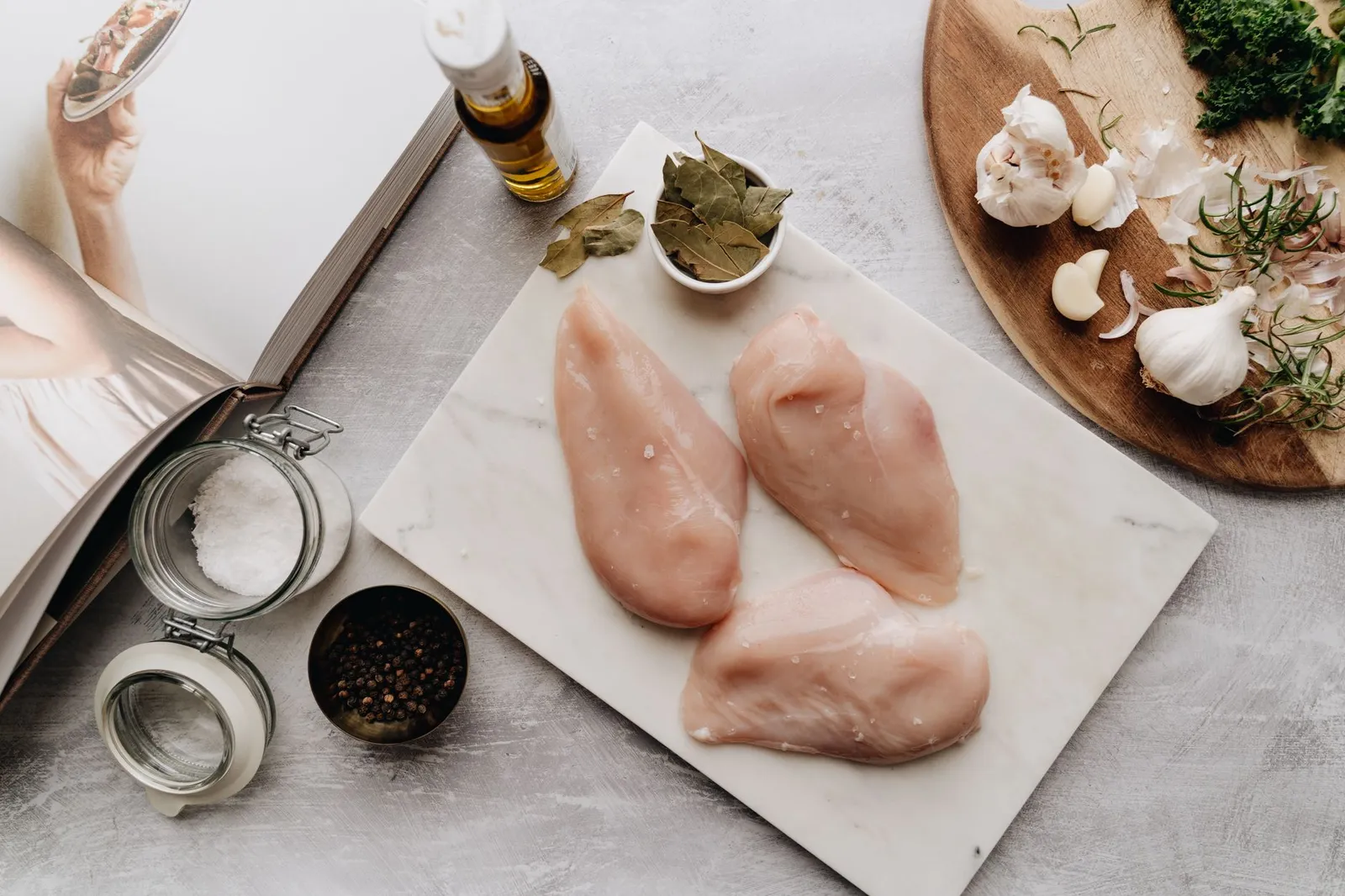
Weigh food in the same state your calorie database lists it — raw or cooked — because cooking changes weight, not calories. Water and fat losses mean 100 g of raw chicken breast becomes roughly 70 to 75 g cooked, while 100 g of dry rice swells to about 250 to 300 g. The kilojoules stay the same; only the number on the scale moves, so matching your weigh-in to your database entry is what keeps a log accurate.
"Do I weigh my rice cooked or raw?" is one of the most common questions in calorie tracking, and it trips up beginners and long-time loggers alike. The confusion is understandable: a bowl of cooked rice weighs far more than the dry rice it came from, and a grilled chicken breast weighs noticeably less than the raw fillet. Yet neither food gained or lost any real energy in the pan. This guide explains why that happens, gives you a printable raw-to-cooked conversion table built from USDA cooking-yield research, and shows how to stop the single most common source of silent tracking error.
The sources below are primary: the USDA Table of Cooking Yields for Meat and Poultry, the USDA Table of Nutrient Retention Factors, a 2020 peer-reviewed analysis of cooking loss in 400 retail beef samples, the FAO weight-yield and retention-factor tables, and the Australian Food Composition Database from Food Standards Australia New Zealand. Where yields vary by cut and cooking method, a range is given rather than a single tidy figure.
Should you weigh food raw or cooked?
Weigh it in whichever state your database entry specifies. Most packaged and reference data — including the numbers on a rice packet or a raw chicken label — describe the food before cooking, so weighing raw and logging the raw entry is usually the most reliable choice. The one rule that never fails: the weighed state and the logged entry must match.
The reason this matters is that a food label's calorie figure is anchored to a specific weight. A chicken breast labelled "110 kcal per 100 g" means 100 g of raw breast, because that is how it was packaged and measured. If you cook it, weigh the cooked 75 g, and still log it as 100 g of raw, you have under-counted by a quarter. Do the reverse with rice — weigh 250 g cooked but log it against the dry entry — and you triple your real intake on paper. Neither error comes from bad willpower; it comes from a units mismatch. If you are just getting started, our beginner's guide to calorie tracking walks through choosing a consistent method first.
Why does cooking change weight but not calories?
Because cooking mostly moves water. Heat drives moisture out of meat and melts away some fat, so a steak shrinks; boiling forces water into rice and pasta, so they swell. Water carries zero kilojoules, so the food's total energy barely changes even as its weight rises or falls dramatically.
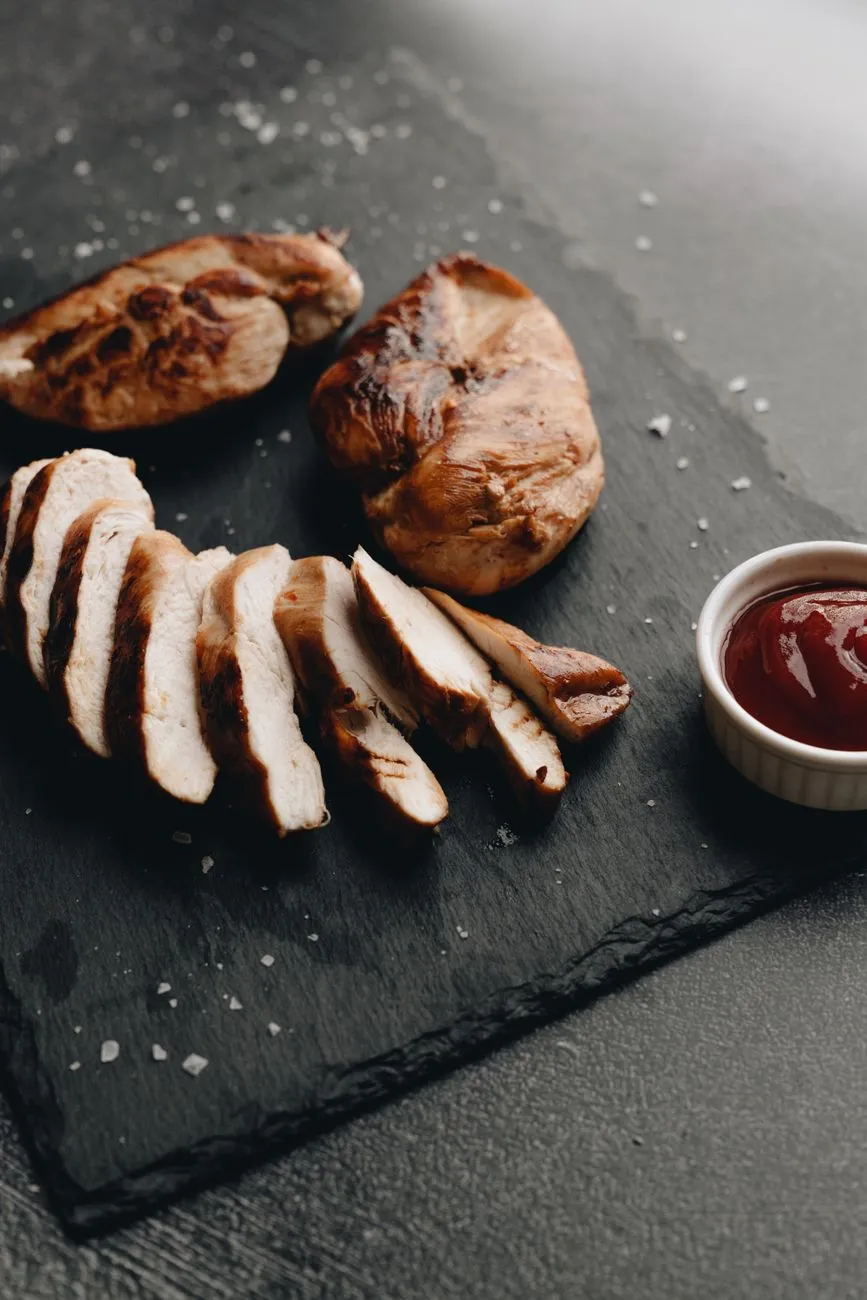
The USDA defines cooking yield as the cooked weight divided by the raw weight, expressed as a percentage. Its Table of Nutrient Retention Factors exists precisely because databases need to convert raw nutrient values into cooked ones — the calories per gram shift only because the grams shift, not because energy appears or disappears. A useful way to picture it: a lean chicken breast is roughly 75 percent water, and grilling evaporates a large share of that, concentrating the same protein and fat into fewer grams. The protein and fat you actually eat are unchanged.
This is also why calorie density changes in opposite directions for different foods. Cooked rice has fewer calories per gram than dry rice (it soaked up calorie-free water), while cooked chicken has more calories per gram than raw (it lost calorie-free water). The energy in your serving is identical either way — the density just tells you how much the scale will read.
What is the raw-to-cooked conversion for common foods?
Meat and poultry lose weight (yields of roughly 65 to 75 percent), while grains and legumes gain it (yields of 200 to 300 percent). The table below gives typical yields drawn from USDA and FAO data. Use it to estimate a portion when you can only weigh in one state — but weighing directly in your database's state is always more accurate than converting.
| Food (raw → cooked) | Typical yield | 100 g raw becomes | Best weigh state |
|---|---|---|---|
| Chicken breast, grilled/roasted | ~70–75% | ~70–75 g (2.5–2.6 oz) | Raw |
| Beef steak, grilled | ~65–75% | ~65–75 g (2.3–2.6 oz) | Raw |
| Lean beef mince, pan-browned | ~70–75% | ~70–75 g (2.5–2.6 oz) | Raw |
| Pork chop, pan-fried | ~68–73% | ~68–73 g (2.4–2.6 oz) | Raw |
| White rice, boiled | ~250–300% | ~250–300 g (8.8–10.6 oz) | Cooked |
| Dried pasta, boiled | ~220–250% | ~220–250 g (7.8–8.8 oz) | Cooked |
| Rolled oats, cooked | ~240% | ~240 g (8.5 oz) | Cooked |
| Dried lentils/beans, boiled | ~230–250% | ~230–250 g (8.1–8.8 oz) | Cooked |
| Potato, boiled with skin | ~100–105% | ~100–105 g (3.5–3.7 oz) | Either |
| Spinach/leafy greens, cooked | ~10–20% | ~10–20 g (0.4–0.7 oz) | Depends on entry |
How accurate are these conversion factors?
Treat them as good estimates, not exact numbers. Real yields swing with cut, fat content, cooking method, time, and temperature. A 2020 study of 400 retail beef samples found cooking losses ranging from about 24.5 to 35.8 percent for the same broad category — a 10-point spread driven by ageing, salt, and whether the meat was roasted, broiled, or grilled.
That variability is the honest caveat behind every tidy conversion chart. The USDA's own cooking-yield tables report a mean, a standard deviation, and a minimum and maximum for each cut precisely because no single number fits every kitchen. Grilling a thin steak to well-done drives off more moisture than gently roasting a thick one to medium-rare, so the same starting weight can land anywhere across a range. The 2020 beef analysis also found that added salt reduced cooking losses and improved juiciness, another variable your database can't see.
The practical takeaway is not to distrust the table — it is to avoid false precision. Chasing accuracy past about plus or minus 10 percent on a converted weight is guesswork dressed up as data. This is the same trap that makes people over-value the exact figure a database returns, a theme in our comparison of MyFitnessPal versus Cronometer accuracy. Weighing directly in the database's state removes the conversion step entirely, which is why it beats even the best chart.

How do you weigh food accurately without overthinking it?
Pick one state per food, match it to your database entry, and stay consistent. Weighing raw whenever practical sidesteps most conversion errors, because most reference and label data are raw. For batch-cooked staples like rice you portion from a pot, weighing cooked and logging a cooked entry is simpler — just confirm the entry says "cooked".
Here is a reliable routine that keeps error low without turning every meal into a maths problem:
- Default to raw for meat, fish, and poultry. Labels and reference databases almost always describe these raw, so weighing the raw fillet and logging the raw entry avoids a conversion.
- Weigh grains and legumes cooked if you batch-cook them. Choose the database entry explicitly labelled "cooked" — for example "rice, white, cooked" — and weigh your portion from the pot.
- Read the entry before you log. The words "raw", "dry", "cooked", or "boiled" in a database entry tell you which weight it expects. A mismatch here is the number-one silent error.
- Use the conversion table only as a fallback. When you can weigh in just one state — a restaurant plate, a shared dish — convert with the table and accept a wider margin.
- Stay consistent day to day. Trends matter more than any single meal, so a small repeatable method beats a perfect-but-fragile one. Feed your numbers into a realistic target using our TDEE calculator.
Consistency is the quiet superpower here. A method that is slightly imperfect but applied the same way every day still reveals an accurate trend, because the small offset cancels out when you compare week to week.
Frequently Asked Questions
Should I weigh chicken raw or cooked for calorie tracking?
Weigh it raw whenever practical. Chicken labels and most reference databases describe the raw fillet, and raw weight is more stable than cooked weight, which varies with how long and how hot you cook. If you can only weigh it cooked, multiply by about 1.35 to estimate the raw weight, since chicken breast retains roughly 70 to 75 percent of its weight after cooking.
Do foods have more calories cooked or raw?
Neither — a serving has the same calories in both states. Cooking changes weight by moving water and some fat, not energy. Cooked rice has fewer calories per gram than dry rice because it absorbed calorie-free water, and cooked chicken has more calories per gram than raw because it lost water. The total energy you eat is unchanged.
How much does rice expand when cooked?
Dry rice typically swells to about 2.5 to 3 times its raw weight when boiled, so 100 g of dry rice becomes roughly 250 to 300 g cooked. The exact figure depends on the rice type and how much water it absorbs. Because the dry entry and cooked entry differ so much, mixing them up is one of the largest tracking errors possible.
Is it more accurate to weigh food raw?
Usually, yes. Raw weight is anchored to label and reference data and does not vary with cooking method, so it removes a source of error. Cooked weights differ depending on time, temperature, and technique. The exception is batch-cooked staples you portion out cooked, where a clearly-labelled cooked database entry is both accurate and more convenient.
Why does my cooked meat weigh less than the package said?
Because roasting, grilling, and pan-frying drive out water and render some fat. Meat is roughly three-quarters water, and cooking evaporates a large share of it, so a 150 g raw breast can finish near 105 to 115 g. A 2020 analysis of 400 beef samples measured cooking losses of about 24.5 to 35.8 percent, varying with cut, salt, and method.
Can I just use a conversion factor instead of weighing both ways?
You can, as a fallback, but expect a wider margin. Conversion factors are averages, and real yields swing by 10 points or more with cut and cooking method. Weighing directly in the state your database lists removes the conversion step and its error. Use factors when you genuinely cannot weigh in the needed state, such as a plated restaurant meal.
Sources
- USDA Table of Cooking Yields for Meat and Poultry, Release 2 (2014). USDA Agricultural Research Service, Nutrient Data Laboratory. https://www.ars.usda.gov/ARSUserFiles/80400535/Data/retn/USDA_CookingYields_MeatPoultry02.pdf
- USDA Table of Nutrient Retention Factors, Release 6 (2007). USDA Agricultural Research Service. https://www.ars.usda.gov/ARSUserFiles/80400525/Data/retn/retn06.pdf
- Cooking loss in retail beef cuts: the effect of muscle type, sex, ageing, pH, salt and cooking method. Meat Science (2020), PubMed. https://pubmed.ncbi.nlm.nih.gov/32853886/
- Tables on weight yield of food and retention factors of food constituents (Bognar). Food and Agriculture Organization. https://www.fao.org/uploads/media/bognar_bfe-r-02-03.pdf
- Australian Food Composition Database. Food Standards Australia New Zealand (FSANZ). https://www.foodstandards.gov.au/science-data/food-nutrient-databases/afcd/search
- Impact of Pasta Intake on Body Weight and Body Composition: A Technical Review. Nutrients (2023), PubMed. https://pubmed.ncbi.nlm.nih.gov/37375591/
Ready to track smarter?
Join thousands who use kcalm for calorie tracking. AI-powered food recognition, scientifically-validated calculations, and zero anxiety.